


• Home
  • About Us
    • Brief Introduction
    • Address from the Director
    • Directors
    • Organization
    • IUE in Media
  • Scientists
    • Academicians
    • Professors
    • Associate Professors
  • Research
    • Research Divisions
    • Research Progress
  • Education
    • Admission
    • Study at IUE
    • Scholarships
  • INT'L Cooperation
    • INT'L Cooperation News
    • Partnership
  • Papers
  • Join Us
    • Job Opportunities
    • PIFI
      • What's PIFI
Contact Us   |   Sitemap   |   CAS   |   中文
  • Home
  • About Us
    • Brief Introduction
    • Address from the Director
    • Directors
    • Organization
    • IUE in Media
  • Scientists
    • Academicians
    • Professors
    • Associate Professors
  • Research
    • Research Divisions
    • Research Progress
  • Education
    • Admission
    • Study at IUE
    • Scholarships
  • INT'L Cooperation
    • INT'L Cooperation News
    • Partnership
  • Papers
  • Join Us
    • Job Opportunities
    • PIFI

Research

  • HomeResearch Research Progress
  • Research Progress

    New study reveals China’s pathways to address the pressing natural sand crisis

    Date:Aug 09, 2024

    Sand forms the foundation of modern society as the world’s most consumed natural resource on the planet besides water. Yet, the natural sand is not infinite and some unregulated mining activities are causing severe environmental impacts and social risks. In the context of rapid urbanization, the world is facing a pressing natural sand crisis. This is particularly relevant for China, which accounts for nearly half of the world’s sand consumption. Hence, how to meet the booming sand demand while reducing natural sand mining has emerged as a paramount challenge for both China and other countries.

    A recent study published in Nature Geoscience, provides novel quantitative evidence to showcase China’s effective strategies in addressing such a natural sand crisis. Through the material flow analysis of China’s sand flow from mining to final use, this study finds China’s overall sand supply has surged by approximately 400% during 1995-2020, yet the proportion of natural sand mining dropped from ~80% to ~21% due to the increasing use of manufactured sand. From 2010 to 2020, China’s natural sand supply nearly halved due to the strict policies on natural sand mining and the promotion of manufactured sand in final usage. The shift towards manufactured sand could help mitigate the environmental impacts associated with natural sand mining, such as habitat destruction, riverbank erosion, and loss of biodiversity.

    In response to previous concerns, this analysis of China’s pathways suggests that the rapid depletion of natural sand deposits can be avoided through a shift from natural sand to manufactured sand. In the meanwhile, China’s experience offers valuable insights for sustainable sand management, particularly for developing economies undergoing urbanization, which will probably fuel future demand for sand.

    This study is conducted by an international research team, from the Institute of Urban Environment of the Chinese Academy of Sciences, Northeastern University, CSIRO, Reichman University, Leiden University, University of Bristol, Chongqing University, Tongji University, Michigan State University, Research Center for Eco-Environmental Sciences of the Chinese Academy of Sciences, and other institutions.
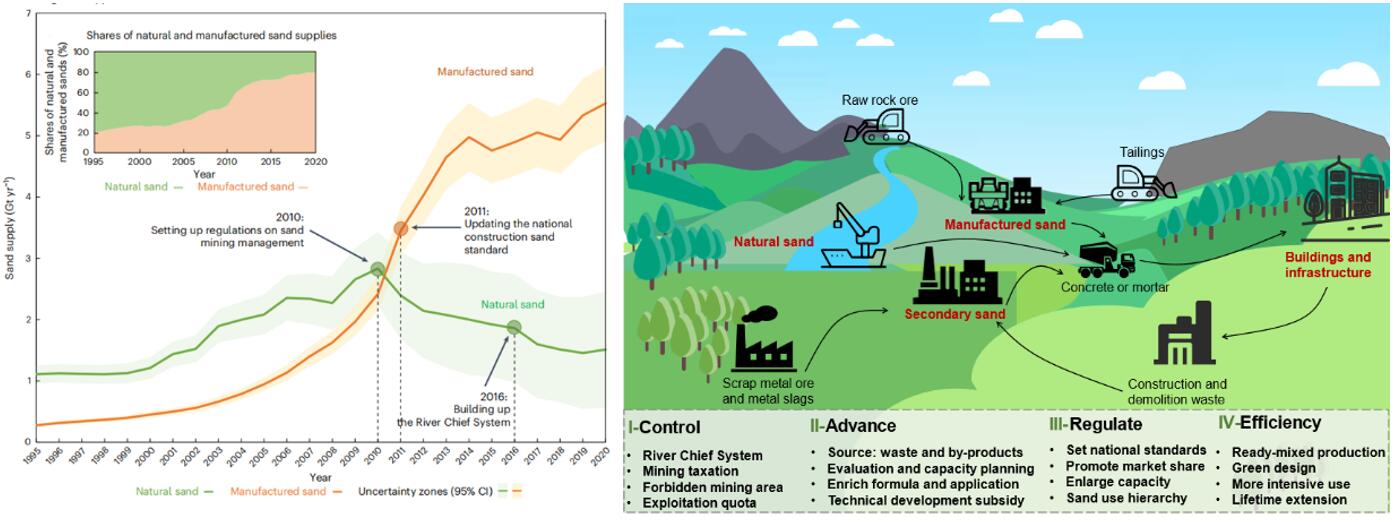
    The transition from natural sand to manufactured sand in China’s sand supply (Image by WANG Heming, WANG Peng, and CHEN Wei-Qiang)


    Contacts:CHEN Weiqiang

    E-mail:wqchen@iue.ac.cn

    Nature Geoscience

    link:https://doi.org/10.1038/s41561-024-01501-6


    Attachment Download:

    Contact

    E-mail:

    Related Articles

    • Generative AI is creating looming e-waste challenges, and how can be tackled by circular economy

      2024-10-29
      Contact CHEN Weiqiang Institute of Urban Environment,Chinese Academy of Sciences. E-mail: wqchen@iue.ac.cn E-mail: pwang@iue.ac.cnGenerative Artificial Intelligence (GAI) marks a significant leap in the realm of Artificial Intelligence (AI) by creating text, images, videos, and various other content types based on input prompts. However, the utilization of GAI dema...
    • New Single-Cell Method for Rapid Identification of Airborne Pathogens in Real-World Environment

      2025-01-09
      Figure 1:Workflow of the MethodologyContact:Zhu Longji Institute of Urban Environment, Chinese Academy of SciencesE-mail:ljzhu@iue.ac.cn.Aerosols are critical vehicles for airborne pathogen transmission between the environment and humans. Timely and accurate detection of airborne pathogens is essential to contain infectious disease outbreaks at their source and to reduce ...
    • Global Exploration of Drought-Tolerant Bacteria in the Wheat Rhizosphere Reveals Microbiota Shifts and Functional Taxa Enhancing Plant Resilience

      2025-10-09
      A research team led by Prof. CHEN Qing-Lin from the Institute of Urban Environment (IUE), Chinese Academy of Sciences, has discovered that drought-induced changes in wheat metabolites selectively enrich drought-tolerant bacteria (DTB) in...A research team led by Prof. CHEN Qing-Lin from the Institute of Urban Environment (IUE), Chinese Academy of Sciences, has found that drought-induced changes in wheat metabolites selectively enrich drought-tolerant bacteria (DTB) in the ...

    About Us

    • Brief Introduction
    • Address from the Director
    • Directors
    • Organization
    • IUE in Media

    Scientists

    • Academicians
    • Professors
    • Associate Professors

    Research

    • Research Divisions
    • Research Progress

    Education

    • Admission
    • Study at IUE
    • Scholarships

    INT'L Cooperation

    • INT'L Cooperation News
    • Partnership

    Papers

    Join Us

    • Job Opportunities
    • PIFI
    Copyright © Institute of Urban Environment,Chinese Academy of Sciences. All Rights Reserved.
    1799 Jimei Road, Xiamen 361021 China.+86-592-6190973.