


• Home
  • About Us
    • Brief Introduction
    • Address from the Director
    • Directors
    • Organization
    • IUE in Media
  • Scientists
    • Academicians
    • Professors
    • Associate Professors
  • Research
    • Research Divisions
    • Research Progress
  • Education
    • Admission
    • Study at IUE
    • Scholarships
  • INT'L Cooperation
    • INT'L Cooperation News
    • Partnership
  • Papers
  • Join Us
    • Job Opportunities
    • PIFI
      • What's PIFI
Contact Us   |   Sitemap   |   CAS   |   中文
  • Home
  • About Us
    • Brief Introduction
    • Address from the Director
    • Directors
    • Organization
    • IUE in Media
  • Scientists
    • Academicians
    • Professors
    • Associate Professors
  • Research
    • Research Divisions
    • Research Progress
  • Education
    • Admission
    • Study at IUE
    • Scholarships
  • INT'L Cooperation
    • INT'L Cooperation News
    • Partnership
  • Papers
  • Join Us
    • Job Opportunities
    • PIFI

Research

  • HomeResearch Research Progress
  • Research Progress

    Global Exploration of Drought-Tolerant Bacteria in the Wheat Rhizosphere Reveals Microbiota Shifts and Functional Taxa Enhancing Plant Resilience

    Date:Oct 09, 2025

    A research team led by Prof. CHEN Qing-Lin from the Institute of Urban Environment (IUE), Chinese Academy of Sciences, has found that drought-induced changes in wheat metabolites selectively enrich drought-tolerant bacteria (DTB) in the rhizosphere,which promote plant growth and enhance drought resilience through key functional traits. The findings were published in Nature Food.

    Drought is one of the most severe abiotic stresses threatening global agriculture, with its frequency and intensity projected to rise in the coming century. Traditional crop improvement approaches, which often rely on genetic modification or domestication of high-yield varieties, can be costly and time-consuming. Harnessing plant-associated microbiomes offers a promising complementary solution for enhancing crop drought tolerance.

    To address the challenge of identifying active DTB in the rhizosphere, the researchers developed a functional single-cell method integrated with multi-omics analyses. This unified approach enabled the detection of functionally active microbial populations directly in situ, advancing understanding of how plant–microbe interactions contribute to drought resilience.

    The study identified 21 key DTB taxa with unique drought-response capabilities critical for plant fitness, including the synthesis of indole-3-acetic acid, siderophores, and osmolytes. Inoculation experiments using synthetic communities (SynCom) composed of these bacteria significantly improved wheat growth under drought conditions.

    Furthermore, by integrating global-scale metadata, the researchers revealed that these active DTB are widely distributed across diverse environments. Their conserved metabolic capacities illustrate universal microbial strategies for coping with drought stress and maintaining ecosystem function.

    “Our work represents an important step toward utilizing microbial resources and processes to enhance crop resilience in the face of climate change,” said Prof. CHEN Qing-Lin, corresponding author of the study.

    This study provides new mechanistic insights into plant–microbe interactions under drought conditions and demonstrates the potential of microbiome-based solutions for improving crop performance and ensuring food security in a changing climate.
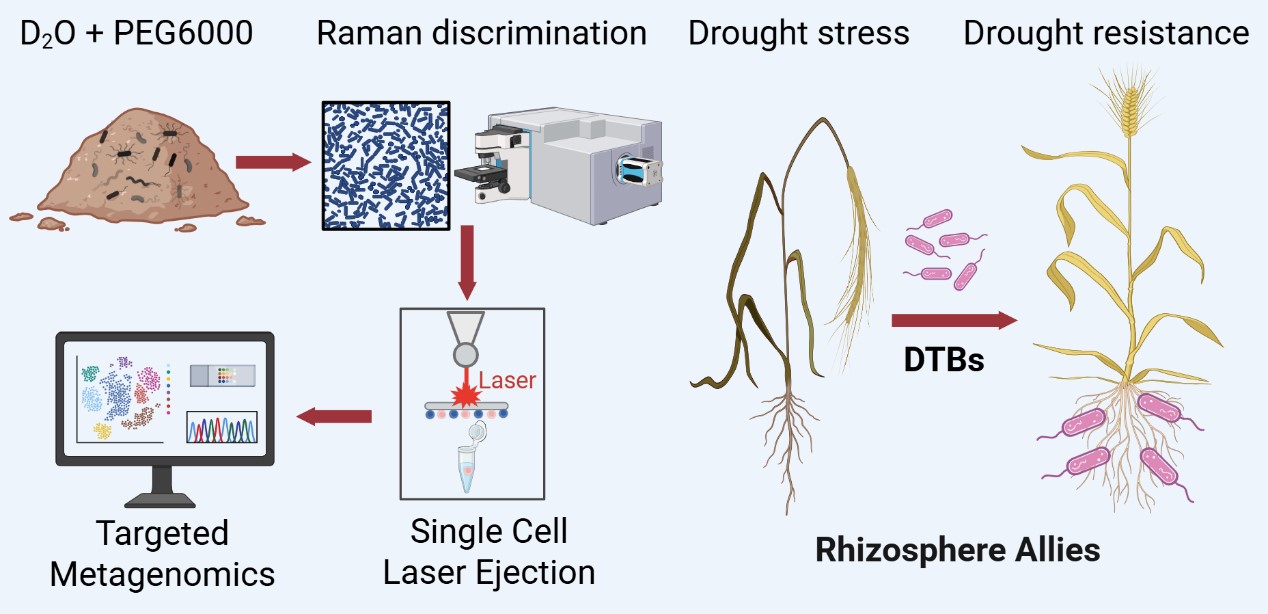
    Proposed model illustrating a potential bacterial solution for enhancing drought resilience in wheat (Image by XIANG Qian)


    Attachment Download:

    Contact

    Chen Qinglin

    Institute of Urban Environment, Chinese Academy of Sciences

    E-mail: qlchen@iue.ac.cn

    Related Articles

    • New Single-Cell Method for Rapid Identification of Airborne Pathogens in Real-World Environment

      2025-01-09
      Figure 1:Workflow of the MethodologyContact:Zhu Longji Institute of Urban Environment, Chinese Academy of SciencesE-mail:ljzhu@iue.ac.cn.Aerosols are critical vehicles for airborne pathogen transmission between the environment and humans. Timely and accurate detection of airborne pathogens is essential to contain infectious disease outbreaks at their source and to reduce ...
    • Single-cell Approach Reveals Active Phosphate-Solubilizing Bacteria in Soils

      2024-08-09
      Single-cell Raman-D2O approach for identifying active PSB in soils and linking their phenotypes to genotypes through targeted sorting and sequencingContact:CUI LiE-mail:lcui@iue.ac.cnLink:https://doi.org/10.1038/s43016-024-01024-8.Phosphorus availability is a critical factor limiting agricultural productivity worldwide. However, a large portion of phosphorus in soils exists in fixed forms unavailable to plants. Phosphate-solubilizing bacteria (PSB) play a crucial ...
    • New study reveals China’s pathways to address the pressing natural sand crisis

      2024-08-09
      Sand forms the foundation of modern society as the world’s most consumed natural resource on the planet besides water.Sand forms the foundation of modern society as the world’s most consumed natural resource on the planet besides water. Yet, the natural sand is not infinite and some unregulated mining activities are causing severe environmental impacts...

    About Us

    • Brief Introduction
    • Address from the Director
    • Directors
    • Organization
    • IUE in Media

    Scientists

    • Academicians
    • Professors
    • Associate Professors

    Research

    • Research Divisions
    • Research Progress

    Education

    • Admission
    • Study at IUE
    • Scholarships

    INT'L Cooperation

    • INT'L Cooperation News
    • Partnership

    Papers

    Join Us

    • Job Opportunities
    • PIFI
    Copyright © Institute of Urban Environment,Chinese Academy of Sciences. All Rights Reserved.
    1799 Jimei Road, Xiamen 361021 China.+86-592-6190973.