


• Home
  • About Us
    • Brief Introduction
    • Address from the Director
    • Directors
    • Organization
    • IUE in Media
  • Scientists
    • Academicians
    • Professors
    • Associate Professors
  • Research
    • Research Divisions
    • Research Progress
  • Education
    • Admission
    • Study at IUE
    • Scholarships
  • INT'L Cooperation
    • INT'L Cooperation News
    • Partnership
  • Papers
  • Join Us
    • Job Opportunities
    • PIFI
      • What's PIFI
Contact Us   |   Sitemap   |   CAS   |   中文
  • Home
  • About Us
    • Brief Introduction
    • Address from the Director
    • Directors
    • Organization
    • IUE in Media
  • Scientists
    • Academicians
    • Professors
    • Associate Professors
  • Research
    • Research Divisions
    • Research Progress
  • Education
    • Admission
    • Study at IUE
    • Scholarships
  • INT'L Cooperation
    • INT'L Cooperation News
    • Partnership
  • Papers
  • Join Us
    • Job Opportunities
    • PIFI

Research

  • HomeResearch Research Progress
  • Research Progress

    Generative AI is creating looming e-waste challenges, and how can be tackled by circular economy

    Date:Oct 29, 2024

    Generative Artificial Intelligence (GAI) marks a significant leap in the realm of Artificial Intelligence (AI) by creating text, images, videos, and various other content types based on input prompts. However, the utilization of GAI demands substantial computational resources for training and inference, necessitating robust computing hardware and infrastructure. This reliance raises pressing sustainability concerns, notably surrounding hardware operations.

    Unlike previous studies focused on the energy use and carbon emissions of AI models, this study has developed a novel approach, termed as computational power-driven material flow analysis (CP-MFA). This approach aims to quantify and explore strategies for managing the electronic waste (e-waste) generated by GAI, with a specific emphasis on large language models.

    Projections from the study suggest that the proliferation of generative AI could lead to an additional 5 million tonnes of e-waste by 2030. These estimates vary based on different scenarios of GAI expansion, computing resource requirements, and their operational lifespans. The research indicates a potential thousandfold increase in annual generative AI e-waste, surging from 2,600 tonnes in 2023 to 400,000-2,500,000 tonnes annually by 2030. This is equivalent to each individual on the planet discarding between 0.2 to 1.6 iPhones by 2030.

    To tackle such challenge, this study proposed a set of circular economy strategies, like improving performance, increasing lifespan, and re-using modules in manufacturing, and further explored the potential of those strategies in reducing this e-waste. It is estimated that around 16–86% of those e-waste can be avoided with combined efforts from the GAI value chain.

    The researchers also underscore the impact of geopolitical tensions within the semiconductor industry, which could exacerbate the e-waste predicament. In a scenario where nations face challenges in acquiring the latest chips for their AI technologies, they may resort to older models that are swiftly discarded.

    “The objective is not to impede the adoption of this transformative GAI technology”, emphasized by Dr. Peng Wang and the research team, “they recognize as both promising and increasingly inevitable in our modern world”. Rather than hinder its progress, said by Peng, “the primary goal is to prepare the global community for the tangible impacts of its rapid expansion”.

    This study is supported by the National Natural Science Foundation of China and the CAS IUE Research Program, with Dr. Peng Wang and Ling-Yu Zhang leading this work, complemented by contributions from Dr. Asaf Tzachor and Dr. Wei-Qiang Chen as corresponding authors.
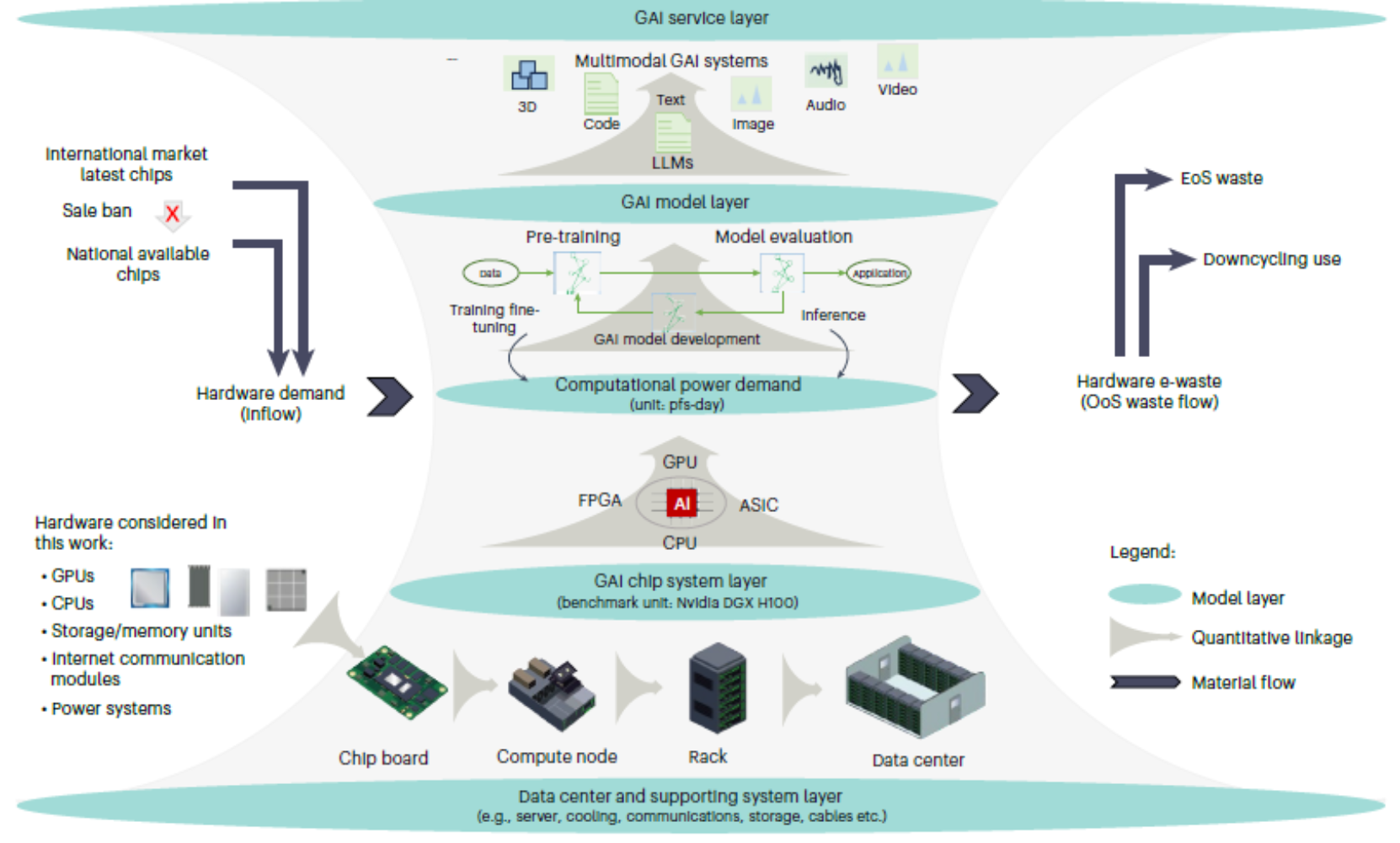
    Figure 1 Hierarchical framework of the computational power-driven material flow analysis model


    Attachment Download:

    Contact

    E-mail:

    Related Articles

    • New study reveals China’s pathways to address the pressing natural sand crisis

      2024-08-09
      Sand forms the foundation of modern society as the world’s most consumed natural resource on the planet besides water.Sand forms the foundation of modern society as the world’s most consumed natural resource on the planet besides water. Yet, the natural sand is not infinite and some unregulated mining activities are causing severe environmental impacts...
    • Single-cell Approach Reveals Active Phosphate-Solubilizing Bacteria in Soils

      2024-08-09
      Single-cell Raman-D2O approach for identifying active PSB in soils and linking their phenotypes to genotypes through targeted sorting and sequencingContact:CUI LiE-mail:lcui@iue.ac.cnLink:https://doi.org/10.1038/s43016-024-01024-8.Phosphorus availability is a critical factor limiting agricultural productivity worldwide. However, a large portion of phosphorus in soils exists in fixed forms unavailable to plants. Phosphate-solubilizing bacteria (PSB) play a crucial ...
    • New Single-Cell Method for Rapid Identification of Airborne Pathogens in Real-World Environment

      2025-01-09
      Figure 1:Workflow of the MethodologyContact:Zhu Longji Institute of Urban Environment, Chinese Academy of SciencesE-mail:ljzhu@iue.ac.cn.Aerosols are critical vehicles for airborne pathogen transmission between the environment and humans. Timely and accurate detection of airborne pathogens is essential to contain infectious disease outbreaks at their source and to reduce ...

    About Us

    • Brief Introduction
    • Address from the Director
    • Directors
    • Organization
    • IUE in Media

    Scientists

    • Academicians
    • Professors
    • Associate Professors

    Research

    • Research Divisions
    • Research Progress

    Education

    • Admission
    • Study at IUE
    • Scholarships

    INT'L Cooperation

    • INT'L Cooperation News
    • Partnership

    Papers

    Join Us

    • Job Opportunities
    • PIFI
    Copyright © Institute of Urban Environment,Chinese Academy of Sciences. All Rights Reserved.
    1799 Jimei Road, Xiamen 361021 China.+86-592-6190973.