


Effect of nonbiodegradable microplastics on soil respiration and enzyme activity: A meta-analysis
Date:Jan 12, 2023
Plastics are widely used because of their low cost, excellent performance and portability. It is predicted that by 2050, approximately 12,000 million tons of plastic waste will accumulate in the environment. Plastic fragments in the environment can decompose into microplastics (MPs) with diameters < 5 mm. Once MPs enter the soil, they usually require hundreds or even thousands of years to degrade and affect soil physicochemical properties and microorganisms in the long term. Biological variables can regulate the conversion of organic residues and nutrient cycling, and reflect the intensity and direction of biochemical processes in the soil. However, until now, there has been no consensus on the effects of MPs on soil respiration and enzyme activity due to the various MP types and exposure conditions.
In a study published on 6 December in Applied Soil Ecology, a research group led by Prof. YAO Huaiying and Prof. YU yongxiang from the Institute of Urban Environment, Chinese Academy of Sciences has made progress in understanding the effect of nonbiodegradable microplastics on soil respiration and enzyme activity. This meta-analysis including 1980 observations was used to assess the effects of MPs on soil microbial activity. The effect of MPs on soil respiration and enzyme activity in this study was divided into different MP types, four MP contents, two MP sizes and three incubation periods.
This meta-analysis presented evidence that the presence of MPs increased soil respiration by 18 % but had a limited effect on soil enzyme activity, and these effects depended on the MP type, concentration, size, and exposure period. The amendment of polypropylene MP increased soil respiration and enzyme activity, whereas exposure to polyethylene terephthalate, polyethylene and polystyrene MPs inhibited soil enzyme activity. Interestingly, the environmentally relevant concentration (<1 %) of MPs did not affect soil respiration but stimulated soil enzyme activity. The response of soil respiration to MPs addition was also dependent on MP size, as small (<500 μm) and large (≥500 μm) plastic particles increased and decreased soil respiration, respectively. Short-term (≤30 days) exposure to MPs significantly increased soil respiration, whereas the presence of MPs significantly inhibited soil enzyme activity when the incubation period ranged from 30 to 100 days.
This work highlighted that nonbiodegradable MPs accelerated the release of CO2 from soils but had an insignificant effect on enzyme activity. We suggest management measures such as increased the application of organic fertilizers and planting green manure should be implemented to enhance the SOC in microplastic contaminated soils.
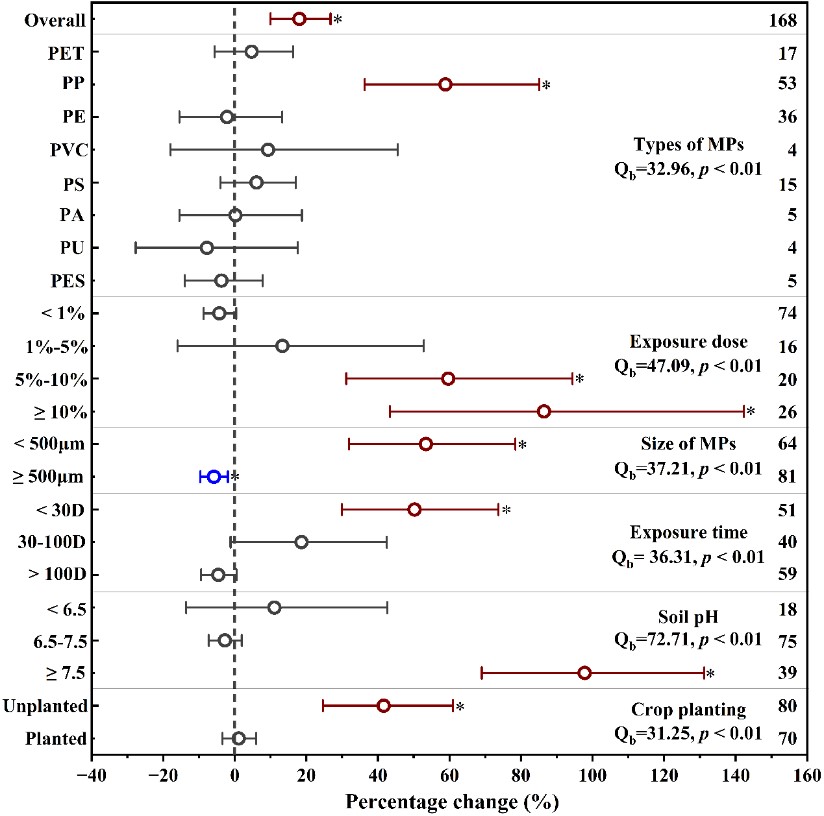
Response in soil respiration to MPs exposure as affected by different microplastic (MP) types, exposure doses, MP sizes, exposure time, soil pH and the presence or absence of plants
Page:https://doi.org/10.1016/j.chemosphere.2023.137755
Contact: LI Yaying
Institute of Urban Environment, Chinese Academy of Sciences
E-mail: yyli@iue.ac.cn
Attachment Download: