


Researchers Investigate Spatial Distribution of Reservoir Plankton Communities in Southeast China
Date:Aug 09, 2022
Distance-decay relationships are the most well-established biogeographical patterns in describing species spatial distribution in ecology. The decay of community similarity with geographical distance has been recognized by ecologists for several decades. The ecologists compared the distance-decay patterns of different communities at local, regional and continental scales.
Reservoirs are an important source of drinking water for residents in Southeast China, and provide ecosystem functioning and services for human production and life. Plankton are the major primary producers in reservoir ecosystems and play crucial roles in matter cycling and energy flow across trophic levels. In the previous studies, researchers found distance-decay relationships in animals, plants, bacteria and fungi communities in different ecosystems. However, there is still a lack of research on the spatial distribution of plankton communities in lakes or reservoirs at different scales, and the understanding of the driving factors and community assembly mechanisms of plankton at a large spatial scale is limited.
The research team (Aquatic EcoHealth Group, Institute of Urban Environment, Chinese Academy of Sciences) led by Prof. Jun Yang explored the spatial distribution of phytoplankton and zooplankton communities in 24 reservoirs in Southeast China. The distance-decay relationship, structural equation modeling (SEM) and dispersal-niche continuum index (DNCI) methods were used to investigate the spatial distribution patterns and community assembly mechanism based on the microscope-identification data. Distance decay relationships were divided into three scales (within-reservoir, within-drainage but between reservoirs, and between drainages) based on if the pairwise sampling sites were from the same reservoir or drainage (catchment).
They found that the spatial distribution of phytoplankton and zooplankton communities was scale-dependent. There were significant distance decay relationships of phytoplankton and zooplankton at the three spatial scales, and the slopes of distance decay became shallower with the expansion of the spatial scale. Further, their study provided strong evidence that both spatial and environmental variables contributed to the distance decay relationships of plankton communities, and the impact of spatial factors was overall greater. Finally, their study revealed that dispersal-related processes contributed to the biogeography of reservoir plankton more strongly than environmental filtering. Collectively, this study enhanced the understanding of plankton biogeography and distribution at multiple spatial scales.
The study entitled The scale-dependence of spatial distribution of reservoir plankton communities in subtropical and tropical China was published in Science of the Total Environment, 2022, 845: 157179 . PhD student Lei Jin and Dr. Jun Yang are the first and corresponding authors, respectively. This work was supported by the National Natural Science Foundation of China, the Science & Technology Basic Resources Investigation Program of China, the “Light of West” Program and “Fujian STS” Program of the Chinese Academy of Sciences. .
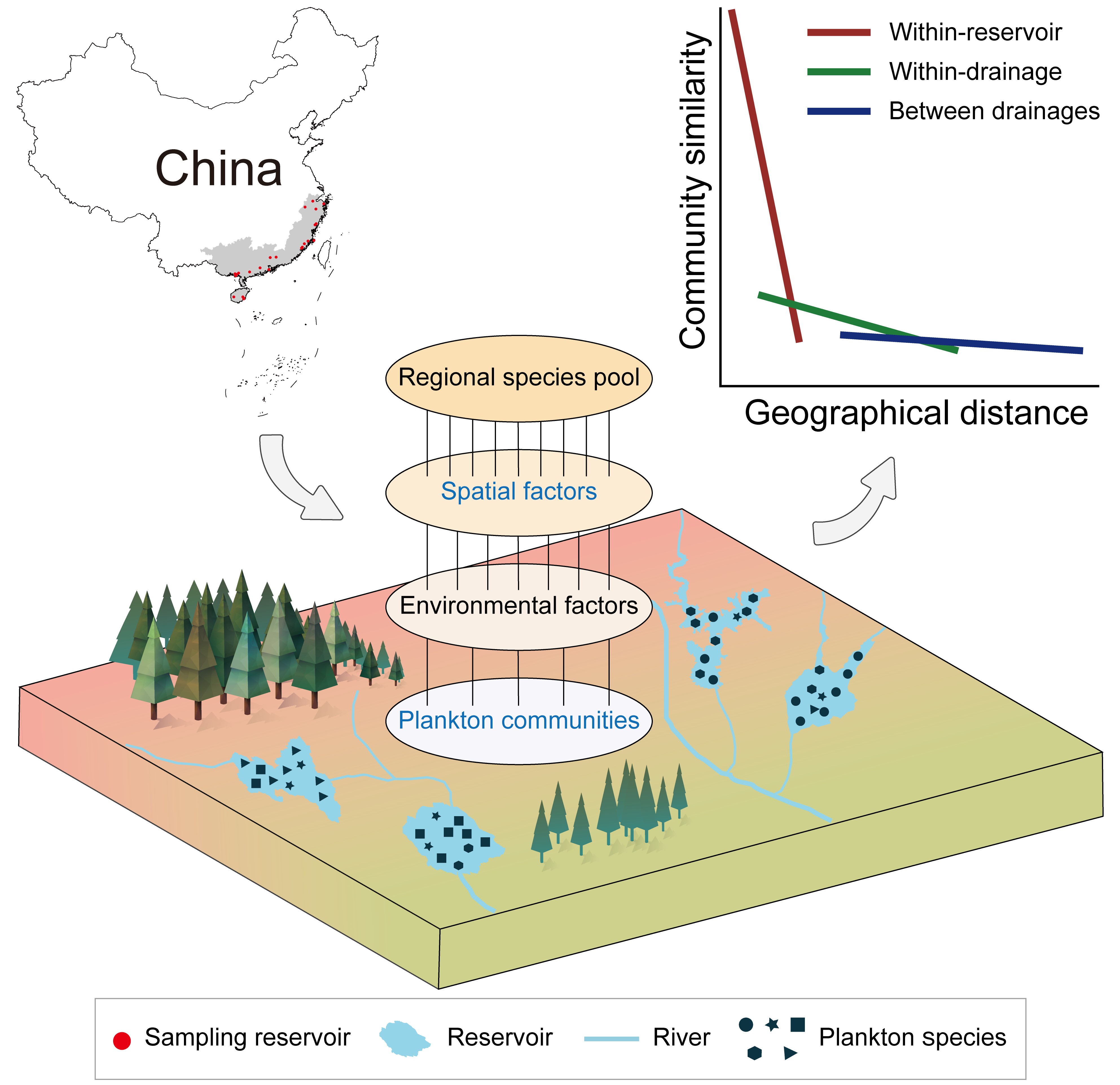
The spatial scale dependence of plankton community
Contacts:YANG Jun
E-mail:jyang@iue.ac.cn
Science of the Total Environment
link1:https://doi.org/10.1016/j.scitotenv.2022.157179
Attachment Download: