


Researchers reviews recent development for mitigation N2O emissions in agricultural soils
Date:Mar 03, 2022
Nitrous oxide (N2O) is also an ozone-depleting substance. Farming activities account for nearly 60% of total anthropogenic N2O emissions. The manufactured nitrogen (N) fertilizers applied to soils are major sources of N2O emissions from agricultural systems. Among the synthetic N fertilizers, urea has the highest nitrogen content of all solid nitrogenous fertilizers and accounts for 66% of global synthetic N fertilizer use. Hence efficient urea-N management is imperative for global N2O abatement.
The group led by Prof. Huai-Ying YAO from Institute of Urban Environment, Chinese Academy of Sciences reviews the key source of N2O emissions and recent development in mitigating strategies receiving urea-based fertilizer. They introduces an update on advances in N2O-generating pathways, microbial mechanisms, abiotic and biotic regulating factors, and mitigation strategies.
Apart from inhibitors (NIs and UIs) and controlled/slow-release fertilizer formulations, biochar, microbial inoculation with arbuscular mycorrhizal fungi (AMF), biological nitrification inhibitors (BNIs) and biological denitrification inhibitors (BDIs) may enable the development of novel and environment friendly strategies for practicable N2O mitigation in future.
This work was mainly carried out by PhD student Yingying Zhang and Prof. Huai-Ying Yao, and recently published in Archives of Agronomy and Soil Science (2022) with title of “Urea-based nitrogen fertilization in agriculture: a key source of N2O emissions and recent development in mitigating strategies”. This work was supported by National Natural Science Foundation of China (41525002, 41877051, 41761134085), Ningbo Municipal Science and Technology Bureau Number 202002N3079).
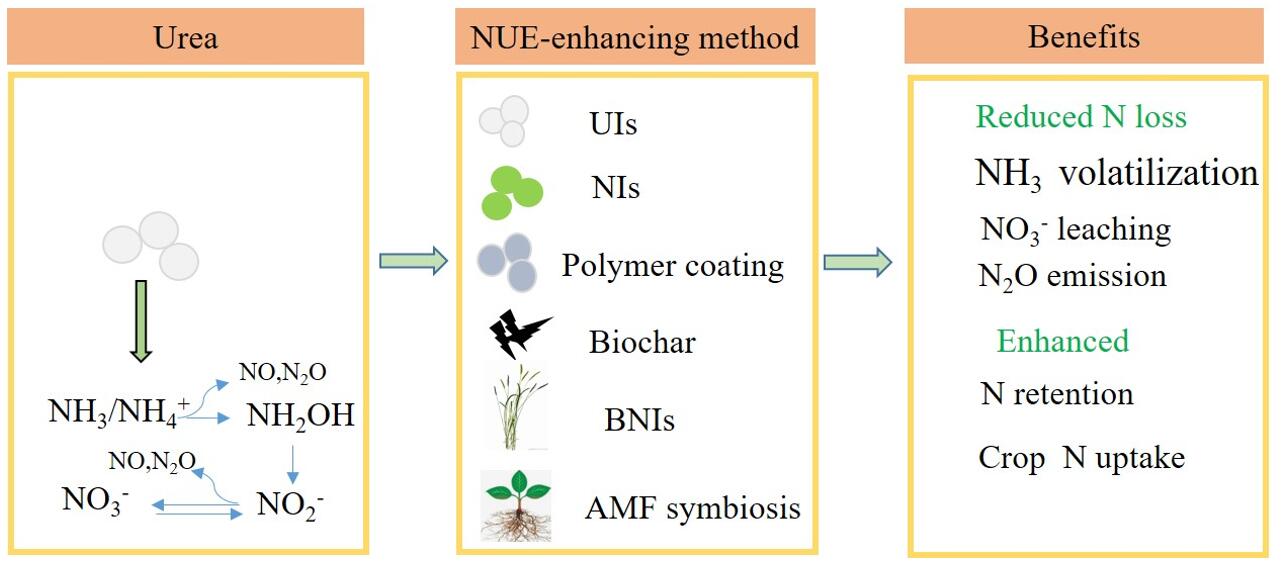
Efficient urea-N enhancing method and benefits in soil (Image by Huaiying YAO)
Attachment Download: