


Exploration of the atmospheric chemistry of nitrous acid in a coastal city of southeastern China: Results from measurements across four seasons
Date:Jan 20, 2022
Prof. Chen jinsheng from Institute of Urban Environment, Chinese Academy of Sciences and his collaborators have studied the atmospheric chemistry of nitrous acid in a coastal city of southeastern China. The study was published in Atmospheric Chemistry Physics.
Because nitrous acid (HONO) photolysis is a key source of hydroxyl (OH) radicals, identifying the atmospheric sources of HONO is essential to enhance the understanding of atmospheric chemistry processes and improve the accuracy of simulation models. We performed seasonal field observations of HONO in a coastal city of southeastern China, along with measurements of trace gases, aerosol compositions, photolysis rate constants (J), and meteorological parameters. The results showed that the average observed concentration of HONO was 0.54 ± 0.47 ppb. Vehicle exhaust emissions contributed an average of 1.45 % to HONO, higher than the values found in most other studies, suggesting an influence from diesel vehicle emissions. The mean conversion frequency of NO2 to HONO in the nighttime was the highest in summer due to water droplets was evaporated under the condition of high temperatures. Based on a budget analysis, the rate of emission from unknown sources (Runknown) was highest around midday, with values of 4.51 ppb·h-1 in summer, 3.51 ppb·h-1 in spring, 3.28 ppb·h-1 in autumn, and 2.08 ppb·h-1 in winter. Unknown sources made up the largest proportion of all sources in summer (81.25 %), autumn (73.99 %), spring (70.87 %), and winter (59.28 %). The photolysis of particulate nitrate was probably a source in spring and summer while the conversion from NO2 to HONO on BC enhanced by light was perhaps a source in autumn and winter. The variation of HONO at night can be exactly simulated based on the HONO/NOx ratio, while the J(NO3-_R) × pNO3- should be considered for daytime simulations in summer and autumn, or 1/4?( J(NO3-_R) × pNO3-) in spring and winter. Compared with O3 photolysis, HONO photolysis has long been an important source of OH except for summer afternoon. Observation on HONO across four seasons with various auxiliary parameters improves the comprehension of HONO chemistry in southeastern coastal China.
This study was funded by the Cultivating Project of Strategic Priority Research Program of Chinese Academy of Sciences (XDPB1903),the National Key Research and Development Program (2017YFC0209400, 2016YFC02005, 2016YFC0112200), the National Natural Science Foundation of China (41575146, 41875154), the FJIRSM&IUE Joint Research Fund (RHZX-2019-006), the Center for Excellence in Regional Atmospheric Environment, CAS (E0L1B20201), State Key Laboratory of Environmental Chemistry and Ecotoxicology, Research Center for Eco-Environmental Sciences, CAS and Xiamen Atmospheric Environment Observation and Research Station of Fujian Province.
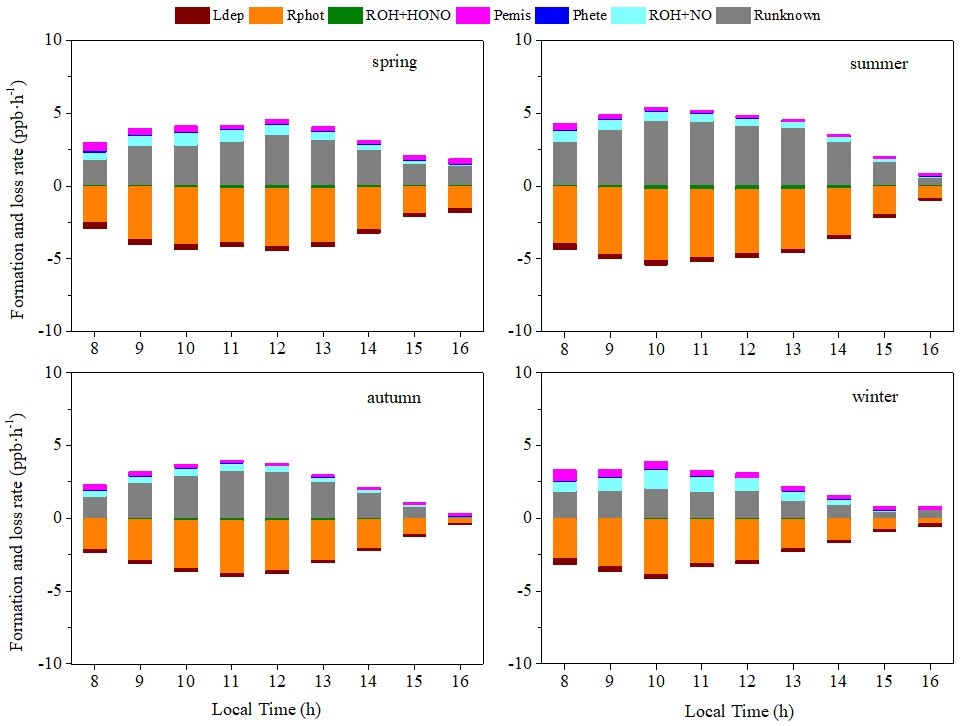
Figure 1. Average diurnal variations of each source (>0) and sink (<0) of HONO in the four seasons
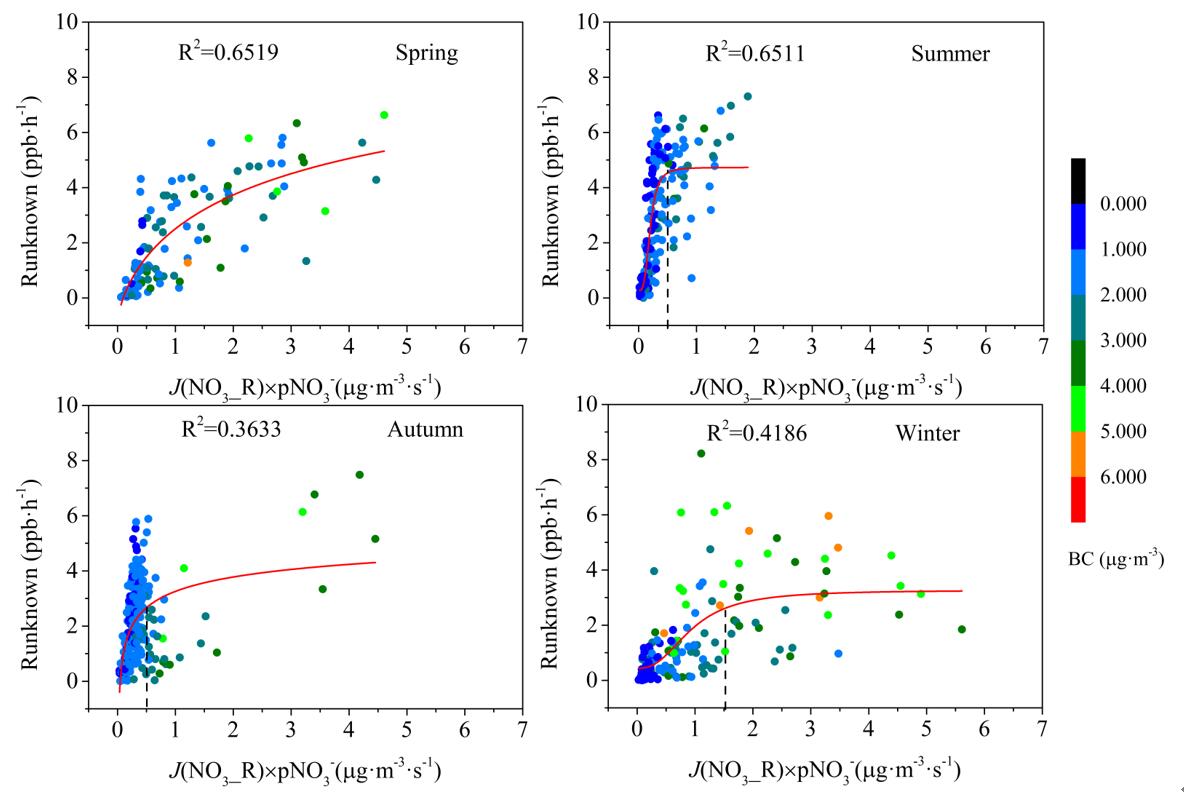
Figure 2. Relationships between the photolysis of particulate nitrate and Runknown, colored by BC in spring, summer, autumn, and winter. (Red lines and dashed lines represent logarithmic fitting curve and turning point, respectively.)
Attachment Download: