


Scientists study the biological nitrification inhibition by sorghum root exudates in soil condition
Date:Mar 27, 2021
Scientists from the Institute of Urban Environment, Chinese Academy of Sciences, have determined soil nitrification inhibitory activity in situ during the growth of sorghum and the effect of biological nitrification inhibitors on the abundance and composition of nitrifiers.
Plant roots secret nitrification inhibitors to inhibit soil nitrification which are termed biological nitrification inhibitors (BNI). Compared to synthetic nitrification inhibitors, plant-derived BNIs are low-cost, environmental-friendly and inhibit soil nitrification effectively. Sorghum has a great capacity to release BNIs, but the inhibitory effect on nitrification and nitrifier populations under planted soil conditions is unclear.
A pot experiment with three nitrogen (N) application rates (0, 50, and 200 mg N kg-1) was set up to detect the influence of sorghum growth on soil nitrification and investigate the function of blocking the activity of ammonia oxidizers. Compared with unplanted soil, sorghum planting had a significant inhibitory effect on the nitrification process even at the high N fertilizer rates.
Sorghum root exudates were collected at 30 days after transplanting to hydroponic culture, and added into cultured soil to determine the shifts in the populations of nitrifiers. They found that autotrophic nitrification was the prevailing process, and sorghum root exudation inhibited this process as much as the dicyandiamide (DCD, 10 mg kg-1). Root exudates had a significant inhibitory effect on ammonia oxidizing bacteria (AOB) but had no effect on ammonia oxidizing archaea (AOA).
BNI secretion is supposed to be a survival mechanism in low-N environments, but their results show that sorghum has the BNI capability to inhibit soil nitrification even in high-N input soils. Sorghum root exudates inhibited AOB in an agricultural soil but didn't influence AOA abundance, in contrast to a recent study that showed the reverse. They attribute this difference to be related to which nitrifiers dominate in any particular soil, either AOA or AOB, and suggest that sorghum can inhibit both groups. These results provide additional evidence for understanding BNI function under soil conditions.
The study was published in Biology and Fertility of Soils entitled "Biological nitrification inhibition by sorghum root exudates impacts ammonia-oxidizing bacteria but not ammonia-oxidizing archaea".
This study was supported by the National Natural Science Foundation of China, and the National Key R & D Program of China.
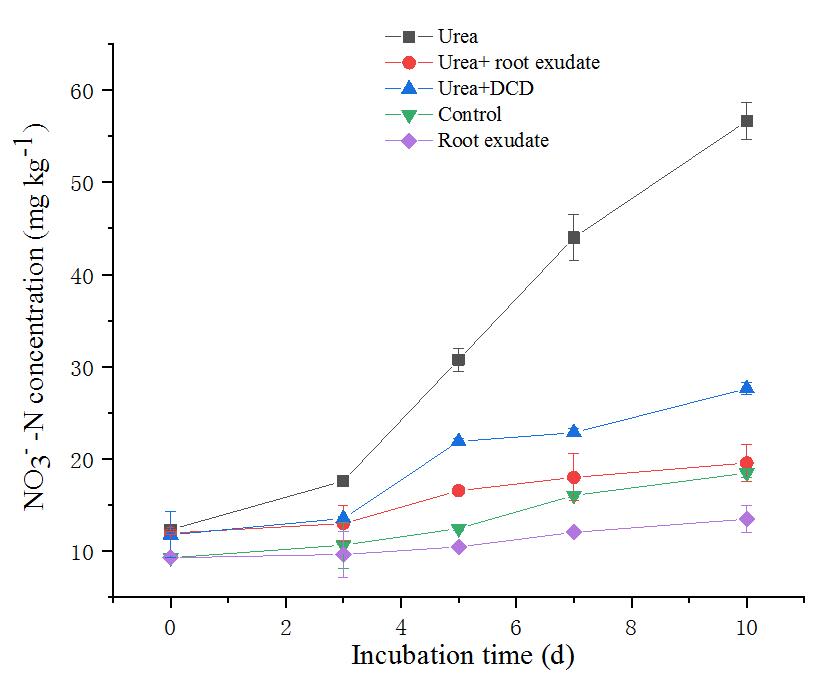
The variations in NO3-N concentrations with different inhibitor treatments.
Attachment Download: