


Scientists reveal the effect of inhibitors on the fate of fertilizer nitrogen and soil denitrification
Date:Nov 02, 2020
Increasing evidence indicates that nitrification is a vital factor in crop growth and nitrous oxide emission. Nitrification and urease inhibitors have been demonstrated to be effective in inhibiting the nitrification process and are widely used as fertilizer additives in agricultural soils. However, the effects of these inhibitors on rice N uptake and N2O production through denitrification in paddy soils remain unclear.
MENG Xiangtian and Prof. YAO Huaiying from the institute of urban environment compared the influences of nitrification inhibitors dicyandiamide (DCD), nitrapyrin (2-chloro-6-(trichloromethyl) pyridine; NP) and N-(n-butyl) thiophosphoric triamide (NBPT) on rice growth, the fate of urea nitrogen (N), and the abundances and activities of ammonia oxidizers and denitrifiers.
By using 15N isotope labeling technique and qPCR method, the researchers found that all three inhibitors improved rice growth mainly due to the increase in urea N use efficiency. Urea N uptake was negatively correlated with nitrification. The growth of ammonia-oxidizing bacteria (AOB), important in nitrification, was directly blocked by DCD. Additionally, NP and NBPT impeded the growth of ammonia-oxidizing archaea (AOA). In addition, NP significantly increased the microbial biomass to promote more residual urea N in soil and increased soil N transformation. NBPT significantly inhibited urea hydrolysis indirectly affecting nitrification.
In addition, the researchers found that all three inhibitors decreased the potential denitrification rate at the rice heading stage but had little effect on the denitrifier gene abundance except for nitrapyrin, which decreased the nirK gene abundance. DCD and NBPT may reduce the denitrification activity by decreasing the denitrification substrate (NO3-) concentration.
These results suggest that DCD, NP and NBPT have a beneficial effect on improving rice N uptake and have the potential to reduce N2O generation through denitrification. This study was published in a paper entitled "Nitrification and urease inhibitors improve rice nitrogen uptake and prevent denitrification in alkaline paddy soil" in Applied Soil Ecology. This study was supported by the National Natural Science Foundation of China and the National Key R & D Program of China.
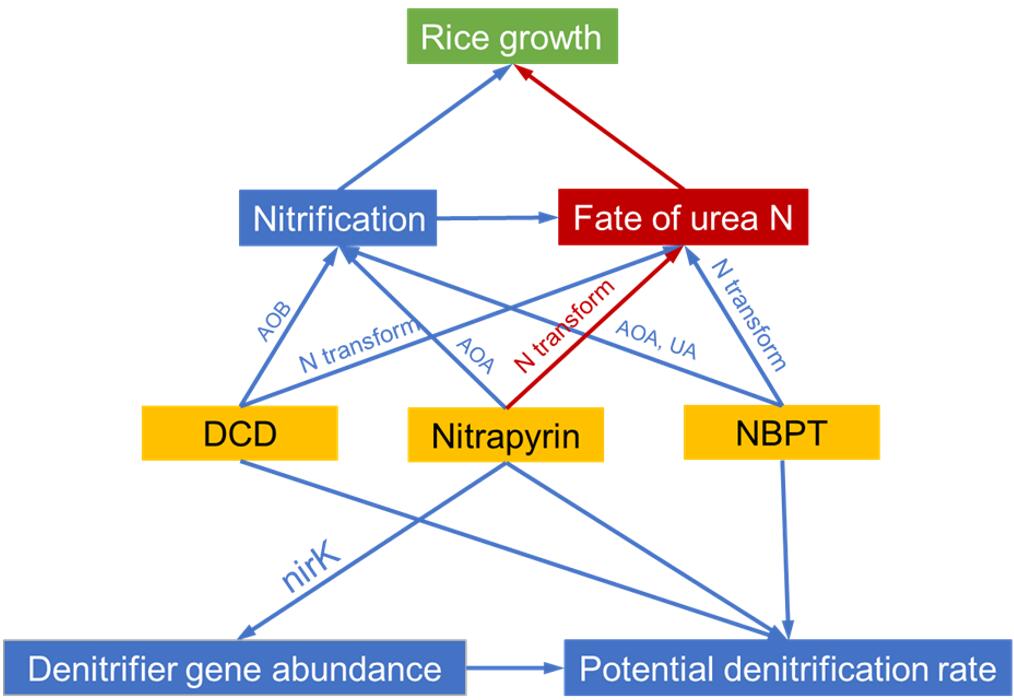
A conceptual model of the influence of inhibitors on the fate of fertilizer nitrogen and soil denitrification
Attachment Download: