


The Institute of Urban Environment gained progress in preparation of core-shell-structure activated carbon composites
Date:Mar 26, 2020
With the development of urbanization and industrialization, the problem of water pollution has attracted more and more attentions. Among them, newly emerging contaminants in the environment, such as pharmaceuticals and personal care products (PPCPs) and endocrine disruptors (EDCs), have attracted many attentions due to their high biological activity and toxicity. Among lots of removal technologies, the adsorption method has been widely focused and applied because of its advantages, such as low operation cost and environmental friendliness. Activated carbon (AC) can effectively adsorb many kinds of contaminants in water owing to its huge specific surface area and controllable surface chemistry. The powder activated carbon (PAC) and granular activated carbon (GAC) are currently widely used. In the process of usage, the common problems facing both ACs are the low recycling rate and degeneration. Meanwhile, the pressure drop of the GAC adsorption bed is high due to small particles, and AC is difficult to be completely separated from the water. The aforementioned problems seriously affect the practical use of AC in liquid phase adsorption. Therefore, it is indispensable to solve these shortages through innovative methods.
The Group of Clean Energy Technology and Carbon Material (team of Prof. WANG Yin) in the Institute of Urban Environment, Chinese Academy of Sciences firstly prepared a core-shell-structure activated carbon (CSAC/CSGAC) composites (cheap kaolin, fly ash, clay, etc. as the shell materials, and PAC or GAC as the core) with thin shell and high mechanical strength through controlling the key parameters, such as porous structure and thickness of the shell via adjusting the ratios of raw materials and conditions. On the basis of ensuring the adsorption capacity of AC, the composite achieved the goals of improving regeneration adsorption performance, reducing the amount of AC loss, and recycling easily. Test of adsorption confirmed that CSAC/CSGAC can effectively remove emerging organic contaminants, such as sulfamethoxazole, bisphenol A, and triclosan in water, and have excellent regeneration performance. These studies provided new ideas for the modification of AC, and proposed the adsorption characteristics and mechanism of the above three organic contaminants by CSAC/CSGAC, which enhanced the application potential of this new adsorption material.
These studies have been published in mainstream journals in the environmental field, such as Environmental Science and Pollution Research ,Journal of Hazardous Materials,Science of the Total Environment. Pamphile Ndagijimana is the first author, and Prof. WANG Yin and Prof. YU Guangwei are the corresponding authors. These studies were funded by the Strategic Priority Research Program of the Chinese Academy of Sciences, the China-Japan Research Cooperative Program, and the Natural Science Foundation of Fujian Province etc.
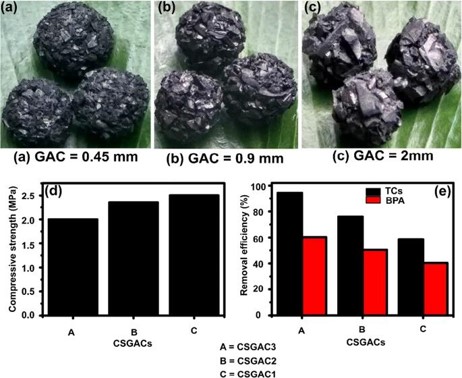
Figure 1. Effects of GAC particle sizes on the mechanical strength of CSGAC and its performance in removing TCs and BPA
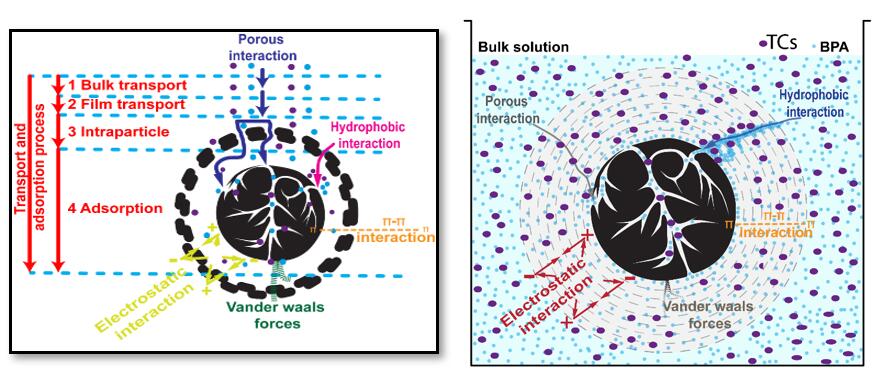
Figure 2. Schematic of mechanism for SMX, TCs and BPA adsorption on CSAC / CSGAC
Attachment Download: