


Scientists investigated the relative contribution of nitrifiers to autotrophic nitrification across a pH-gradient in a vegetable cropped soil
Date:Jun 20, 2019
Scientists from the Institute of Urban Environment, Chinese Academy of Sciences, have detected and discussed the relative contribution of nitrifiers to autotrophic nitrification across a pH-gradient in a vegetable cropped soil.
Microbial nitrification plays an important role in nitrogen cycling in ecosystems. Nitrification is performed by ammoniaoxidizing archaea (AOA), ammonia-oxidizing bacteria (AOB), and nitrite-oxidizing bacteria (NOB) including complete ammonia oxidizers. However, the relative importance of nitrifiers in autotrophic nitrification in relation to soil pH is still unclear.
Combining DNA-based stable isotope probing (SIP) and molecular biological techniques, we investigated the abundance, structure, and activity of AOA, AOB, and NOB along a pH-gradient (3.97–7.04) in a vegetable cropped soil. Scientists found that AOA abundance outnumbered AOB abundance and had a significantly negative relationship with soil pH. The abundances of NOB Nitrospira 16S rRNA, nxrB gene, and Nitrobacter nxrA gene were affected by soil pH. Incubation of soil with 13CO2 and DNA-SIP analysis demonstrated that significant 13CO2 assimilation by AOA rather than by AOB occurred in the acidic soils, whereas the labeled 13C level of AOA was much less in the neutral soil than in the acidic soils. There was no evidence of 13CO2 assimilation by NOB except for Nitrobacter with NxrB gene at pH 3.97. Phylogenetic analysis of AOA amoA gene in the 13C- and 12C-labeled treatments showed that the active AOA mainly belonged to Nitrososphaera in the acidic soils. These results suggested that the main performer of nitrification was AOA in the acidic soils, but both AOA and AOB participated in nitrification in the neutral soil with low nitrification activity. NOB Nitrospira and Nitrobacter did not grow in the soils with pH 4.82–7.04 and other populations of NOB were probably involved in nitrite oxidation in the vegetable cropped soil.
The study was published in Journal of Soils and Sediments entitled " The relative contribution of nitrifiers to autotrophic nitrification across a pH-gradient in a vegetable cropped soil".
This study was supported by the the National Key R &D Program of China and the National Natural Science Foundation of China.
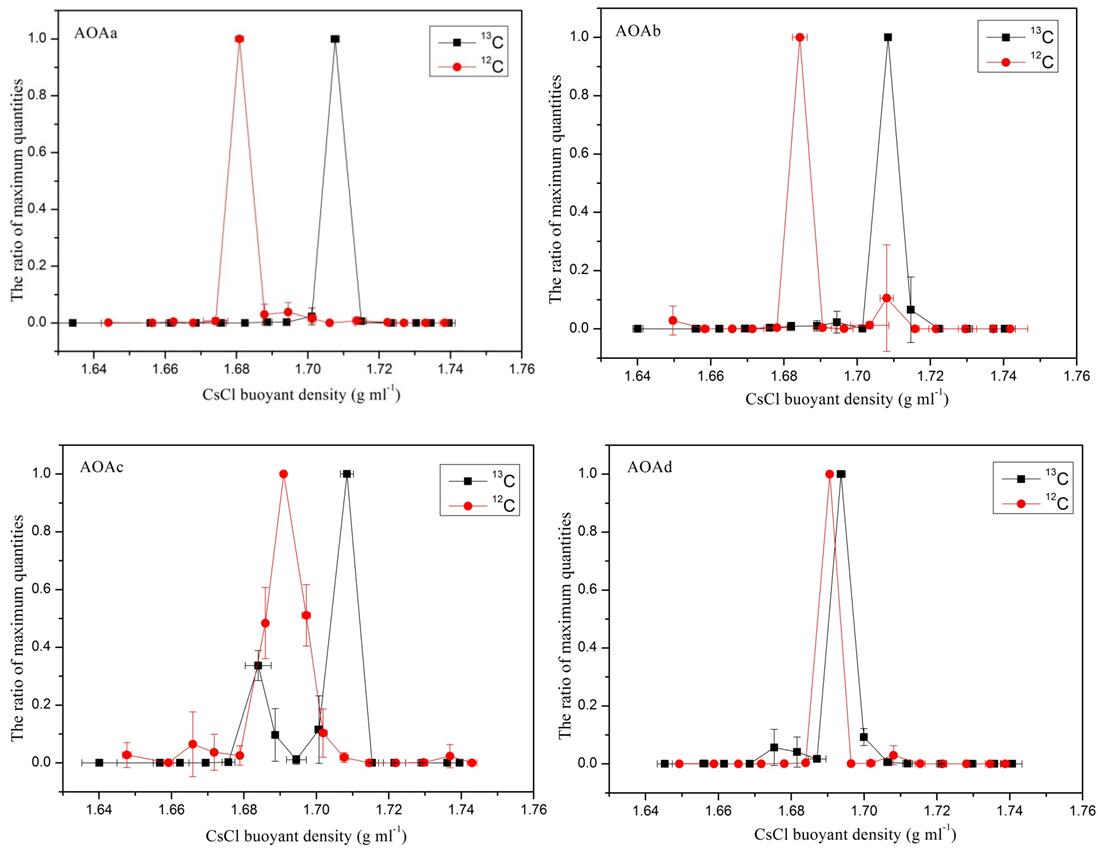
Figure 1.Quantitative distribution of AOA amoA gene copy numbers along a buoyant density gradient for the 13C-CO2 and 12C-CO2 treatments. The relative abundance was the ratio of the amoA gene copy number in each DNA fraction to the maximum quantity in each treatment(a, pH 3.97; b, pH 4.82; c, pH 6.07; d, pH 7.04).
Attachment Download: