


Efficient light promoted degradation of volatile organic compounds over photo-thermal responsive graphene-based composites
Date:May 05, 2019
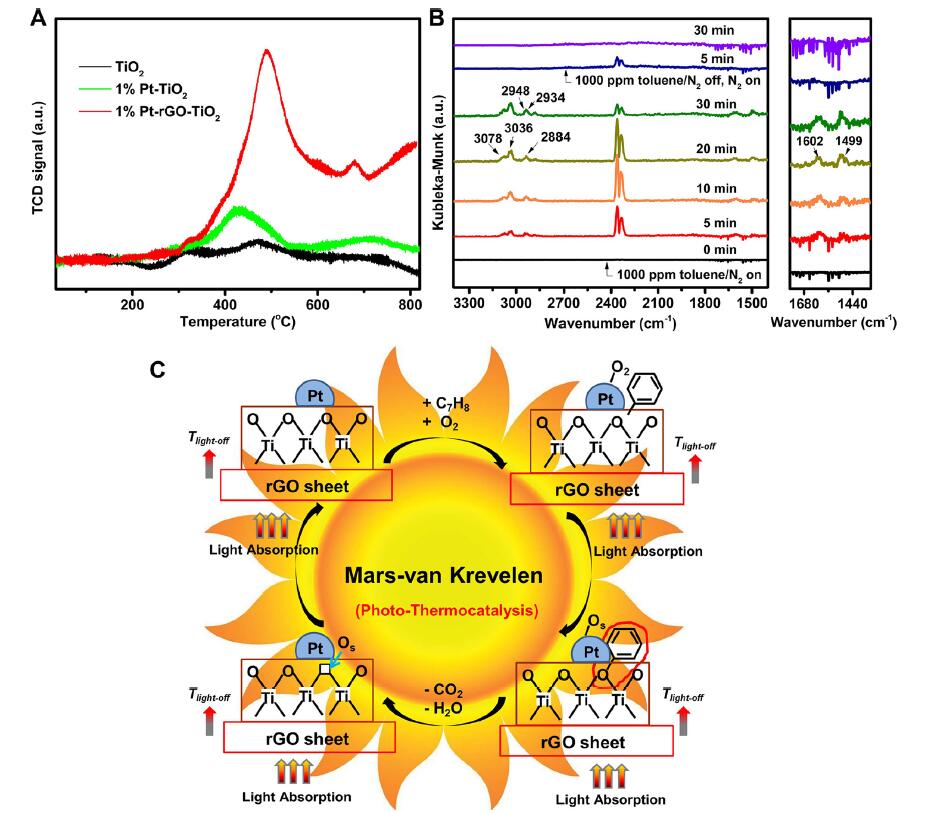
Large amounts of anthropogenic VOCs emissions give rise to photochemical smog and ground-level ozone. Currently, catalytic oxidation for VOCs elimination still requires energy-intensive high temperatures. Light driven photo-thermocatalysis oxidation of VOCs holds great promise to substantially reduce energy consumption for sustainable development in comparison with conventional thermal-based catalytic oxidation. IUE report that the hybrid nanomaterial Pt-rGO-TiO2, featuring the broad light wavelength absorption (800-2500 nm), can be used as a highly active photo-thermal responsive catalyst for efficient VOCs decomposition under IR irradiation. The maximum photo-thermal conversion efficiency is able to reach 14.1% with a significant toluene conversion of 95% and CO2 yield of 72% under infrared irradiation intensity of 116 mW/cm2, along with retaining its stability for nearly 50 h. This study demonstrated that Pt-rGO-TiO2 composite featuring a broad IR light wavelength absorption possesses the capability for remarkable photo-thermal catalytic activity under IR light irradiation, with its performance intensively correlated to the advisable introduction of few-layered rGO nanosheets which enhance light-to-heat conversion, improve reactant adsorption capacity and enable well-dispersed supported Pt-TiO2 catalyst on the 2D rGO nanosheets.
Unfortunately, this photo-thermal catalyst suffered from moderate selective conversion of gaseous toluene to carbon dioxide under light irradiation, accompanied by generated recalcitrant carbonaceous intermediates possibly depositing/blocking/poisoning adsorption sites and catalytic active sites. Accordingly, it remains a challenge but an opportunity to further search for a material that can thoroughly decompose organic pollutants into end-product CO2, especially in the IR-light region To get a more active catalyst, one needs to modulate the molecule-scale surface properties to fundamentally improve reactant adsorption, enhance light-to-heat temperature and expose a greater fraction of catalytic active sites. Specifically, adsorption of the reactant onto the catalyst, particularly at the light-induced temperature, needs to be carefully considered. Herein, we show that the rGO nanosheets-adsorption layer supported Pt NPs, characterized by excellent IR light absorption, efficient light-to-heat conversion, high reactant adsorption capacity and well-dispersed active Pt NPs, can convert solar light, especially a low-intensity IR photon flux, into heat to enhance catalytic activity. In particular, the maximum photo-thermal conversion efficiency over Pt-rGO hybrid reaches 17.6% with a significant toluene conversion of 98% and CO2 yield of 96% under 146 mW.cm-2 infrared light irradiation, together with excellent stability of nearly 45 h, much superior to that of the previous reported catalyst of Pt-rGO-TiO2. It is anticipated that this work will open new avenues toward the design of more energy-efficient catalysts with significant utilization of inexhaustible solar energy.
Attachment Download: