


The Institute of Urban Environment gained progress in the ecotoxicology of Bisphenol A
Date:Oct 29, 2018
Bisphenol A (BPA) is a high-production-volume chemical with a variety of applications. It has been widely detected in environmental matrices and organisms. BPA shows an endocrine disrupting effects and has received widely health concern. The group of environmental toxicology in Institute of Urban Environment, Chinese Academy of Sciences is major in the toxicology of BPA. Cell, fish, mice and rabbit models were combined together to reveal the molecular mechanism of BPA (Environ Sci Pollut Res, 2011;Cell Death Dis, 2013; J Appl Toxicol, 2015; Sci Rep., 2016; BBA-Mol Cell Biol L, 2017; Sci Total Environ, 2017).
A marine fish model (Oryzias melastigma) was exposed to serial concentrations of BPA throughout its whole life cycle. The level of BPA-glucuronide (BPAG) dramatically increased throughout the embryonic stage since 4 dpf. Accordingly, the mRNA level and enzymatic activity of UDP-glucuronosyltransferases (UGTs) increased across the embryonic stage. The mRNA level of UGT2 subtype rather than UGT1 or UGT5 showed a concentration dependent response to BPA exposure. BPA exposure led to the morphological disruption of the chorion and villi as shown by scanning electron microscopy; however, the hatchability was not significantly influenced after exposure. Newly hatching larvae were continuously exposed to BPA for 120 days. Lower mRNA levels of hormone metabolism-related genes, decreased ratio of E2/T, slower ovary development and decreased egg production confirmed the inhibitory effect of BPA on reproduction. Overall, our results showed the conjugation of BPA into BPAG by UGT2 at the embryonic stage and convinced the reproductive toxicity from multiple levels after whole life exposure to BPA. The results were published in Environmental Pollution, 2018, 242, 914-9 with the title of New insights into the metabolism and toxicity of bisphenol A on marine fish under long-term exposure. The study was supported by the Strategic Priority Research Program of the Chinese Academy of Sciences, National Natural Science Foundation of China, and Science and Technology Department of Fujian Province.
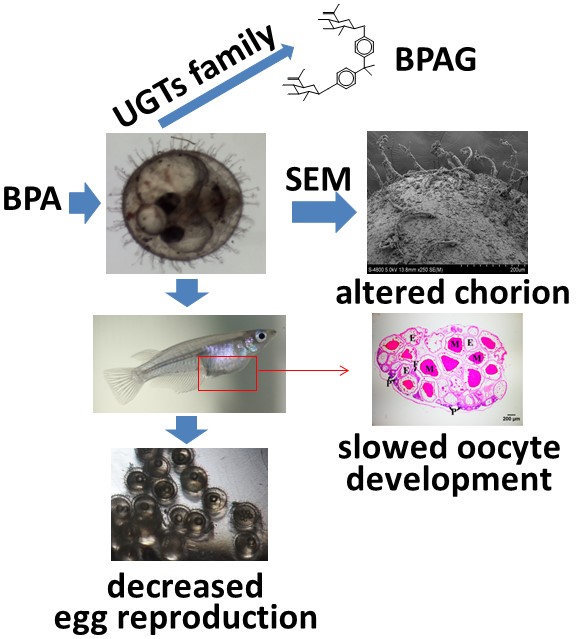
The action model of BPA on the reproduction in O. melastigma.
Attachment Download: