


Changes of Soil Phosphorus Availability Affect the Phosphate-solubilising Microbial Community in the Rice Rhizosphere
Date:Oct 17, 2018
Rice (Oryzae sativa L.) is the staple food supplying more than half of the world’s population. However, phosphorus deficiency is a major factor limiting rice yield, since P is often not readily available due to tight binding in Fe-P or Al-P forms. As the key driver of the element biogeochemical cycle, soil microorganisms play an important role in the promotion of soil P availability.
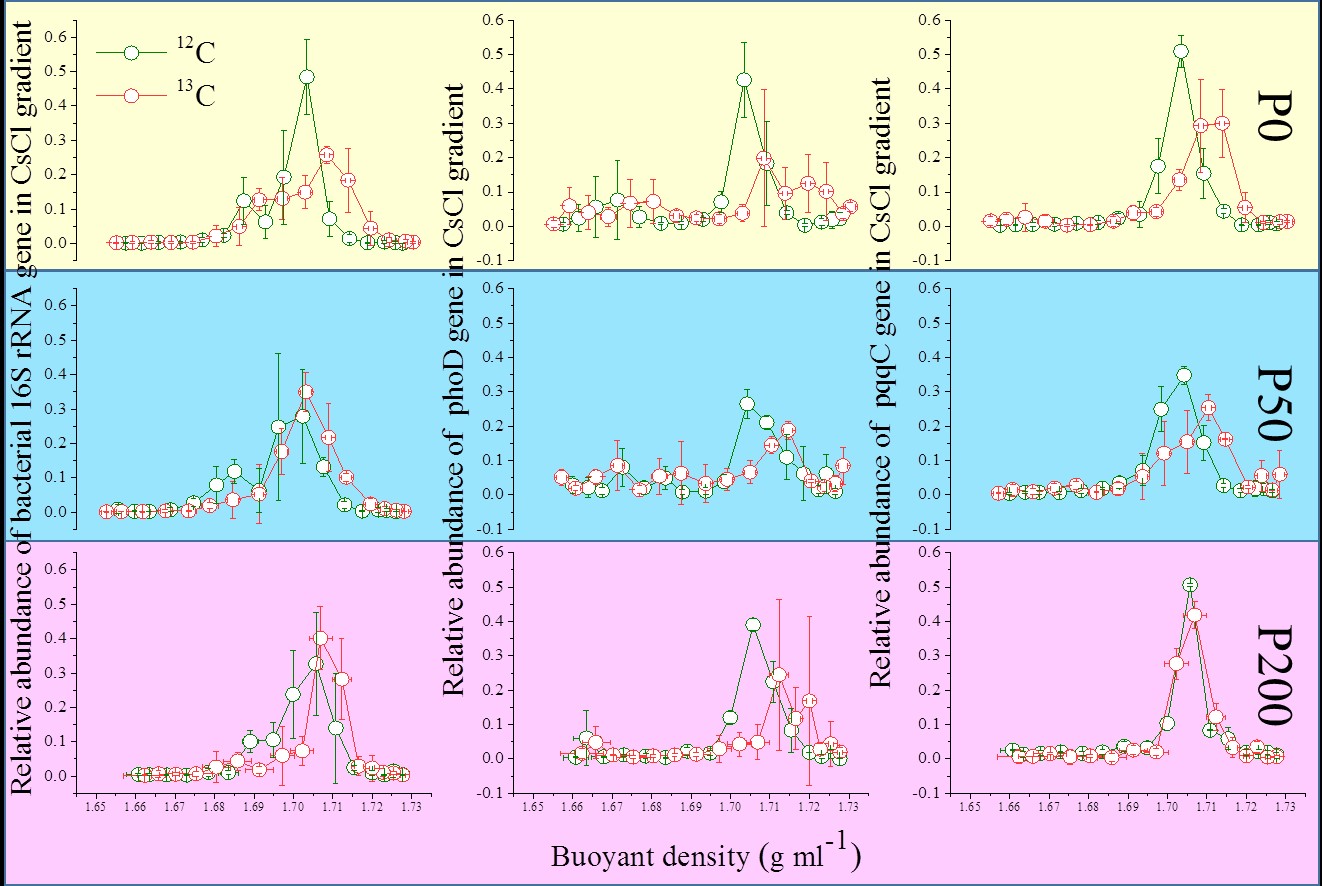
Researchers from the Institute of Urban Environment, Chinese Academy of Sciences, investigated the effect of soil P availability(0,50,200 mg P2O5 kg-1)on the soil phosphate-solubilising microbial community in the rice rhizosphere under a P-deficient paddy soil via stable isotope probing of phospholipid fatty acids and DNA and high-throughput sequencing methods.
Compared with controls (23.4–62.2‰), the δ13C values of 16:1ω7c, 18:1ω7c, and 18:1ω9c (Gram-negative bacteria) increased to 69.2–167.4‰ with low P input, but decreased to 6.6–58.6‰ under high P input. Similarly, higher 13C enrichment (1.04–1.47 ng g-1 dry weight soil) was observed in phospholipid fatty acids (16:1ω7c, 18:1ω7c and 18:1ω9c) with low P input. High-throughput sequencing indicated that low rather than high P input promoted the growth of P-solubilising Bacillus, Alicyclobacillus, and Clostridium. The relative abundance of these organisms increased significantly in light DNA fractions following both 12C and 13C treatments, suggesting they seldom use rice root derived carbon as carbon sources. By contrast, P-solubilising Rhizobiales, Rhodospirillales, and Myxococcales preferred root-derived carbon under P input conditions. Community and phylogenetic analysis of genes related to P solubilisation (alkaline phosphatase phoD and pyrroloquinoline quinone pqqC) indicated a dominant role for Rhizobiales and Actinomycetales in paddy soil P solubilisation.
This study was published in Soil Biology and Biochemistry entitled "Phosphate levels influence the utilisation of rice rhizodeposition carbon and the phosphate-solubilising microbial community in a paddy soil". This work was supported by the National Natural Science Foundation of China, and the Strategic Priority Research Program of Chinese Academy of Sciences.
Attachment Download: