


Scientists Map the Distribution of Antimicrobial Resistance Emission across Chinese Major Cities
Date:Jul 28, 2017
Global emergence of antimicrobial resistance threatens the therapies of bacterial pathogen infections. Professor ZHU Yongguan from Institute of Urban Environment, Chinese Academy of Sciences and his international collaborators, have conducted a nation-wide survey of antimicrobial resistance elements in urban sewage and depicted that the distribution of antimicrobial resistant genes was characterized by the well-known “Hu Huanyong line”, which delineates a striking difference in the distribution of China’s population.
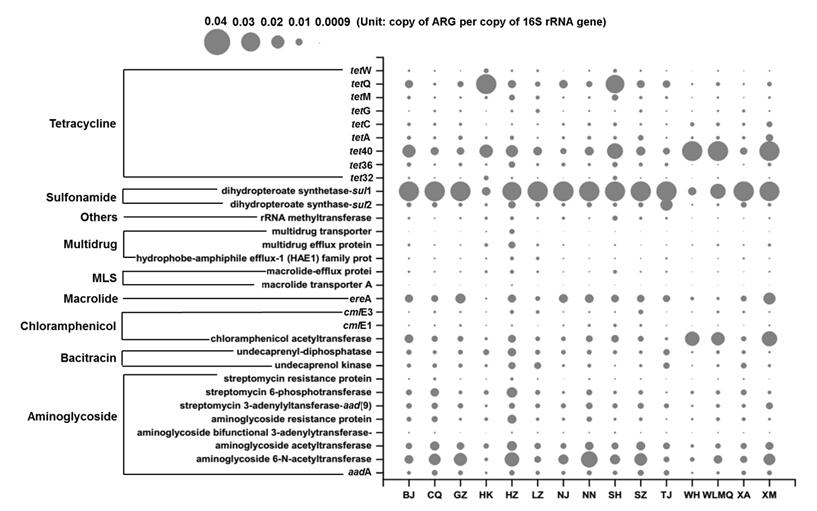
A total of over 116 urban sewage samples from 32 wastewater treatment plants across 17 Chinese major cities were investigated in this study. Urban sewage was found to possess high levels of antimicrobial resistance genes of around 1011~ 1012copies per liter. Antimicrobial resistance occurrence in urban sewage has a distinct seasonal pattern and antibiotic resistome is extensively shared in urban sewage across China.
Adults harbor significant quantities of resistance genes in their gut microbiome, primarily owing to antibiotic usage in infection treatment. In particular, the frequent presence of multi-antibiotic resistant “superbugs” in human feces predicts a return to the pre-antibiotic era, where a growing number of infections can no longer be treated using the current arsenal of drugs.
Urban sewage is a catchment receiving amounts of antibiotic-resistant bacteria from the gastrointestinal tracts of tens to hundreds of thousands of urban residents. The antimicrobial resistance distribution detected in urban sewage could represent the resistance burden map of their urban populations. The data demonstrated that urban sewage is potentially a major conduit for dissemination of anthropogenically derived antibiotic resistance into various environmental compartments.
This work provides a baseline for investigating environmental dissemination of resistance elements, and raises the possibility of using the abundance of ARGs in sewage as a tool for antibiotic stewardship.
These findings were recently published in Microbiome(Zhu, Y.-G., et al. 2017). "Metagenomics of urban sewage identifiesan extensively shared antibiotic resistomein China" Microbiome 5: 84, DOI 10.1186/s40168-017-0298-y, https://microbiomejournal.biomedcentral.com/articles/10.1186/s40168-017-0298-y). This study was conducted with collaborators from the University of Hong Kong, Zhejiang University and Macquarie University. This study was financially supported by the National Key Research and Development Plan, the Natural Science Foundation of China, the Knowledge Innovation Program of the Chinese Academy of Sciences, the International Science & Technology Cooperation Program of China, and Youth Innovation Promotion Association CAS.
Figure captions:
ArcGIS map showing the ARG burden based on urban populations of administrative districts in China. The black line on the map refers to the Chinese demographic “Hu Huanyong line”. The value presented in the legend was log transformed ARG burden (copies/day) discharged by urban populations. The ARG burden in Chinese administrative regions is calculated by multiplying the medium value of ARG load (9.47 × 10¹³copies/cap/day) by total urban population.
Corresponding author:
Professor ZHU Yongguan
Institute of Urban Environment Chinese Academy of Sciences
Tel: 86-592-6190997
Email: ygzhu@iue.ac.cn
Professor ZHANG Tong
The University of Hong Kong
Email:zhangt@hku.hk
Image by AN Xinli
Attachment Download: