


Institute of Urban Environment, C.A.S uncovered the influence of titanium dioxide nanoparticles on arsenate accumulation, distribution, and toxicity in Daphnia magna
Date:Aug 11, 2016
Potential health hazards and environmental impacts of manufactured nanoparticles (MNPs) have become a significant concern with the rapid development of nanotechnology. Titanium dioxide nanoparticles (nano-TiO2) are widely used in consumer products. Most previous studies on health risks and environmental impacts of nano-TiO2 have focused on their biological effects and toxicity levels. Nano-TiO2 dispersion could, however, interact with metals and modify their behavior and bioavailability in aquatic environments.
We aim to completely quantify accumulation, spatial and subcellular distribution, and toxicity of arsenate (As(V)) associated with nano-TiO2 owing to the high risk of potential As contamination on a global scale, and our team has been working on this project (headed by Zhuanxi Luo) since 2013. Our results show that, nano-TiO2 acts as a positive carrier, significantly facilitating D. magna’s ability to uptake As(V). As nano-TiO2 concentrations increased from 2 to 20 mg-Ti/L, total As increased by a factor of 2.3 to 9.8 compared to the uptake from the dissolved phase. This is also supported by significant correlations between arsenic (As) and titanium (Ti) signal intensities at concentrations of 2.0 mg-Ti/L nano-TiO2 (R=0.676, P<0.01) and 20.0 mg-Ti/L nano-TiO2 (R=0.776, P<0.01), as determined by LA-ICP-MS. Even though As accumulation increased with increasing nano-TiO2 concentrations in D. magna, As(V) toxicity associated with nano-TiO2 exhibited a dual effect. Compared to the control, the increased As was mainly distributed in BDM (biologically detoxified metal), but Ti was mainly distributed in MSF (metal-sensitive fractions) with increasing nano-TiO2 levels. Differences in subcellular distribution demonstrated that adsorbed As(V) carried by nano-TiO2 could dissociate itself and be transported separately, which results in higher toxicity at higher nano-TiO2 concentrations. Decreased As(V) toxicity associated with lower nano-TiO2 concentrations results from unaffected As levels in MSFs (when compared to the control), where several As components continued to be adsorbed by nano-TiO2. Therefore, more attention should be paid to the potential influence of nano-TiO2 on bioavailability and toxicity of co-contaminants.
Our results have been recently published on Environmental Science & Technology, 2016, DOI: 10.1021/acs.est.6b01215 (Mengting Li, Zhuanxi Luo*, Yameng Yan, Zhenhong Wang, Qiaoqiao Chi, Changzhou Yan*, and Baoshan Xing. Arsenate accumulation, distribution, and toxicity associated with titanium dioxide nanoparticles in Daphnia magna). This study was jointly funded by the National Nature Science Foundation of China (41271484, 41401552, and 41301346) and the Open Fund of the Fujian Provincial Key Laboratory of Resources and Environment Monitoring & Sustainable Management and Utilization (ZD1402).
http://pubs.acs.org/doi/abs/10.1021/acs.est.6b01215
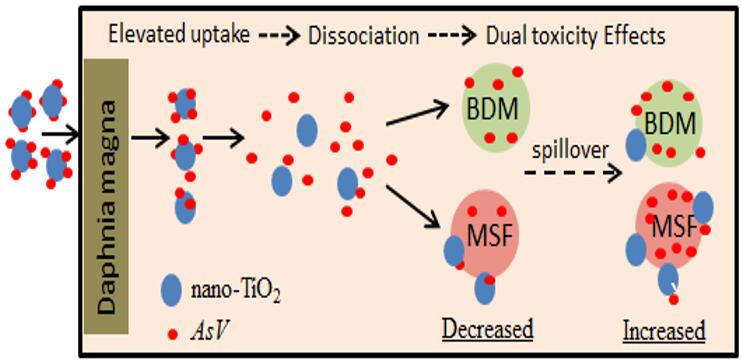
Arsenate accumulation, distribution and toxicity associated with nano-TiO2 in Daphnia magna
Attachment Download: