


• Home
  • About Us
    • Brief Introduction
    • Address from the Director
    • Directors
    • Organization
    • IUE in Media
  • Scientists
    • Academicians
    • Professors
    • Associate Professors
  • Research
    • Research Divisions
    • Research Progress
  • Education
    • Admission
    • Study at IUE
    • Scholarships
  • INT'L Cooperation
    • INT'L Cooperation News
    • Partnership
  • Papers
  • Join Us
    • Job Opportunities
    • PIFI
      • What's PIFI
Contact Us   |   Sitemap   |   CAS   |   中文
  • Home
  • About Us
    • Brief Introduction
    • Address from the Director
    • Directors
    • Organization
    • IUE in Media
  • Scientists
    • Academicians
    • Professors
    • Associate Professors
  • Research
    • Research Divisions
    • Research Progress
  • Education
    • Admission
    • Study at IUE
    • Scholarships
  • INT'L Cooperation
    • INT'L Cooperation News
    • Partnership
  • Papers
  • Join Us
    • Job Opportunities
    • PIFI

Papers

  • HomePapers
  • Papers
    Using Large Language Models to Assist Antimicrobial Resistance Policy Development: Integrating the Environment into Health Protection Planning
    Cai Chen, Shu-Le Li, Anthony D So, Yao-Yang Xu, Zhao-Feng Guo, Xinbing Wang, David W Graham*, Yong-Guan Zhu*

    Increasing antimicrobial resistance (AMR) poses a substantial threat to global health and economies, which has led many countries and regions to develop AMR National Action Plans (NAPs). However, inadequate logistical capacity, funding, and essential information can hinder NAP policymaking, especially in low-to-middle-income countries (LMICs). Therefore, major gaps exist between aspirations and actions, such as fully operationalized environmental AMR surveillance programs in NAPs. To help bridge knowledge gaps, we compiled a multilingual database that contains policy guidance from 146 countries composed of NAPs, internal reports, and other guidance documents on AMR mitigations, including environmental considerations. Leveraging this database, we developed an AMR-Policy GPT, a large language model with advanced retrieval-augmented generation capabilities. This prototype model can search and summarize evidence from plans, metadata, and technical knowledge and provide traceable references from global document databases. It was then manually validated to show its proficiency in accurately managing diverse inquiries while minimizing misinformation. Overall, the AMR-Policy GPT offers a prototype that, with the deepening of its database and further road testing, has the potential to support inclusive, evidence-informed AMR policy guidance to support governments, research, and public agencies. A conversational version of our prototype is available at www.liuhuibot.com/amrpolicy.
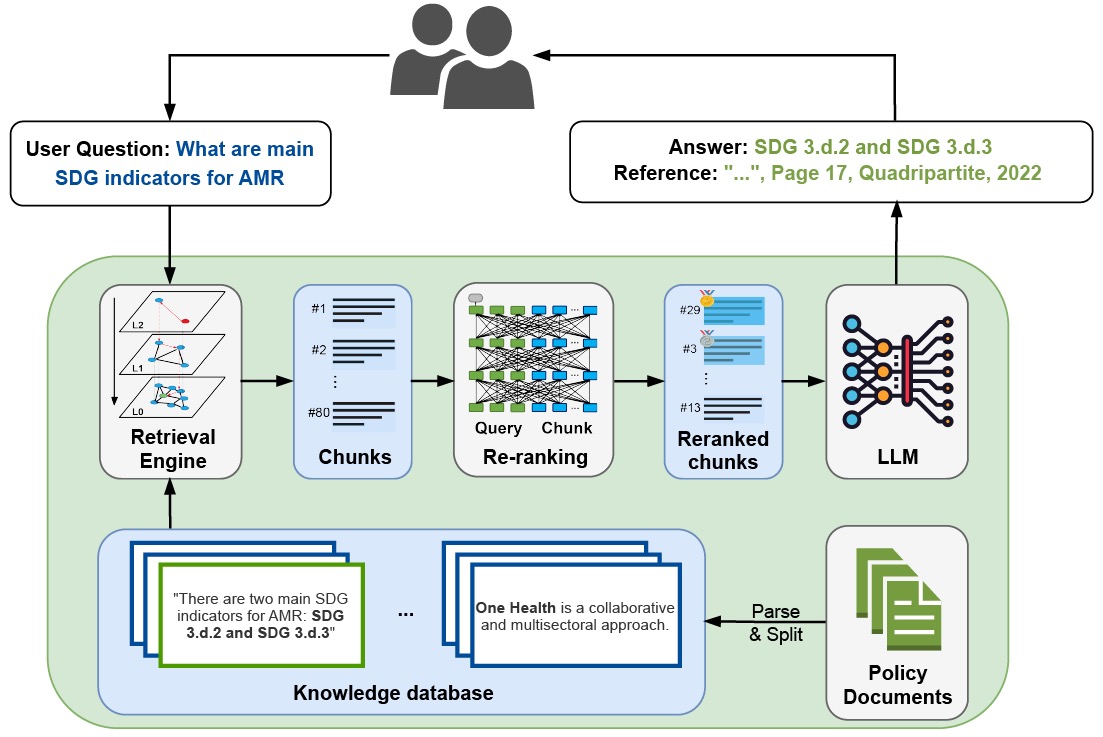

    Key words:Antimicrobial resistance, Policymaking, One Health, Large language model, Artificial intelligence, Retrieval Augmented Generation

    Volume:

    Page:

    Journal:Environmental Science & Technology

    https://pubs.acs.org/doi/10.1021/acs.est.4c07842

    About Us

    • Brief Introduction
    • Address from the Director
    • Directors
    • Organization
    • IUE in Media

    Scientists

    • Academicians
    • Professors
    • Associate Professors

    Research

    • Research Divisions
    • Research Progress

    Education

    • Admission
    • Study at IUE
    • Scholarships

    INT'L Cooperation

    • INT'L Cooperation News
    • Partnership

    Papers

    Join Us

    • Job Opportunities
    • PIFI
    Copyright © Institute of Urban Environment,Chinese Academy of Sciences. All Rights Reserved.
    1799 Jimei Road, Xiamen 361021 China.+86-592-6190973.