


• Home
  • About Us
    • Brief Introduction
    • Address from the Director
    • Directors
    • Organization
    • IUE in Media
  • Scientists
    • Academicians
    • Professors
    • Associate Professors
  • Research
    • Research Divisions
    • Research Progress
  • Education
    • Admission
    • Study at IUE
    • Scholarships
  • INT'L Cooperation
    • INT'L Cooperation News
    • Partnership
  • Papers
  • Join Us
    • Job Opportunities
    • PIFI
      • What's PIFI
Contact Us   |   Sitemap   |   CAS   |   中文
  • Home
  • About Us
    • Brief Introduction
    • Address from the Director
    • Directors
    • Organization
    • IUE in Media
  • Scientists
    • Academicians
    • Professors
    • Associate Professors
  • Research
    • Research Divisions
    • Research Progress
  • Education
    • Admission
    • Study at IUE
    • Scholarships
  • INT'L Cooperation
    • INT'L Cooperation News
    • Partnership
  • Papers
  • Join Us
    • Job Opportunities
    • PIFI

Papers

  • HomePapers
  • Papers
    Unforeseen high continental-scale soil microbiome homogenization in urban greenspaces
    Sun X.*, Robinson J.M.*, Delgado-Baquerizo M., Potapov A., Yao H., Zhu B., Tiunov A.V.,Zhang L.,Chan F.K.S.,Chang S.X.,Breed M.F.,Eisenhauer N.,Scheu S.,Li Z.P.*,Zhu Y.G.

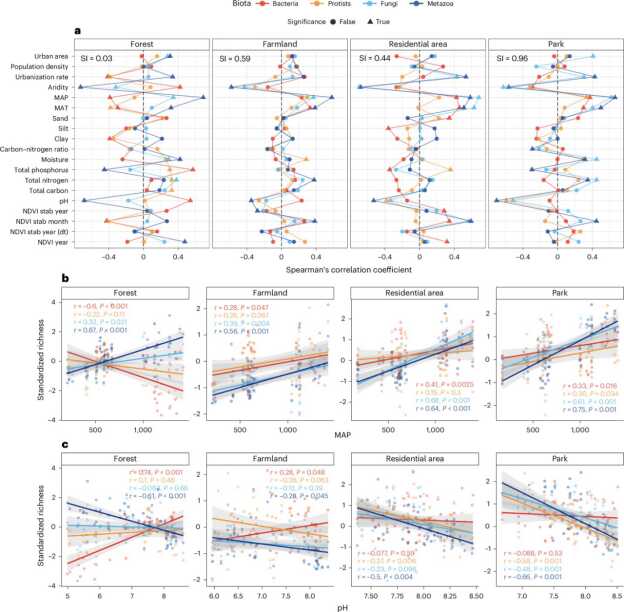
    Soils in urban greenspaces often support higher microbial richness but with more homogenous communities than in natural ecosystems. However, it is not known how urbanization impacts the diversity and homogeneity of soil communities in urban greenspaces compared with other highly managed ecosystems such as farmlands. Here we conducted a continental-scale study spanning 13 cities and four land uses (city parks, residential areas, and adjacent forests and farmlands) in China. We found that urban ecosystems consistently support higher local soil bacterial, protist and fungal (but not metazoan) richness than farmlands and forests. This elevated richness was closely related to higher pH in urban ecosystem soils. Urban greenspaces also supported more homogenous soil communities than farmlands. The results indicate that urbanization drives biotic homogenization and increases synchronous responses to environmental stressors in urban greenspaces at a continental scale. Our findings have important implications for managing soil ecosystem resilience and functional diversity in cities of the future.
    Key words:Urban biodiversity; soil biodiversity; urbanisation; soil ecology; urban ecology

    Volume:

    Page:

    Journal:Nature Cities

    https://doi.org/10.1038/s44284-025-00294-y

    About Us

    • Brief Introduction
    • Address from the Director
    • Directors
    • Organization
    • IUE in Media

    Scientists

    • Academicians
    • Professors
    • Associate Professors

    Research

    • Research Divisions
    • Research Progress

    Education

    • Admission
    • Study at IUE
    • Scholarships

    INT'L Cooperation

    • INT'L Cooperation News
    • Partnership

    Papers

    Join Us

    • Job Opportunities
    • PIFI
    Copyright © Institute of Urban Environment,Chinese Academy of Sciences. All Rights Reserved.
    1799 Jimei Road, Xiamen 361021 China.+86-592-6190973.