


• Home
  • About Us
    • Brief Introduction
    • Address from the Director
    • Directors
    • Organization
    • IUE in Media
  • Scientists
    • Academicians
    • Professors
    • Associate Professors
  • Research
    • Research Divisions
    • Research Progress
  • Education
    • Admission
    • Study at IUE
    • Scholarships
  • INT'L Cooperation
    • INT'L Cooperation News
    • Partnership
  • Papers
  • Join Us
    • Job Opportunities
    • PIFI
      • What's PIFI
Contact Us   |   Sitemap   |   CAS   |   中文
  • Home
  • About Us
    • Brief Introduction
    • Address from the Director
    • Directors
    • Organization
    • IUE in Media
  • Scientists
    • Academicians
    • Professors
    • Associate Professors
  • Research
    • Research Divisions
    • Research Progress
  • Education
    • Admission
    • Study at IUE
    • Scholarships
  • INT'L Cooperation
    • INT'L Cooperation News
    • Partnership
  • Papers
  • Join Us
    • Job Opportunities
    • PIFI

Papers

  • HomePapers
  • Papers
    Nanosized microbiomes from pig manure alter soil microbial communities and increase antibiotic resistance gene abundance
    Hu Liao, Yan-Zi Wang, Chen-Song Duan, Yong-Guan Zhu, Jian-Qiang Su*

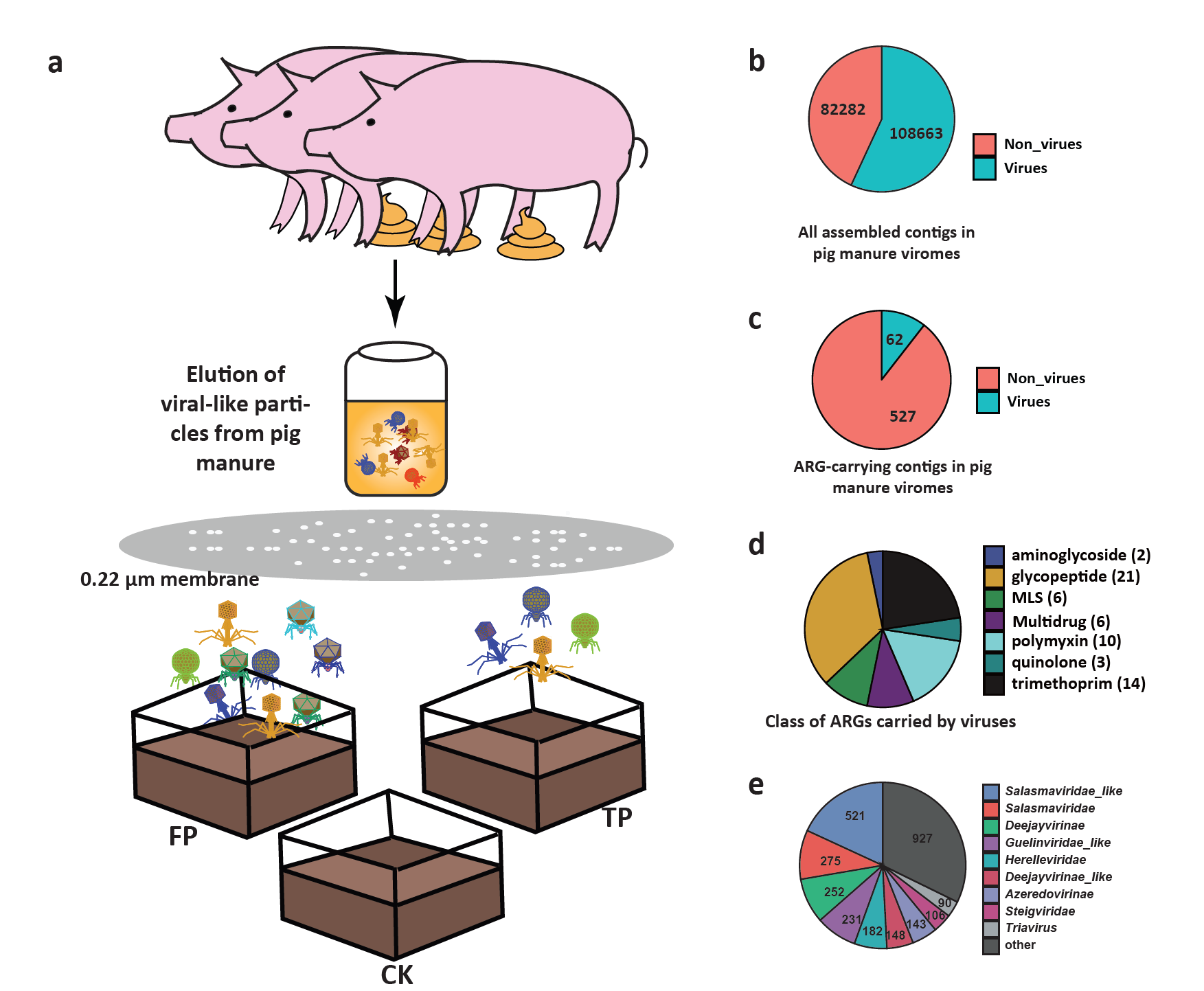
    Agricultural ecosystems are continuously exposed to exogenous phages, including those introduced via animal manure fertilization, yet their colonization dynamics and ecological impacts remain unclear. Using a microcosm experiment, we investigated how pig manure-derived nanosized microbiome (NSM; <0.22 μm) influences phage-bacterial interactions, antibiotic resistance gene (ARG) dissemination, and microbial evolution in paddy soil. NSM addition transiently elevated high-risk ARG abundance, particularly linked to Acinetobacter proliferation from manure. These dynamics were driven by manure-derived Acinetobacter and their associated phages/plasmids, which dominated soil phage communities despite their low initial abundance. Both Acinetobacter and their phages exhibited microdiversity shifts under environmental fluctuations, with strong negative soil phage-bacterial correlations disrupted post-NSM introduction. Our findings highlight the environmental risks of pig manure-derived NSM, emphasizing Acinetobacter and their phages as key drivers of high-risk ARG spread and microbial community evolution. This underscores the need for manure pretreatment strategies to mitigate soil resistome hazards.

    Key words:

    Volume:

    Page:

    Journal:Communications earth & environment (a Nature Portfolio Journal)

    https://www.nature.com/articles/s43247-025-02610-9

    About Us

    • Brief Introduction
    • Address from the Director
    • Directors
    • Organization
    • IUE in Media

    Scientists

    • Academicians
    • Professors
    • Associate Professors

    Research

    • Research Divisions
    • Research Progress

    Education

    • Admission
    • Study at IUE
    • Scholarships

    INT'L Cooperation

    • INT'L Cooperation News
    • Partnership

    Papers

    Join Us

    • Job Opportunities
    • PIFI
    Copyright © Institute of Urban Environment,Chinese Academy of Sciences. All Rights Reserved.
    1799 Jimei Road, Xiamen 361021 China.+86-592-6190973.