


• Home
  • About Us
    • Brief Introduction
    • Address from the Director
    • Directors
    • Organization
    • IUE in Media
  • Scientists
    • Academicians
    • Professors
    • Associate Professors
  • Research
    • Research Divisions
    • Research Progress
  • Education
    • Admission
    • Study at IUE
    • Scholarships
  • INT'L Cooperation
    • INT'L Cooperation News
    • Partnership
  • Papers
  • Join Us
    • Job Opportunities
    • PIFI
      • What's PIFI
Contact Us   |   Sitemap   |   CAS   |   中文
  • Home
  • About Us
    • Brief Introduction
    • Address from the Director
    • Directors
    • Organization
    • IUE in Media
  • Scientists
    • Academicians
    • Professors
    • Associate Professors
  • Research
    • Research Divisions
    • Research Progress
  • Education
    • Admission
    • Study at IUE
    • Scholarships
  • INT'L Cooperation
    • INT'L Cooperation News
    • Partnership
  • Papers
  • Join Us
    • Job Opportunities
    • PIFI

Papers

  • HomePapers
  • Papers
    Growth stage-dependent variations of antibiotic resistance and potential pathogens in earthworm gut: potential risk to soil health
    Hu Li *, Guo-Feng Li , Yanyan Zhou, Xiao-Fang Pan, Xiao-Ru Yang, Chao Cai, Jian-Qiang Su

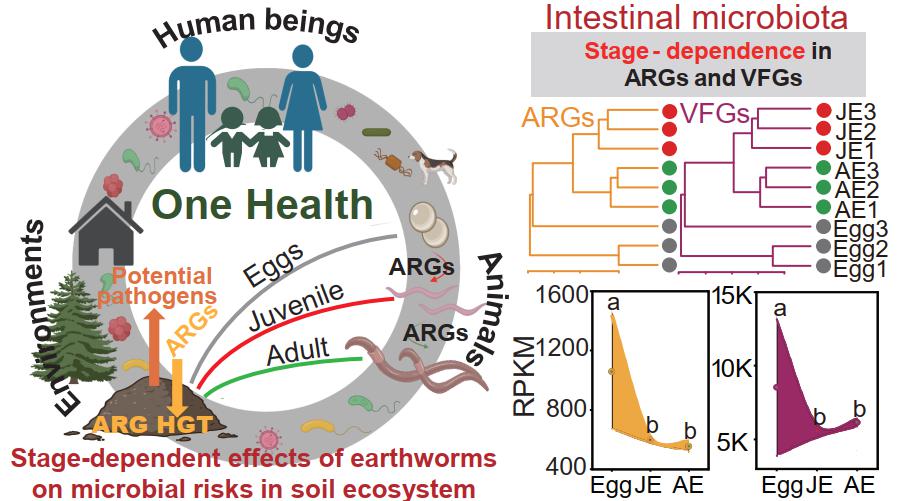
    Under the “One Health” framework, microbial resistance and pathogenicity across environments and animals pose significant health threats and have become a global issue. Although antibiotic resistance genes (ARGs) in earthworm guts and their influence on soil ARGs have been studied, how earthworm life stages affect ARGs and potential pathogens in the gut and soil remains unclear. Here, we assessed intestinal ARGs and virulence factor genes (VFGs) during earthworm development (egg, juvenile, and adult) and their influence on soil ARGs and potential pathogens. Our results showed that ARGs and potential pathogens were widespread and varied within earthworm guts at different growth stages. Earthworm guts harbored significantly (p < 0.05) fewer high-risk ARGs than soil, indicating potential roles of earthworms in soil ARG mitigation. Conversely, potential pathogens were significantly (p < 0.05) higher in guts than in soil. We further found that earthworms across life stages increased soil potential pathogens and reinforced ARG-mobile genetic element (MGE)-pathogen linkages in the soil ecosystem. ARG spread in earthworm guts relied more on vertical transmission than horizontal gene transfer (HGT). These results suggest that earthworms harbor abundant and diverse ARGs and potential pathogens, influencing soil microbiota and resistomes, which reveal earthworm-associated risks to soil ecosystem health.
    Key words:Earthworm; Intestinal microbiota; ARGs; VFGs; Microbial risks.

    Volume:

    Page:

    Journal:Environmental Science and Technology

    https://doi.org/10.1021/acs.est.5c03332

    About Us

    • Brief Introduction
    • Address from the Director
    • Directors
    • Organization
    • IUE in Media

    Scientists

    • Academicians
    • Professors
    • Associate Professors

    Research

    • Research Divisions
    • Research Progress

    Education

    • Admission
    • Study at IUE
    • Scholarships

    INT'L Cooperation

    • INT'L Cooperation News
    • Partnership

    Papers

    Join Us

    • Job Opportunities
    • PIFI
    Copyright © Institute of Urban Environment,Chinese Academy of Sciences. All Rights Reserved.
    1799 Jimei Road, Xiamen 361021 China.+86-592-6190973.