


• Home
  • About Us
    • Brief Introduction
    • Address from the Director
    • Directors
    • Organization
    • IUE in Media
  • Scientists
    • Academicians
    • Professors
    • Associate Professors
  • Research
    • Research Divisions
    • Research Progress
  • Education
    • Admission
    • Study at IUE
    • Scholarships
  • INT'L Cooperation
    • INT'L Cooperation News
    • Partnership
  • Papers
  • Join Us
    • Job Opportunities
    • PIFI
      • What's PIFI
Contact Us   |   Sitemap   |   CAS   |   中文
  • Home
  • About Us
    • Brief Introduction
    • Address from the Director
    • Directors
    • Organization
    • IUE in Media
  • Scientists
    • Academicians
    • Professors
    • Associate Professors
  • Research
    • Research Divisions
    • Research Progress
  • Education
    • Admission
    • Study at IUE
    • Scholarships
  • INT'L Cooperation
    • INT'L Cooperation News
    • Partnership
  • Papers
  • Join Us
    • Job Opportunities
    • PIFI

Papers

  • HomePapers
  • Papers
    Reversibility of Renal Fibrosis Induced by Exposure to Polystyrene Nanoplastics: The Dual Role of Lysosomes
    Yan-Yang Lu,* Wanqing Zhu, Weizhen Hua, Hong-Yun Ren, Meiping Tian, Lianzhong Luo, Yiqin Zhang, Qingyu Huang*

    It has been demonstrated that nanoplastics (NPs) can accumulate in the kidney and induce nephrotoxicity. However, whether NPs induce renal fibrosis remains contentious, and the reversibility of NPs-triggered nephrotoxicity has rarely been reported. This study investigated the role of lysosomes in renal fibrosis induced by low-level polystyrene (PS) NPs with particle sizes of 100 nm and 500 nm (PS100 and PS500) in mice using Masson staining, immunohistochemistry, Western blotting, fluorescence imaging, and other techniques. The results showed that PS100 induced more pronounced renal fibrosis than PS500. Mechanistically, PS NPs promoted autophagosome formation accompanied by the inhibition of autophagic degradation. Moreover, PS NPs impaired lysosomal degradation function, evidenced by reduced CTSB and CTSD protein levels. This impairment blocked autophagic flux, inducing renal fibrosis, which was further confirmed by in vitro results. Notably, lysosomal exocytosis plays a crucial role in the clearance of NPs from mouse kidneys through activating Mcoln1 expression, which contributes to restoring autophagic flux and alleviating renal fibrosis during recovery. Collectively, our findings provide the first evidence that lysosomes serve dual functions in the persistence and reversibility of NPs-induced nephrotoxicity, which could be valuable for the intervention and mitigation of kidney damage resulting from environmental NPs exposure.
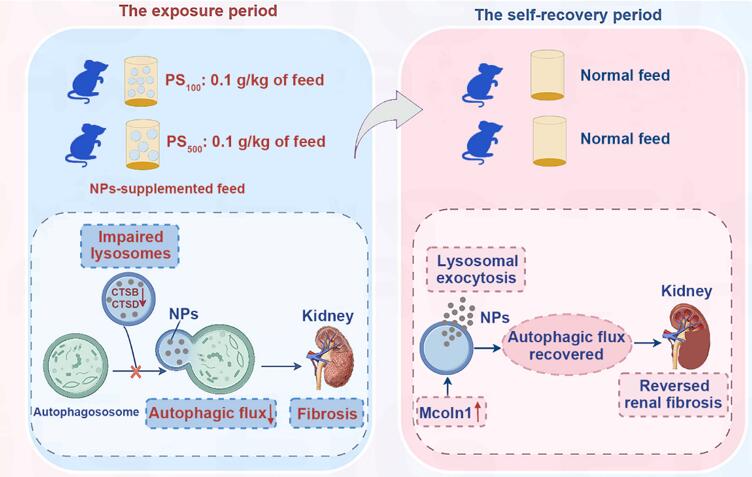


    Key words:nanoplastics, renal fibrosis, autophagic flux, lysosomal exocytosis, reversibility

    Volume:

    Page:

    Journal:Environmental Science & Technology

    https://pubs.acs.org/doi/10.1021/acs.est.5c01582

    About Us

    • Brief Introduction
    • Address from the Director
    • Directors
    • Organization
    • IUE in Media

    Scientists

    • Academicians
    • Professors
    • Associate Professors

    Research

    • Research Divisions
    • Research Progress

    Education

    • Admission
    • Study at IUE
    • Scholarships

    INT'L Cooperation

    • INT'L Cooperation News
    • Partnership

    Papers

    Join Us

    • Job Opportunities
    • PIFI
    Copyright © Institute of Urban Environment,Chinese Academy of Sciences. All Rights Reserved.
    1799 Jimei Road, Xiamen 361021 China.+86-592-6190973.