


• Home
  • About Us
    • Brief Introduction
    • Address from the Director
    • Directors
    • Organization
    • IUE in Media
  • Scientists
    • Academicians
    • Professors
    • Associate Professors
  • Research
    • Research Divisions
    • Research Progress
  • Education
    • Admission
    • Study at IUE
    • Scholarships
  • INT'L Cooperation
    • INT'L Cooperation News
    • Partnership
  • Papers
  • Join Us
    • Job Opportunities
    • PIFI
      • What's PIFI
Contact Us   |   Sitemap   |   CAS   |   中文
  • Home
  • About Us
    • Brief Introduction
    • Address from the Director
    • Directors
    • Organization
    • IUE in Media
  • Scientists
    • Academicians
    • Professors
    • Associate Professors
  • Research
    • Research Divisions
    • Research Progress
  • Education
    • Admission
    • Study at IUE
    • Scholarships
  • INT'L Cooperation
    • INT'L Cooperation News
    • Partnership
  • Papers
  • Join Us
    • Job Opportunities
    • PIFI

Papers

  • HomePapers
  • Papers
    Metabolic mechanism in biosynthesis of polyhydroxyalkanoate from terephthalic acid by mixed microbial consortium
    Lanjia Pan, Wardah Hayat Khan, Jie Li*, Kengo Kubota, Qiang Wang, Yin Wang*

    Biosynthesis of polyhydroxyalkanoates (PHA) from waste plastics offers a sustainable solution to mitigating plastic pollution for circular economy. Terephthalic acid (TPA), derived from polyethylene terephthalate (PET) hydrolysis, shows potential as a carbon source for PHA production. However, the isolation of microbial strains with high efficiency in converting TPA to PHA remain a significant challenge. In this study, a microbial consortium enriched from sludge during the flask experiments was employed for fed-batch fermentation in a 5 L bioreactor to facilitate the conversion of TPA to PHA. The fermentation process achieved a maximum PHA concentration of 2.25 g/L with a yield of 0.10 gPHA/gTPA. The dominant microorganisms and TPA transformation pathways were analyzed by genome annotation and intermediate metabolites identification. The consortium exhibited synergistic interactions, with member species producing specific enzymes that sequentially transformed TPA into protocatechuic acid or catechol, ultimately yielding acetyl-CoA as the PHA biosynthesis precursor. This study establishes a sustainable approach for upcycling waste PET plastics into biodegradable polymers. The revealed metabolic mechanisms provide fundamental insights for future improvement of PHA production.
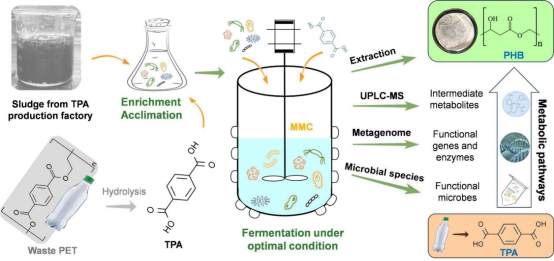
    Key words:Plastic pollution;PET hydrolysate;Biosynthesis;Biodegradable plastics;Metabolic pathway

    Volume:163695

    Page:163695

    Journal:Chemical Engineering Journal

    https://doi.org/10.1016/j.cej.2025.163695

    About Us

    • Brief Introduction
    • Address from the Director
    • Directors
    • Organization
    • IUE in Media

    Scientists

    • Academicians
    • Professors
    • Associate Professors

    Research

    • Research Divisions
    • Research Progress

    Education

    • Admission
    • Study at IUE
    • Scholarships

    INT'L Cooperation

    • INT'L Cooperation News
    • Partnership

    Papers

    Join Us

    • Job Opportunities
    • PIFI
    Copyright © Institute of Urban Environment,Chinese Academy of Sciences. All Rights Reserved.
    1799 Jimei Road, Xiamen 361021 China.+86-592-6190973.