


• Home
  • About Us
    • Brief Introduction
    • Address from the Director
    • Directors
    • Organization
    • IUE in Media
  • Scientists
    • Academicians
    • Professors
    • Associate Professors
  • Research
    • Research Divisions
    • Research Progress
  • Education
    • Admission
    • Study at IUE
    • Scholarships
  • INT'L Cooperation
    • INT'L Cooperation News
    • Partnership
  • Papers
  • Join Us
    • Job Opportunities
    • PIFI
      • What's PIFI
Contact Us   |   Sitemap   |   CAS   |   中文
  • Home
  • About Us
    • Brief Introduction
    • Address from the Director
    • Directors
    • Organization
    • IUE in Media
  • Scientists
    • Academicians
    • Professors
    • Associate Professors
  • Research
    • Research Divisions
    • Research Progress
  • Education
    • Admission
    • Study at IUE
    • Scholarships
  • INT'L Cooperation
    • INT'L Cooperation News
    • Partnership
  • Papers
  • Join Us
    • Job Opportunities
    • PIFI

Papers

  • HomePapers
  • Papers
    HOCl Formation Driven by Photochemical Processes Enhanced Atmospheric Oxidation Capacity in a Coastal Atmosphere
    Gaojie Chen;Xiaolong Fan*;Shaocai Yu*;Yee Jun Tham;Ziyi Lin;Xiaoting Ji;Lingling Xu;Jinsheng Chen*

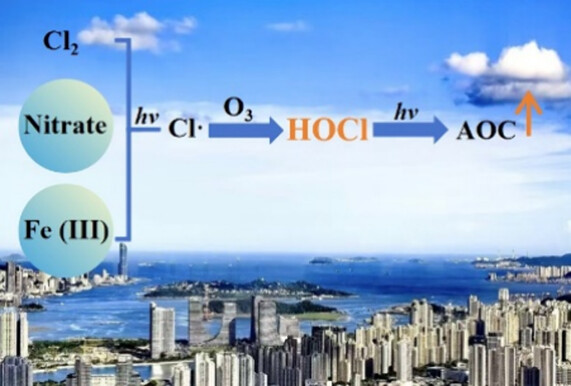
    Chlorine (Cl) radicals can profoundly affect the atmospheric oxidation capacity and the fates of pollutants. Hypochlorous acid (HOCl) is a potentially crucial Cl precursor, yet the understanding of its formation mechanisms and atmospheric impacts is still limited. Here, we observed high concentrations of HOCl in a coastal city of Southeast China during the autumn of 2022, with an average daytime peak of 181 ppt. Machine learning analysis identified Cl2, O3, nitrate, temperature, and iron as the primary factors affecting HOCl distribution. Beyond Cl2 photolysis, both nitrate photolysis and aerosol iron photochemistry also contributed to Cl radical production, which drove daytime HOCl production through reactions involving ClO and HO2 radicals in the presence of O3. Both OH and Cl radicals released via HOCl photolysis increased the levels of ROx radicals by ∼10%, thereby enhancing the daytime O3 generation and atmospheric oxidation capacity. Our findings emphasize the significant role of HOCl in atmospheric chemistry and suggest that controlling O3 levels could alleviate Cl radical production and its adverse impacts on air quality.


    Key words:Hypochlorous Acid;Production Mechanisms;Molecular Chlorine;Ozone;Coastal Atmosphere

    Volume:

    Page:

    Journal:Environmental Science & Technology

    https://pubs.acs.org/doi/10.1021/acs.est.5c01363

    About Us

    • Brief Introduction
    • Address from the Director
    • Directors
    • Organization
    • IUE in Media

    Scientists

    • Academicians
    • Professors
    • Associate Professors

    Research

    • Research Divisions
    • Research Progress

    Education

    • Admission
    • Study at IUE
    • Scholarships

    INT'L Cooperation

    • INT'L Cooperation News
    • Partnership

    Papers

    Join Us

    • Job Opportunities
    • PIFI
    Copyright © Institute of Urban Environment,Chinese Academy of Sciences. All Rights Reserved.
    1799 Jimei Road, Xiamen 361021 China.+86-592-6190973.