


• Home
  • About Us
    • Brief Introduction
    • Address from the Director
    • Directors
    • Organization
    • IUE in Media
  • Scientists
    • Academicians
    • Professors
    • Associate Professors
  • Research
    • Research Divisions
    • Research Progress
  • Education
    • Admission
    • Study at IUE
    • Scholarships
  • INT'L Cooperation
    • INT'L Cooperation News
    • Partnership
  • Papers
  • Join Us
    • Job Opportunities
    • PIFI
      • What's PIFI
Contact Us   |   Sitemap   |   CAS   |   中文
  • Home
  • About Us
    • Brief Introduction
    • Address from the Director
    • Directors
    • Organization
    • IUE in Media
  • Scientists
    • Academicians
    • Professors
    • Associate Professors
  • Research
    • Research Divisions
    • Research Progress
  • Education
    • Admission
    • Study at IUE
    • Scholarships
  • INT'L Cooperation
    • INT'L Cooperation News
    • Partnership
  • Papers
  • Join Us
    • Job Opportunities
    • PIFI

Papers

  • HomePapers
  • Papers
    The disparities and development trajectories of nations in achieving the sustainable development goals
    Fengmei Ma, Heming Wang*,Asaf Tzachor* ,César A. Hidalgo, Heinz Schandl, Yue Zhang, jinglingZhang, Wei-Qiang Chen*,Yanzhi Zhao, Yong-Guan Zhu & Bojie Fu

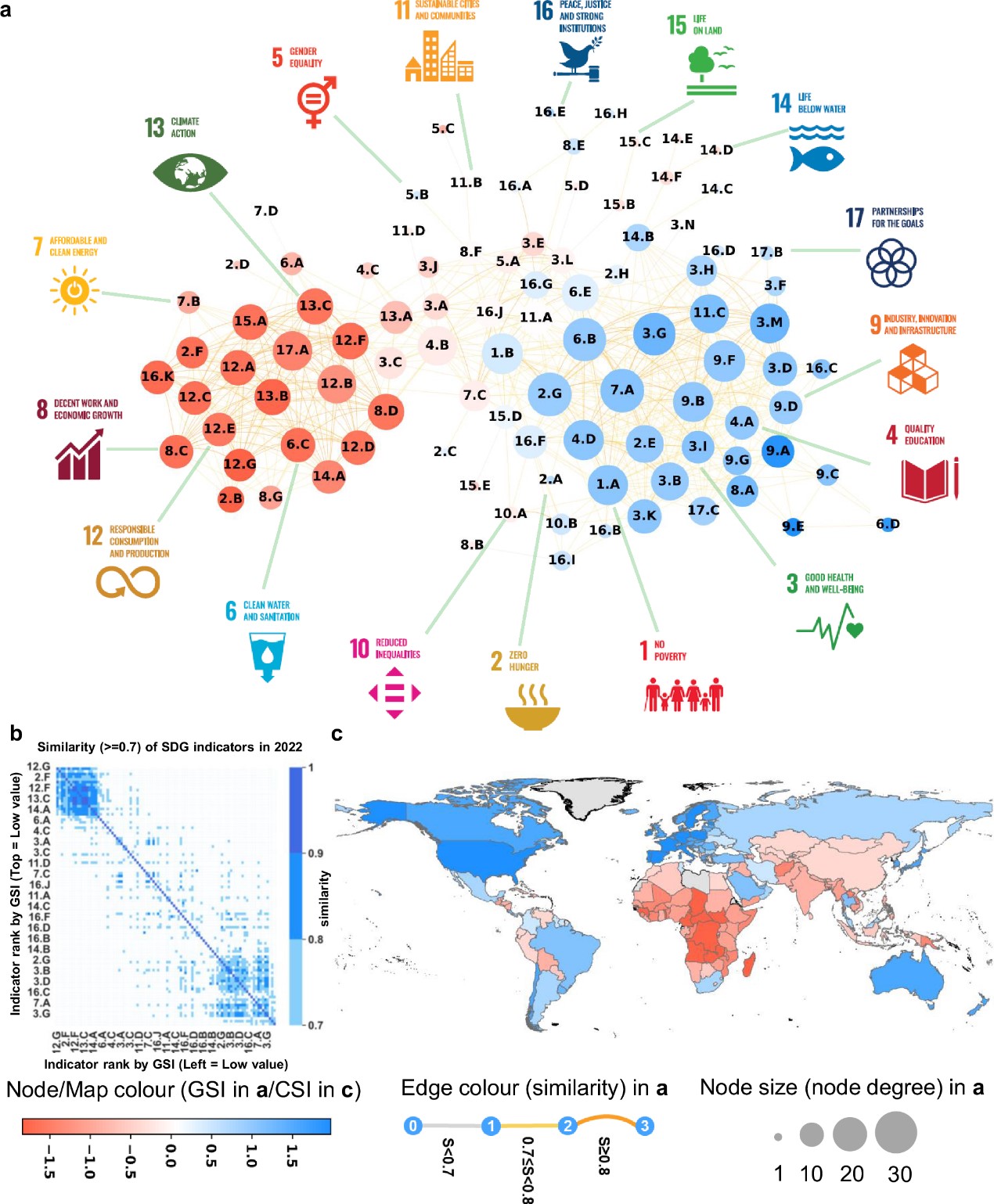
    The  Sustainable Development Goals (SDGs) provide a comprehensive framework  for societal progress and planetary health. However, it remains unclear  whether universal patterns exist in how nations pursue these goals and  whether key development areas are being overlooked. Here, we apply the  product space methodology, widely used in development economics, to  construct an ‘SDG space of nations’. The SDG space models the relative  performance and specialization patterns of 166 countries across 96 SDG  indicators from 2000 to 2022. Our SDG space reveals a polarized global  landscape, characterized by distinct groups of nations, each  specializing in specific development indicators. Furthermore, we find  that as countries improve their overall SDG scores, they tend to modify  their sustainable development trajectories, pursuing different  development objectives. Additionally, we identify orphaned SDG  indicators — areas where certain country groups remain  under-specialized. These patterns, and the SDG space more broadly,  provide a high-resolution tool to understand and evaluate the progress  and disparities of countries towards achieving the SDGs. 
     

    Key words:

    Volume:1107

    Page:

    Journal:Nature Communications

    https://www.nature.com/articles/s41467-025-56076-6

    About Us

    • Brief Introduction
    • Address from the Director
    • Directors
    • Organization
    • IUE in Media

    Scientists

    • Academicians
    • Professors
    • Associate Professors

    Research

    • Research Divisions
    • Research Progress

    Education

    • Admission
    • Study at IUE
    • Scholarships

    INT'L Cooperation

    • INT'L Cooperation News
    • Partnership

    Papers

    Join Us

    • Job Opportunities
    • PIFI
    Copyright © Institute of Urban Environment,Chinese Academy of Sciences. All Rights Reserved.
    1799 Jimei Road, Xiamen 361021 China.+86-592-6190973.