


• Home
  • About Us
    • Brief Introduction
    • Address from the Director
    • Directors
    • Organization
    • IUE in Media
  • Scientists
    • Academicians
    • Professors
    • Associate Professors
  • Research
    • Research Divisions
    • Research Progress
  • Education
    • Admission
    • Study at IUE
    • Scholarships
  • INT'L Cooperation
    • INT'L Cooperation News
    • Partnership
  • Papers
  • Join Us
    • Job Opportunities
    • PIFI
      • What's PIFI
Contact Us   |   Sitemap   |   CAS   |   中文
  • Home
  • About Us
    • Brief Introduction
    • Address from the Director
    • Directors
    • Organization
    • IUE in Media
  • Scientists
    • Academicians
    • Professors
    • Associate Professors
  • Research
    • Research Divisions
    • Research Progress
  • Education
    • Admission
    • Study at IUE
    • Scholarships
  • INT'L Cooperation
    • INT'L Cooperation News
    • Partnership
  • Papers
  • Join Us
    • Job Opportunities
    • PIFI

Papers

  • HomePapers
  • Papers
    Data-Driven Insights into the Contamination of Polycyclic Aromatic Hydrocarbons in Marine Bays
    Dong Liu;Yan Luo;Wei-Hong Bao;Muhammad Junaid;Zhao-Feng Guo;Yao-Yang Xu*

    The synthesis of polycyclic aromatic hydrocarbon (PAH) data allows us to quantify and gain insights into the spatiotemporal dynamics of PAH contamination in marine bays. Here, a data synthesis framework was developed to understand data-driven insights into the spatiotemporal levels, compositional profiles, and potential sources of PAHs in water and sediment of marine bays. PAHs were detected in 69 bays worldwide, with contamination hotspots located in Asian bays. PAH concentrations in pre-2000 were significantly lower than those in the 2000s and post-2010, while the dominant species in water and sediment were 2–3 ring and 4–6 ring PAHs, respectively. The composition patterns of PAHs included 2–3 ring, 3–5 ring, and 4–5 ring dominant categories, but no significant distance decay relationship was found in the composition similarity due to international energy trade. Temporal dynamic patterns of concentrations included Descending-, Ascending-, and Inverted V-type, whereas over longer time spans, the pattern is more similar to the Inverted V-type owing to the reductions in emission intensity. PAHs were derived from both petrogenic and pyrolytic sources, with combustion from both coal and petroleum being the dominant source. These data-driven discoveries provide quantitative insights into the spatiotemporal patterns in the concentration and composition of PAHs, contributing to the mitigation of PAH contamination.
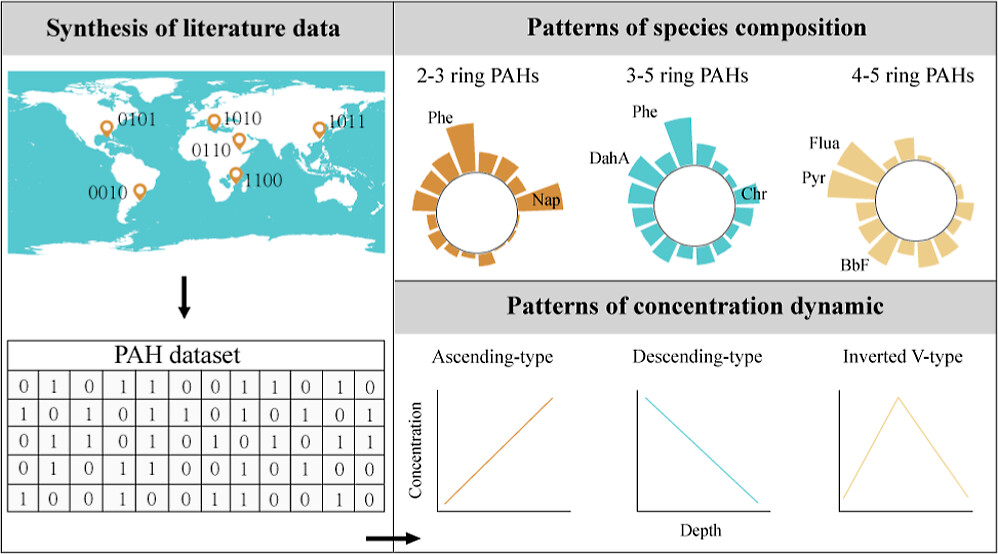
     

    Key words:Concentration Variation;Composition Profile;Potential Source;Vertical Dynamic;Data Synthesis

    Volume:58

    Page:

    Journal:Environmental Science & Technology

    https://pubs.acs.org/doi/10.1021/acs.est.4c04099

    About Us

    • Brief Introduction
    • Address from the Director
    • Directors
    • Organization
    • IUE in Media

    Scientists

    • Academicians
    • Professors
    • Associate Professors

    Research

    • Research Divisions
    • Research Progress

    Education

    • Admission
    • Study at IUE
    • Scholarships

    INT'L Cooperation

    • INT'L Cooperation News
    • Partnership

    Papers

    Join Us

    • Job Opportunities
    • PIFI
    Copyright © Institute of Urban Environment,Chinese Academy of Sciences. All Rights Reserved.
    1799 Jimei Road, Xiamen 361021 China.+86-592-6190973.