


• Home
  • About Us
    • Brief Introduction
    • Address from the Director
    • Directors
    • Organization
    • IUE in Media
  • Scientists
    • Academicians
    • Professors
    • Associate Professors
  • Research
    • Research Divisions
    • Research Progress
  • Education
    • Admission
    • Study at IUE
    • Scholarships
  • INT'L Cooperation
    • INT'L Cooperation News
    • Partnership
  • Papers
  • Join Us
    • Job Opportunities
    • PIFI
      • What's PIFI
Contact Us   |   Sitemap   |   CAS   |   中文
  • Home
  • About Us
    • Brief Introduction
    • Address from the Director
    • Directors
    • Organization
    • IUE in Media
  • Scientists
    • Academicians
    • Professors
    • Associate Professors
  • Research
    • Research Divisions
    • Research Progress
  • Education
    • Admission
    • Study at IUE
    • Scholarships
  • INT'L Cooperation
    • INT'L Cooperation News
    • Partnership
  • Papers
  • Join Us
    • Job Opportunities
    • PIFI

Papers

  • HomePapers
  • Papers
    Evolutionary diversification and succession of soil huge phages in glacier foreland
    Hu Liao, Jian Li, Yan-Zi Wang, Hu Li, Xin-Li An, Tao Wang, Rui-Ying Chang, Yong-Guan Zhu & Jian-Qiang Su*

    Background

    Huge phages (genome size ≥ 200 kb) have been detected in diverse habitats worldwide, infecting a variety of prokaryotes. However, their evolution and adaptation strategy in soils remain poorly understood due to the scarcity of soil-derived genomes.

    Results

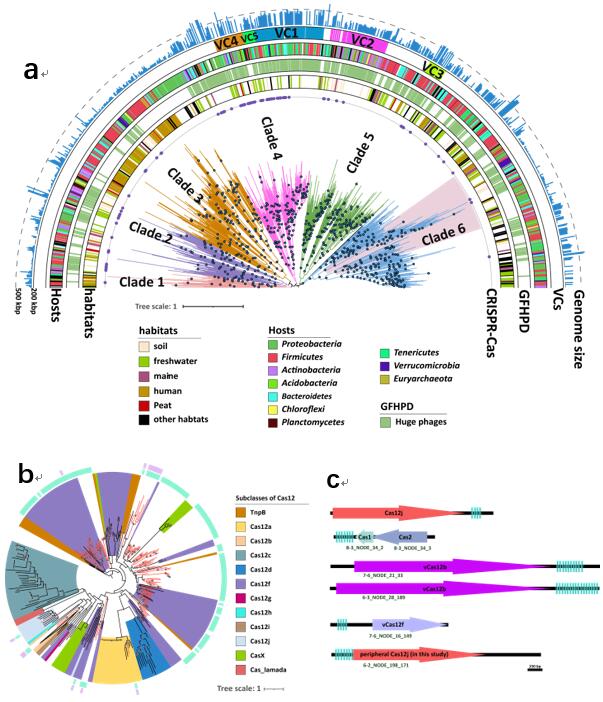
    Here, we conduct a size-fractioned (< 0.22 μm) metagenomic analysis across a 130-year chronosequence of a glacier foreland in the Tibetan Plateau and discovered 412 novel viral operational taxonomic units (vOTUs) of huge phages. The phylogenomic and gene-shared network analysis gained insights into their unique evolutionary history compared with smaller phages. Their communities in glacier foreland revealed a distinct pattern between the early (≤ 41 years) and late stages (> 41 years) based on the macrodiveristy (interspecies diversity) analysis. A significant increase in the diversity of huge phages communities following glacier retreat were observed according to current database. The phages distributed across sites within late stage demonstrated a remarkable higher microdiversity (intraspecies diversity) compared to other geographic range such as the intra early stage, suggesting that glacial retreat is key drivers of the huge phage speciation. Alongside the shift in huge phage communities, we also noted an evolutionary and functional transition between the early and late stages. The identification of abundant CRISPR-Cas12 and type IV restriction-modification (RM) systems in huge phages indicates their complex mechanisms for adaptive immunity.

    Conclusions

    Overall, this study unravels the importance of climate change in shaping the composition, evolution, and function of soil huge phage communities, and such further understanding of soil huge phages is vital for broader inclusion in soil ecosystem models.


    Key words:

    Volume:13

    Page:

    Journal:Microbiome

    https://microbiomejournal.biomedcentral.com/articles/10.1186/s40168-024-02017-2

    About Us

    • Brief Introduction
    • Address from the Director
    • Directors
    • Organization
    • IUE in Media

    Scientists

    • Academicians
    • Professors
    • Associate Professors

    Research

    • Research Divisions
    • Research Progress

    Education

    • Admission
    • Study at IUE
    • Scholarships

    INT'L Cooperation

    • INT'L Cooperation News
    • Partnership

    Papers

    Join Us

    • Job Opportunities
    • PIFI
    Copyright © Institute of Urban Environment,Chinese Academy of Sciences. All Rights Reserved.
    1799 Jimei Road, Xiamen 361021 China.+86-592-6190973.