


• Home
  • About Us
    • Brief Introduction
    • Address from the Director
    • Directors
    • Organization
    • IUE in Media
  • Scientists
    • Academicians
    • Professors
    • Associate Professors
  • Research
    • Research Divisions
    • Research Progress
  • Education
    • Admission
    • Study at IUE
    • Scholarships
  • INT'L Cooperation
    • INT'L Cooperation News
    • Partnership
  • Papers
  • Join Us
    • Job Opportunities
    • PIFI
      • What's PIFI
Contact Us   |   Sitemap   |   CAS   |   中文
  • Home
  • About Us
    • Brief Introduction
    • Address from the Director
    • Directors
    • Organization
    • IUE in Media
  • Scientists
    • Academicians
    • Professors
    • Associate Professors
  • Research
    • Research Divisions
    • Research Progress
  • Education
    • Admission
    • Study at IUE
    • Scholarships
  • INT'L Cooperation
    • INT'L Cooperation News
    • Partnership
  • Papers
  • Join Us
    • Job Opportunities
    • PIFI

Papers

  • HomePapers
  • Papers
    Arsenic Exposure Triggers Nonalcoholic Fatty Liver Disease through Repressing S-Adenosylmethionine-Dependent Histone Methylation in Rats
    Lu Lu;Weizhen Hua;Fuping Li;Zhenbin Che;Meiping Tian;Yan-Yang Lu*;Qiaoqiao Chi;Jie Zhang;Qingyu Huang*

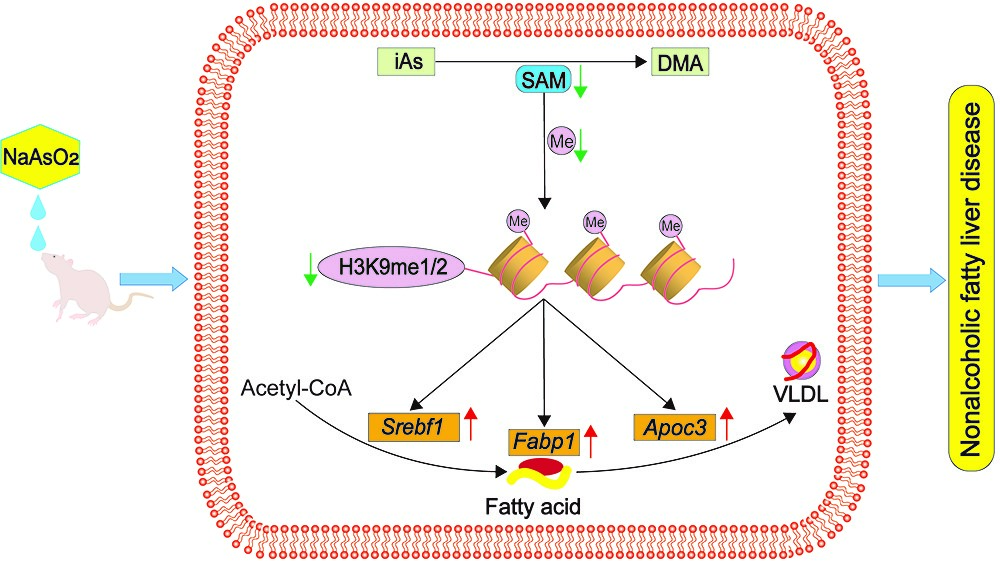
    Arsenic (As) is a toxic metalloid widespread in the environment, and its exposure has been associated with a variety of adverse health outcomes. As exposure is demonstrated to cause nonalcoholic fatty liver disease (NAFLD), and the underlying epigenetic mechanisms remain largely unknown. This study aimed to investigate the roles of histone modifications in low-level As exposure-induced NAFLD in rats. The results showed that exposure to As caused lipid accumulation and upregulated the expression of lipid metabolism-related genes Fabp1, Srebf1, and Apoc3, while downregulated Acox1 and Cpt1a in rat liver. In addition, it was found that inorganic arsenite (iAsIII) was methylated to DMA, and the S-adenosylmethionine (SAM) level was decreased, which would contribute to the repression of H3K9me1/2 in rat liver after exposure. The in vitro studies revealed that SAM supplementation attenuated lipid accumulation by restoring H3K9me1/2 in HepG2 cells, which further confirmed our animal results. Therefore, it is suggested that As methylation depleted SAM, which inhibited H3K9me1/2 and activated Fabp1, Srebf1, and Apoc3 expressions, leading to NAFLD upon inorganic As exposure. Overall, these data shed new light on the role of SAM-mediated histone methylation in As-triggered NAFLD, which could be useful for the prevention and intervention of hepatotoxicity induced by environmental As exposure.
     

    Key words:Arsenic Exposure;NAFLD;Histone Modification;Arsenic Methylation;S-Adenosylmethionine

    Volume:

    Page:

    Journal:Environmental Science & Technology

    https://pubs.acs.org/doi/10.1021/acs.est.4c10417

    About Us

    • Brief Introduction
    • Address from the Director
    • Directors
    • Organization
    • IUE in Media

    Scientists

    • Academicians
    • Professors
    • Associate Professors

    Research

    • Research Divisions
    • Research Progress

    Education

    • Admission
    • Study at IUE
    • Scholarships

    INT'L Cooperation

    • INT'L Cooperation News
    • Partnership

    Papers

    Join Us

    • Job Opportunities
    • PIFI
    Copyright © Institute of Urban Environment,Chinese Academy of Sciences. All Rights Reserved.
    1799 Jimei Road, Xiamen 361021 China.+86-592-6190973.