


• Home
  • About Us
    • Brief Introduction
    • Address from the Director
    • Directors
    • Organization
    • IUE in Media
  • Scientists
    • Academicians
    • Professors
    • Associate Professors
  • Research
    • Research Divisions
    • Research Progress
  • Education
    • Admission
    • Study at IUE
    • Scholarships
  • INT'L Cooperation
    • INT'L Cooperation News
    • Partnership
  • Papers
  • Join Us
    • Job Opportunities
    • PIFI
      • What's PIFI
Contact Us   |   Sitemap   |   CAS   |   中文
  • Home
  • About Us
    • Brief Introduction
    • Address from the Director
    • Directors
    • Organization
    • IUE in Media
  • Scientists
    • Academicians
    • Professors
    • Associate Professors
  • Research
    • Research Divisions
    • Research Progress
  • Education
    • Admission
    • Study at IUE
    • Scholarships
  • INT'L Cooperation
    • INT'L Cooperation News
    • Partnership
  • Papers
  • Join Us
    • Job Opportunities
    • PIFI

Papers

  • HomePapers
  • Papers
    Open-set deep learning–enabled single-cell Raman spectroscopy for rapid identification of airborne pathogens in real-world environments
    Longji Zhu Yunan Yang, Fei Xu, Xinyu Lu, Mingrui Shuai, Zhulin An, Xiaomeng Chen, Hu Li, Francis L. Martin, Peter J. Vikesland , Bin Ren ,Zhong-Qun Tian, Yong-Guan Zhu* , and Li Cui*

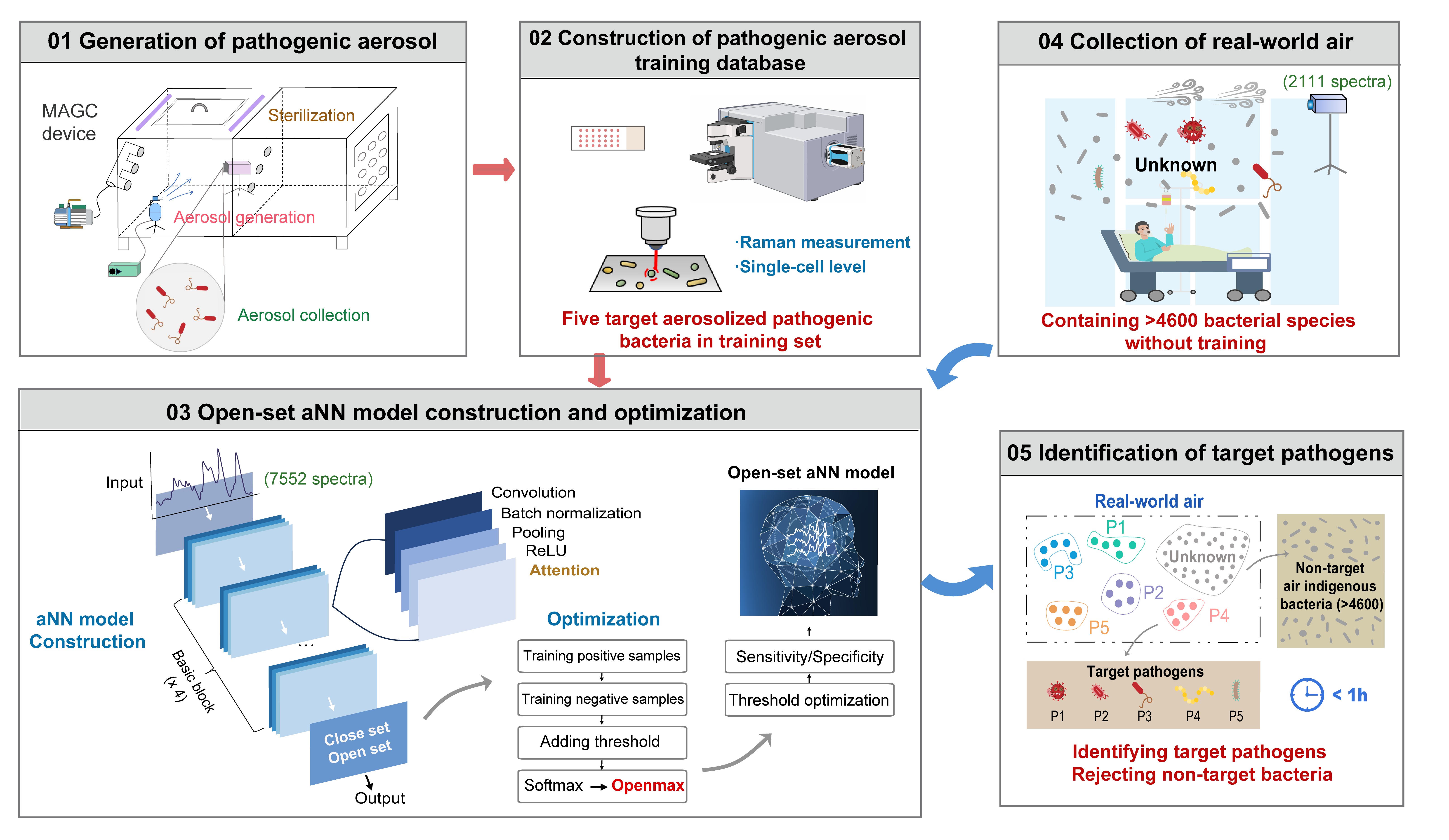
    Pathogenic bioaerosols are critical for outbreaks of airborne disease; however, rapidly and accurately identifying pathogens directly from complex air environments remains highly challenging. We present an advanced method that combines open-set deep learning (OSDL) with single-cell Raman spectroscopy to identify pathogens in real-world air containing diverse unknown indigenous bacteria that cannot be fully included in training sets. To test and further enhance identification, we constructed the Raman datasets of aerosolized bacteria. Through optimizing OSDL algorithms and training strategies, Raman-OSDL achieves 93% accuracy for five target airborne pathogens, 84% accuracy for untrained air bacteria, and 36% reduction in false positive rates compared to conventional close-set algorithms. It offers a high detection sensitivity down to 1:1000. When applied to real air containing >4600 bacterial species, our method accurately identifies single or multiple pathogens simultaneously within an hour. This single-cell tool advances rapidly surveilling pathogens in complex environments to prevent infection transmission.
     

    Key words:

    Volume:11

    Page:

    Journal:Science Advances

    https://www.science.org/doi/10.1126/sciadv.adp7991

    About Us

    • Brief Introduction
    • Address from the Director
    • Directors
    • Organization
    • IUE in Media

    Scientists

    • Academicians
    • Professors
    • Associate Professors

    Research

    • Research Divisions
    • Research Progress

    Education

    • Admission
    • Study at IUE
    • Scholarships

    INT'L Cooperation

    • INT'L Cooperation News
    • Partnership

    Papers

    Join Us

    • Job Opportunities
    • PIFI
    Copyright © Institute of Urban Environment,Chinese Academy of Sciences. All Rights Reserved.
    1799 Jimei Road, Xiamen 361021 China.+86-592-6190973.