


• Home
  • About Us
    • Brief Introduction
    • Address from the Director
    • Directors
    • Organization
    • IUE in Media
  • Scientists
    • Academicians
    • Professors
    • Associate Professors
  • Research
    • Research Divisions
    • Research Progress
  • Education
    • Admission
    • Study at IUE
    • Scholarships
  • INT'L Cooperation
    • INT'L Cooperation News
    • Partnership
  • Papers
  • Join Us
    • Job Opportunities
    • PIFI
      • What's PIFI
Contact Us   |   Sitemap   |   CAS   |   中文
  • Home
  • About Us
    • Brief Introduction
    • Address from the Director
    • Directors
    • Organization
    • IUE in Media
  • Scientists
    • Academicians
    • Professors
    • Associate Professors
  • Research
    • Research Divisions
    • Research Progress
  • Education
    • Admission
    • Study at IUE
    • Scholarships
  • INT'L Cooperation
    • INT'L Cooperation News
    • Partnership
  • Papers
  • Join Us
    • Job Opportunities
    • PIFI

Papers

  • HomePapers
  • Papers
    Soil Plastisphere Reinforces the Adverse Effect of Combined Pollutant Exposure on the Microfood Web
    Bang Ni;Da Lin;Tiangui Cai;Shuai Du;Dong Zhu*

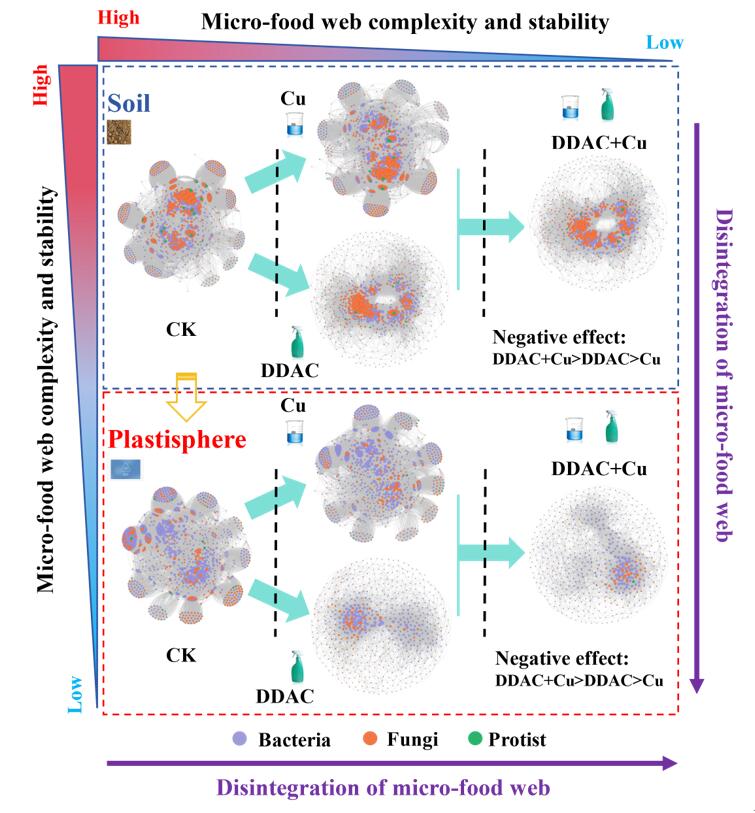
    Microbial interactions form  microfood webs, crucial for ecological functions. The steady state of  these webs, shaped by cooperation and competition among trophic levels,  prevents pathogen proliferation and invasion, maintaining soil health.  Combined pollutants pose a widespread environmental issue, exerting  significant pressure on microfood webs. However, understanding how these  webs respond to combined pollutants in soil plastispheres, an emerging  niche, remains limited. This study explores trophic interactions among  bacteria, fungi, and protists, examining their effects on potential  pathogens in three soil types amended with Cu or disinfectant, along  with their plastispheres, using a microcosm experiment. Pollutant  exposure disrupts trophic-level interactions through bottom-up and  top-down regulation in soils and plastispheres, respectively. Microfood  web network topology parameters prove more sensitive to pollutant stress  than indicators from a single trophic-level community composition.  Combined exposure causes greater disruption to the microfood web than  exposure to a single pollutant (Cu or didecyl dimethylammonium chloride  (DDAC)). Plastisphere reinforces negative impacts of combined pollutant  exposure on the microfood web network, escalating potential pathogenic  bacteria. Overall, this study deepens our understanding of microfood web  responses under pollutant pressure in soil plastispheres and provides  valuable insights for health risk assessments of soil combined  pollutants.
     

    Key words:combined pollution; health risk; microbial interactions; network analysis; pathogens; plastisphere; soil microfood web

    Volume:

    Page:

    Journal:Environmental Science & Technology

    About Us

    • Brief Introduction
    • Address from the Director
    • Directors
    • Organization
    • IUE in Media

    Scientists

    • Academicians
    • Professors
    • Associate Professors

    Research

    • Research Divisions
    • Research Progress

    Education

    • Admission
    • Study at IUE
    • Scholarships

    INT'L Cooperation

    • INT'L Cooperation News
    • Partnership

    Papers

    Join Us

    • Job Opportunities
    • PIFI
    Copyright © Institute of Urban Environment,Chinese Academy of Sciences. All Rights Reserved.
    1799 Jimei Road, Xiamen 361021 China.+86-592-6190973.