


• Home
  • About Us
    • Brief Introduction
    • Address from the Director
    • Directors
    • Organization
    • IUE in Media
  • Scientists
    • Academicians
    • Professors
    • Associate Professors
  • Research
    • Research Divisions
    • Research Progress
  • Education
    • Admission
    • Study at IUE
    • Scholarships
  • INT'L Cooperation
    • INT'L Cooperation News
    • Partnership
  • Papers
  • Join Us
    • Job Opportunities
    • PIFI
      • What's PIFI
Contact Us   |   Sitemap   |   CAS   |   中文
  • Home
  • About Us
    • Brief Introduction
    • Address from the Director
    • Directors
    • Organization
    • IUE in Media
  • Scientists
    • Academicians
    • Professors
    • Associate Professors
  • Research
    • Research Divisions
    • Research Progress
  • Education
    • Admission
    • Study at IUE
    • Scholarships
  • INT'L Cooperation
    • INT'L Cooperation News
    • Partnership
  • Papers
  • Join Us
    • Job Opportunities
    • PIFI

Papers

  • HomePapers
  • Papers
    Soil viral–host interactions regulate microplastic-dependent carbon storage
    Lu Wang 23, Da Lin, Ke-Qing Xiao, and Yong-Guan Zhu*

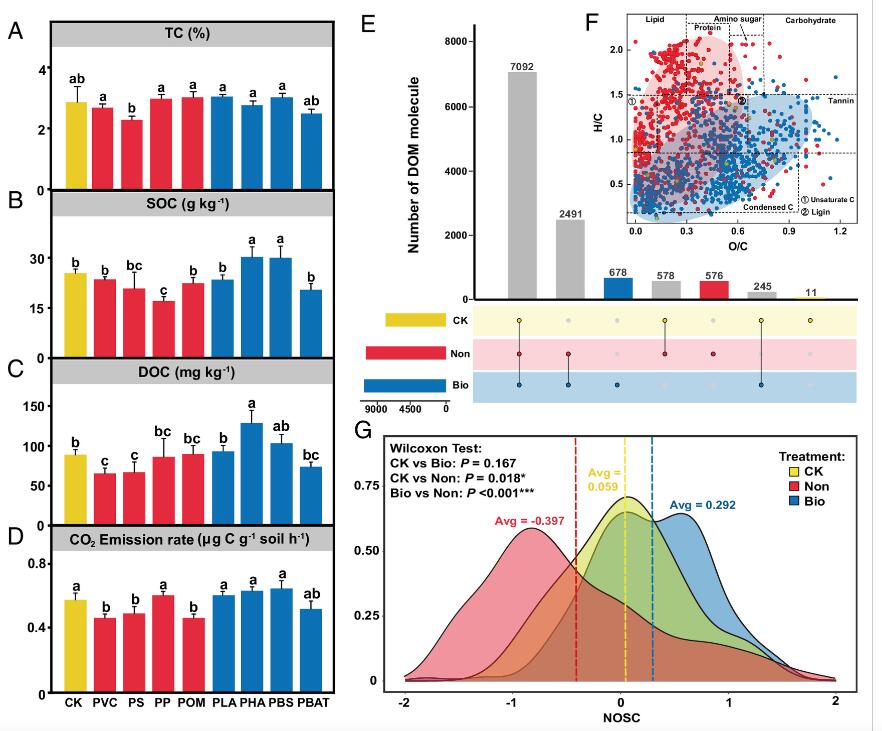
    Microplastic is globally regarded as an important factor impacting biogeochemical cycles, yet our understanding of such influences is limited by the uncertainties of intricate microbial processes. By multiomics analysis, coupled with soil chemodiversity characterization and microbial carbon use efficiency (CUE), we investigated how microbial responses to microplastics impacted soil carbon cycling in a long-term field experiment. We showed that biodegradable microplastics promoted soil organic carbon accrual by an average of 2.47%, while nondegradable microplastics inhibited it by 17.4%, as a consequence of the virus–bacteria coadaptations to the microplastics disturbance. In the relevant functional pathways, nondegradable microplastics significantly (P < 0.05) enhanced the abundance and transcriptional activity related to complex carbohydrate metabolism, whereas biodegradable microplastics significantly (P < 0.05) promoted functions involved in amino acid metabolism and glycolysis. Accordingly, viral lysis enhanced in nondegradable microplastics treatments to introduce more complex organic compounds to soil dissolved organic matters, thus benefiting the oligotrophs with high carbon metabolic capabilities in exploitation competition. In contrast, biodegradable microplastics enriched viral auxiliary metabolic genes of carbon metabolism through “piggyback-the-winner” strategy, conferring to dominant copiotrophs, enhanced substrate utilization capabilities. These virus–host interactions were also demonstrated in the corresponding soil plastisphere, which would alter microbial resource allocation and metabolism via CUE, affecting carbon storage consequently. Overall, our results underscore the importance of viral–host interactions in understanding the microplastics-dependent carbon storage in the soil ecosystem.
    Key words:

    Volume:121 (45)

    Page:e2413245121

    Journal:PNAS

    https://www.pnas.org/doi/10.1073/pnas.2413245121

    About Us

    • Brief Introduction
    • Address from the Director
    • Directors
    • Organization
    • IUE in Media

    Scientists

    • Academicians
    • Professors
    • Associate Professors

    Research

    • Research Divisions
    • Research Progress

    Education

    • Admission
    • Study at IUE
    • Scholarships

    INT'L Cooperation

    • INT'L Cooperation News
    • Partnership

    Papers

    Join Us

    • Job Opportunities
    • PIFI
    Copyright © Institute of Urban Environment,Chinese Academy of Sciences. All Rights Reserved.
    1799 Jimei Road, Xiamen 361021 China.+86-592-6190973.