


• Home
  • About Us
    • Brief Introduction
    • Address from the Director
    • Directors
    • Organization
    • IUE in Media
  • Scientists
    • Academicians
    • Professors
    • Associate Professors
  • Research
    • Research Divisions
    • Research Progress
  • Education
    • Admission
    • Study at IUE
    • Scholarships
  • INT'L Cooperation
    • INT'L Cooperation News
    • Partnership
  • Papers
  • Join Us
    • Job Opportunities
    • PIFI
      • What's PIFI
Contact Us   |   Sitemap   |   CAS   |   中文
  • Home
  • About Us
    • Brief Introduction
    • Address from the Director
    • Directors
    • Organization
    • IUE in Media
  • Scientists
    • Academicians
    • Professors
    • Associate Professors
  • Research
    • Research Divisions
    • Research Progress
  • Education
    • Admission
    • Study at IUE
    • Scholarships
  • INT'L Cooperation
    • INT'L Cooperation News
    • Partnership
  • Papers
  • Join Us
    • Job Opportunities
    • PIFI

Papers

  • HomePapers
  • Papers
    E-waste challenges of generative artificial intelligence
    Peng Wang*, Ling-Yu Zhang, Asaf Tzachor* & Wei-Qiang Chen*

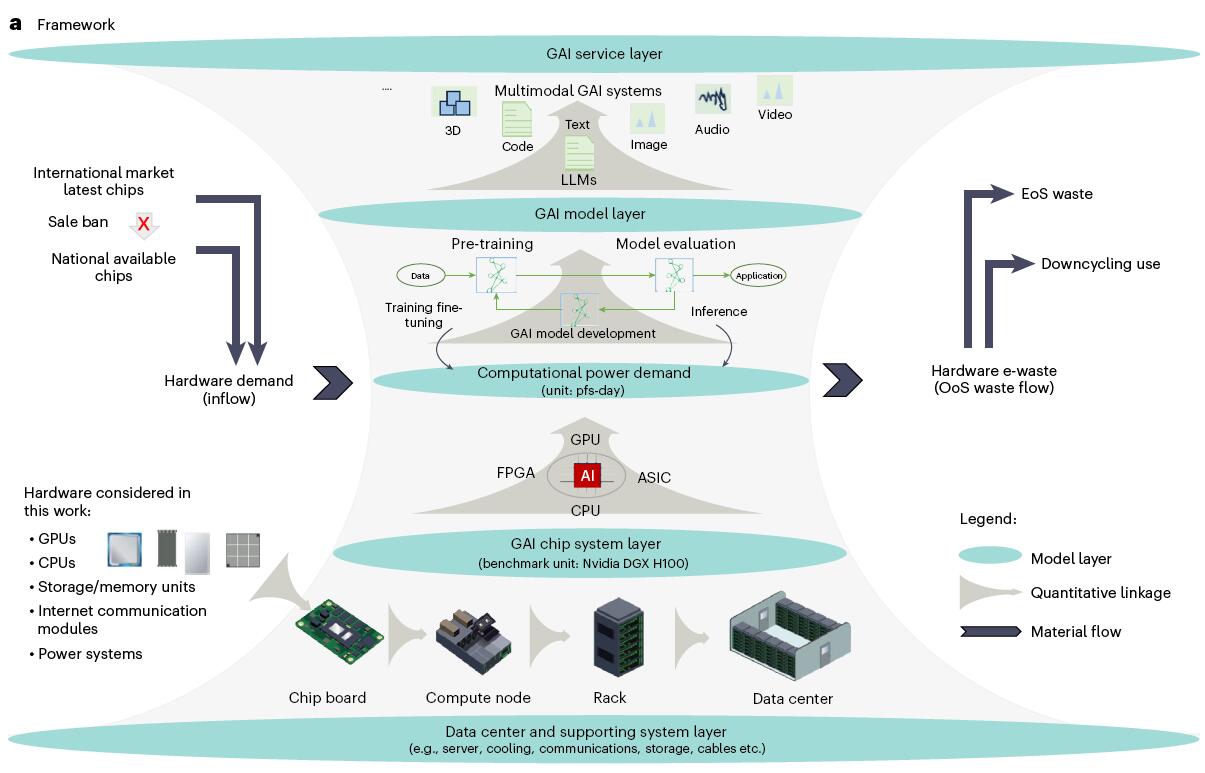
    Generative artificial intelligence (GAI) requires substantial computational resources for model training and inference, but the electronic-waste (e-waste) implications of GAI and its management strategies remain underexplored. Here we introduce a computational power-driven material flow analysis framework to quantify and explore ways of managing the e-waste generated by GAI, with a particular focus on large language models. Our findings indicate that this e-waste stream could increase, potentially reaching a total accumulation of 1.2–5.0 million tons during 2020–2030, under different future GAI development settings. This may be intensified in the context of geopolitical restrictions on semiconductor imports and the rapid server turnover for operational cost savings. Meanwhile, we show that the implementation of circular economy strategies along the GAI value chain could reduce e-waste generation by 16–86%. This underscores the importance of proactive e-waste management in the face of advancing GAI technologies.
     

    Key words:

    Volume:

    Page:

    Journal:Nature Computational Science

    https://www.nature.com/articles/s43588-024-00712-6

    About Us

    • Brief Introduction
    • Address from the Director
    • Directors
    • Organization
    • IUE in Media

    Scientists

    • Academicians
    • Professors
    • Associate Professors

    Research

    • Research Divisions
    • Research Progress

    Education

    • Admission
    • Study at IUE
    • Scholarships

    INT'L Cooperation

    • INT'L Cooperation News
    • Partnership

    Papers

    Join Us

    • Job Opportunities
    • PIFI
    Copyright © Institute of Urban Environment,Chinese Academy of Sciences. All Rights Reserved.
    1799 Jimei Road, Xiamen 361021 China.+86-592-6190973.