Insights into the migration mechanism of extracellular antibiotic resistance genes during struvite recovery using synthetic wastewater
Wenqian Liao , Xuewei Huang , Zhi-Long Ye* , Tianyi Zhang , Jiasheng Cai , Yahui Huang , Yanlin Li
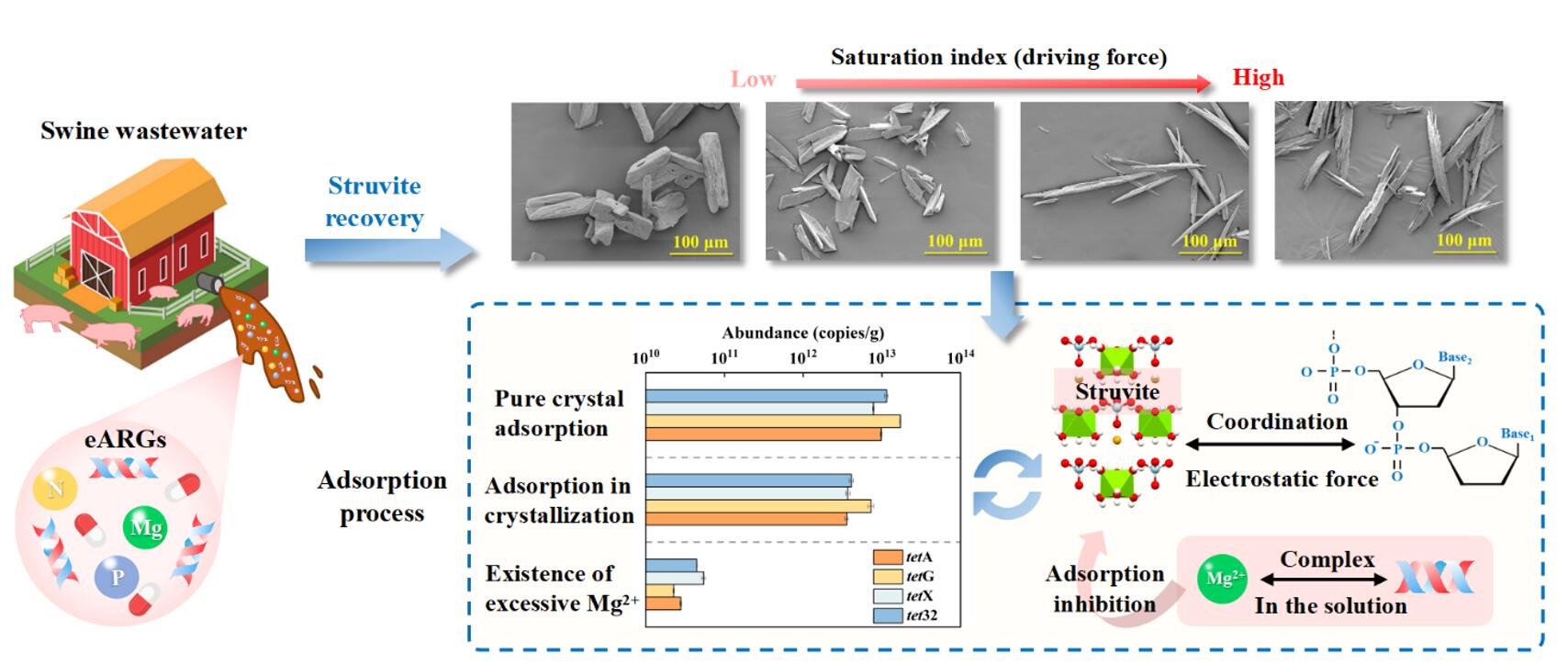
In recent, the complexation of extracellular antibiotic resistance genes (eARGs) with environmental particles has been getting significant concerns, since eARGs can consequently disseminate, propagate and pose ecological risks to the environment. This study focused on eARGs complexing with struvite (MgNH4PO4·6H2O) particles in struvite recovery by using synthetic wastewater. The adsorption capacities of eARGs by struvite crystals with different morphologies were firstly examined. Results revealed that struvite crystals possessed the maximum eARGs adsorption capacity of 7.95 × 10¹²-1.76 × 10¹³ copies/g. The evolution of struvite morphologies from regular polyhedron to needle-like, coupled with larger BET surface area, resulted in a matching increase relationship of eARGs adsorption. Electrostatic interaction and covalent binding were the predominant forces between eARGs and struvite crystals, attributed to the Mg[H2O]62+ octahedra in the struvite crystallite and the phosphate backbone with its external position in eARGs molecule. The eARGs adsorption in struvite crystallization displayed a “U” curve with the minimum values of 3.57 × 10¹²-7.28 × 10¹² copies/g at pH 8.8, which was ascribed to the excessive existence of Mg2+ ions in the liquid. Despite the gradual increase in the Mg:P molar ratio from 1.0 to 2.5 during crystallization, the abundance of eARGs on recovered solids displayed twice dramatic declines with two or three orders of magnitude lower, which was attributed to the formation and binding saturation of eARGs-Mg chelate, as well as the non-negligible evolution of magnesium species under different pH values. These outcomes provide new insights into the migration behavior of eARGs during struvite recovery from wastewater.
Key words:Phosphorus recovery; Extracellular antibiotic resistance genes (eARGs); Struvite; Morphology; Adsorption
Volume:
Page:122681
Journal:Water Research


