


• Home
  • About Us
    • Brief Introduction
    • Address from the Director
    • Directors
    • Organization
    • IUE in Media
  • Scientists
    • Academicians
    • Professors
    • Associate Professors
  • Research
    • Research Divisions
    • Research Progress
  • Education
    • Admission
    • Study at IUE
    • Scholarships
  • INT'L Cooperation
    • INT'L Cooperation News
    • Partnership
  • Papers
  • Join Us
    • Job Opportunities
    • PIFI
      • What's PIFI
Contact Us   |   Sitemap   |   CAS   |   中文
  • Home
  • About Us
    • Brief Introduction
    • Address from the Director
    • Directors
    • Organization
    • IUE in Media
  • Scientists
    • Academicians
    • Professors
    • Associate Professors
  • Research
    • Research Divisions
    • Research Progress
  • Education
    • Admission
    • Study at IUE
    • Scholarships
  • INT'L Cooperation
    • INT'L Cooperation News
    • Partnership
  • Papers
  • Join Us
    • Job Opportunities
    • PIFI

Papers

  • HomePapers
  • Papers
    Diversity and Activity of Soil N2O-Reducing Bacteria Shaped by Urbanization
    Le-Yang Yang, Shun Li, Hua-Yuan Shangguan, Zhi-Hong Qiao, Xin-Rong Huang, Shu-Yi-Dan Zhou, Hu Li, Xiao-Xuan Su, Xin Sun, Yong-Guan Zhu, Xiao-Ru Yang*

    Nitrous oxide (N2O) is a potent greenhouse gas with various production pathways. N2O reductase (N2OR) is the primary N2O sink, but the distribution of its gene clades, typically nosZI and atypically nosZII, along urbanization gradients remains poorly understood. Here we sampled soils from forests, parks, and farmland across eight provinces in eastern China, using high-throughput sequencing to distinguish between two N2O-reducing bacteria clades. A deterministic process mainly determined assemblies of the nosZI communities. Homogeneous selection drove nosZI deterministic processes, and both homogeneous and heterogeneous selection influenced nosZII. This suggests nosZII is more sensitive to environmental changes than nosZI, with significant changes in community structure over time or space. Ecosystems with stronger anthropogenic disturbance, such as urban areas, provide diverse ecological niches for N2O-reducing bacteria (especially nosZII) to adapt to environmental fluctuations. Structural equation modeling (SEM) and correlation analyses revealed that pH significantly influences the community composition of both N2O-reducing bacteria clades. This study underscores urbanization’s impact on N2O-reducing bacteria in urban soils, highlighting the importance of nosZII and survival strategies. It offers novel insights into the role of atypical denitrifiers among N2O-reducing bacteria, underscoring their potential ecological importance in mitigating N2O emissions from urban soils.
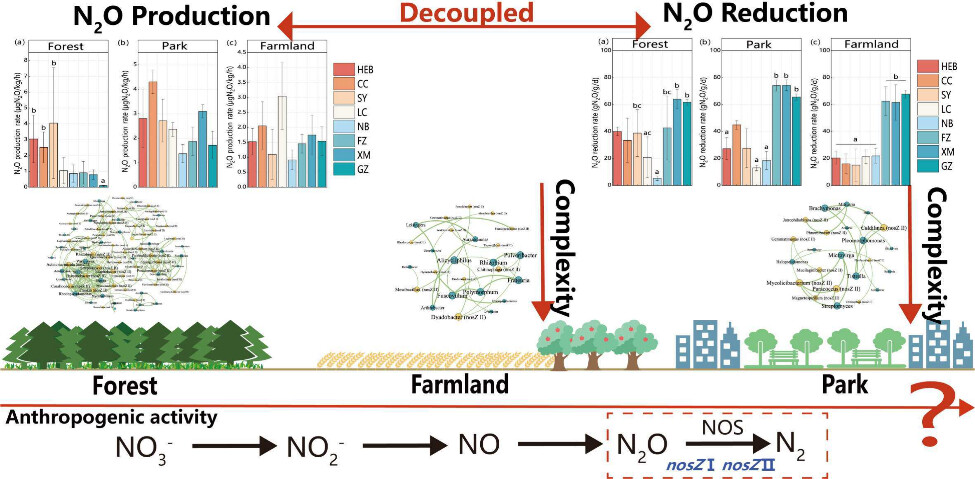
    Key words:soil habitats, N2O-reducing bacteria, N2O mitigation, urban ecosystems, nosZI, nosZII

    Volume:58

    Page:17295-17303

    Journal:Environmental Science & Technology

    https://doi.org/10.1021/acs.est.4c01750

    About Us

    • Brief Introduction
    • Address from the Director
    • Directors
    • Organization
    • IUE in Media

    Scientists

    • Academicians
    • Professors
    • Associate Professors

    Research

    • Research Divisions
    • Research Progress

    Education

    • Admission
    • Study at IUE
    • Scholarships

    INT'L Cooperation

    • INT'L Cooperation News
    • Partnership

    Papers

    Join Us

    • Job Opportunities
    • PIFI
    Copyright © Institute of Urban Environment,Chinese Academy of Sciences. All Rights Reserved.
    1799 Jimei Road, Xiamen 361021 China.+86-592-6190973.