


• Home
  • About Us
    • Brief Introduction
    • Address from the Director
    • Directors
    • Organization
    • IUE in Media
  • Scientists
    • Academicians
    • Professors
    • Associate Professors
  • Research
    • Research Divisions
    • Research Progress
  • Education
    • Admission
    • Study at IUE
    • Scholarships
  • INT'L Cooperation
    • INT'L Cooperation News
    • Partnership
  • Papers
  • Join Us
    • Job Opportunities
    • PIFI
      • What's PIFI
Contact Us   |   Sitemap   |   CAS   |   中文
  • Home
  • About Us
    • Brief Introduction
    • Address from the Director
    • Directors
    • Organization
    • IUE in Media
  • Scientists
    • Academicians
    • Professors
    • Associate Professors
  • Research
    • Research Divisions
    • Research Progress
  • Education
    • Admission
    • Study at IUE
    • Scholarships
  • INT'L Cooperation
    • INT'L Cooperation News
    • Partnership
  • Papers
  • Join Us
    • Job Opportunities
    • PIFI

Papers

  • HomePapers
  • Papers
    Trends of peroxyacetyl nitrate and its impact on ozone over 2018–2022 in urban atmosphere
    Ziyi Lin, Lingling Xu*, Chen Yang, Gaojie Chen, Xiaoting Ji, Lingjun Li, Keran Zhang, Youwei Hong, Mengren Li, Xiaolong Fan, Baoye Hu, Fuwang Zhang & Jinsheng Chen*

    Peroxyacetyl nitrate (PAN) is an important photochemical product and affects ozone (O3) formation in the troposphere. Yet, the long-term observation of PAN remains scarce, limiting the full understanding of its impacts on photochemical pollution. Here, we observed PAN from 2018 to 2022 in urban Fuzhou, Southeastern China. We found that, in contrast to upward trend of O3, PAN concentrations shown a significant decreasing trend at an average rate of −0.07 ppb/year. NO2, CO, UVB, and T contributed to the decreasing trend of PAN according to Machine learning analyses, while the effect of O3-represented atmospheric oxidation capacity on PAN was fluctuating from year to year. Chemical box model revealed active PA production and depletion in Fuzhou. Thus, despite the decreasing PAN concentration, PAN chemistry effectively promoted O3 formation by rising ROx levels, leading to increases of 2.18%–58.4% in net O3 production rate in different years. Our results provide valuable insights into the evolution of photochemical pollution in urban environments.
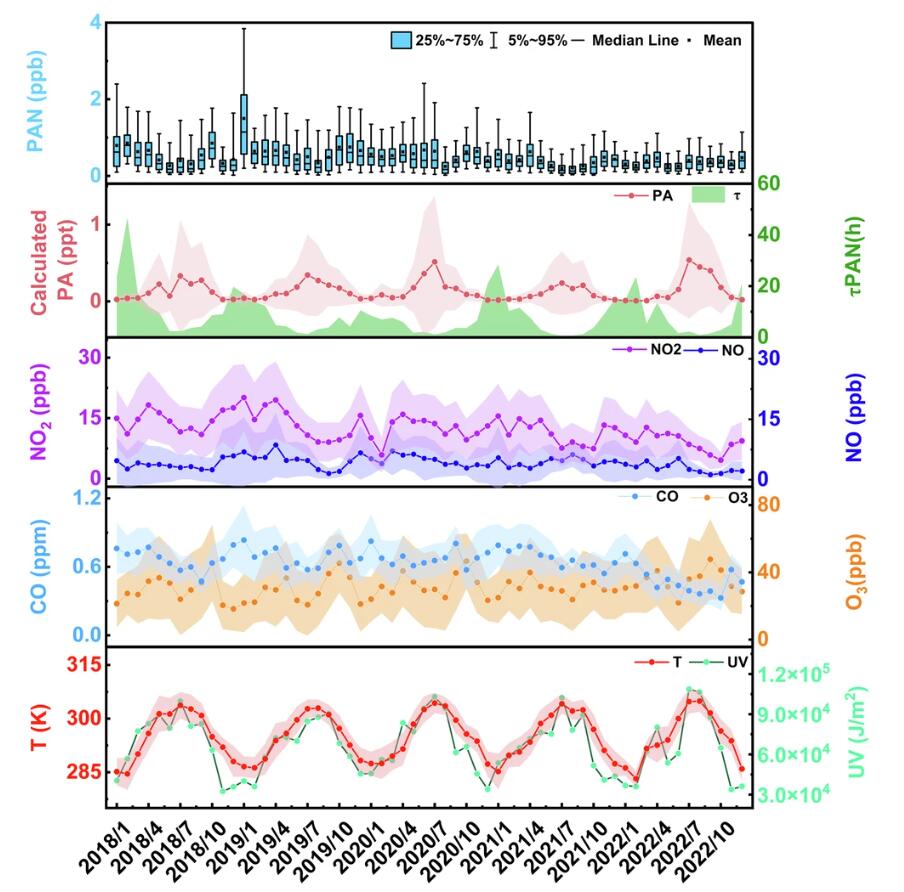

    Monthly mean values of PAN, PA, atmospheric lifetime (τ) of PAN, pollutants (NO2, NO, CO, O3) and photochemical condition (T, UV) during 2018–2022. Shade represents a standard deviation.


    Key words:

    Volume:192 (2024)

    Page:

    Journal:npj climate and atmospheric science

    https://www.nature.com/articles/s41612-024-00746-7/figures/1

    About Us

    • Brief Introduction
    • Address from the Director
    • Directors
    • Organization
    • IUE in Media

    Scientists

    • Academicians
    • Professors
    • Associate Professors

    Research

    • Research Divisions
    • Research Progress

    Education

    • Admission
    • Study at IUE
    • Scholarships

    INT'L Cooperation

    • INT'L Cooperation News
    • Partnership

    Papers

    Join Us

    • Job Opportunities
    • PIFI
    Copyright © Institute of Urban Environment,Chinese Academy of Sciences. All Rights Reserved.
    1799 Jimei Road, Xiamen 361021 China.+86-592-6190973.