


• Home
  • About Us
    • Brief Introduction
    • Address from the Director
    • Directors
    • Organization
    • IUE in Media
  • Scientists
    • Academicians
    • Professors
    • Associate Professors
  • Research
    • Research Divisions
    • Research Progress
  • Education
    • Admission
    • Study at IUE
    • Scholarships
  • INT'L Cooperation
    • INT'L Cooperation News
    • Partnership
  • Papers
  • Join Us
    • Job Opportunities
    • PIFI
      • What's PIFI
Contact Us   |   Sitemap   |   CAS   |   中文
  • Home
  • About Us
    • Brief Introduction
    • Address from the Director
    • Directors
    • Organization
    • IUE in Media
  • Scientists
    • Academicians
    • Professors
    • Associate Professors
  • Research
    • Research Divisions
    • Research Progress
  • Education
    • Admission
    • Study at IUE
    • Scholarships
  • INT'L Cooperation
    • INT'L Cooperation News
    • Partnership
  • Papers
  • Join Us
    • Job Opportunities
    • PIFI

Papers

  • HomePapers
  • Papers
    Nitrifying niche in estuaries is expanded by the plastisphere
    XX SU#, XR HUANG#, YY ZHANG#, LY YANG, T WEN, XR YANG, GB ZHU, JB ZHANG, YJ TANG, ZL LI, J DING, R LI, JL PAN, XP CHEN, FY HUANG, Matthias C. Rillig & YG ZHU*

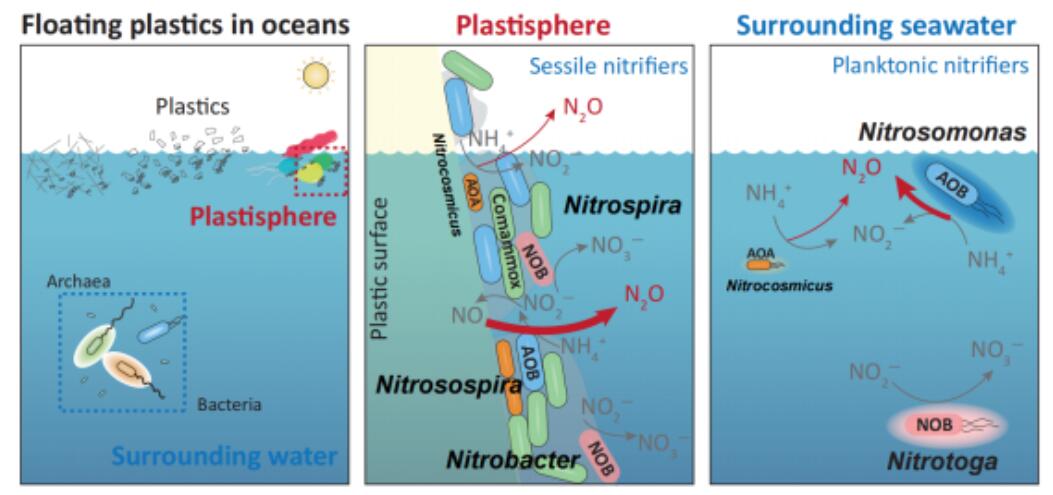
    The estuarine plastisphere, a novel ecological habitat in the Anthropocene, has garnered global concerns. Recent geochemical evidence has pointed out its potential role in influencing nitrogen biogeochemistry. However, the biogeochemical significance of the plastisphere and its mechanisms regulating nitrogen cycling remain elusive. Using 15N- and 13C-labelling coupled with metagenomics and metatranscriptomics, here we unveil that the plastisphere likely acts as an underappreciated nitrifying niche in estuarine ecosystems, exhibiting a 0.9 ~ 12-fold higher activity of bacteria-mediated nitrification compared to surrounding seawater and other biofilms (stone, wood and glass biofilms). The shift of active nitrifiers from O2-sensitive nitrifiers in the seawater to nitrifiers with versatile metabolisms in the plastisphere, combined with the potential interspecific cooperation of nitrifying substrate exchange observed among the plastisphere nitrifiers, collectively results in the unique nitrifying niche. Our findings highlight the plastisphere as an emerging nitrifying niche in estuarine environment, and deepen the mechanistic understanding of its contribution to marine biogeochemistry.
    Key words:

    Volume:

    Page:

    Journal:Nature Communications

    https://www.nature.com/articles/s41467-024-50200-8

    About Us

    • Brief Introduction
    • Address from the Director
    • Directors
    • Organization
    • IUE in Media

    Scientists

    • Academicians
    • Professors
    • Associate Professors

    Research

    • Research Divisions
    • Research Progress

    Education

    • Admission
    • Study at IUE
    • Scholarships

    INT'L Cooperation

    • INT'L Cooperation News
    • Partnership

    Papers

    Join Us

    • Job Opportunities
    • PIFI
    Copyright © Institute of Urban Environment,Chinese Academy of Sciences. All Rights Reserved.
    1799 Jimei Road, Xiamen 361021 China.+86-592-6190973.