


• Home
  • About Us
    • Brief Introduction
    • Address from the Director
    • Directors
    • Organization
    • IUE in Media
  • Scientists
    • Academicians
    • Professors
    • Associate Professors
  • Research
    • Research Divisions
    • Research Progress
  • Education
    • Admission
    • Study at IUE
    • Scholarships
  • INT'L Cooperation
    • INT'L Cooperation News
    • Partnership
  • Papers
  • Join Us
    • Job Opportunities
    • PIFI
      • What's PIFI
Contact Us   |   Sitemap   |   CAS   |   中文
  • Home
  • About Us
    • Brief Introduction
    • Address from the Director
    • Directors
    • Organization
    • IUE in Media
  • Scientists
    • Academicians
    • Professors
    • Associate Professors
  • Research
    • Research Divisions
    • Research Progress
  • Education
    • Admission
    • Study at IUE
    • Scholarships
  • INT'L Cooperation
    • INT'L Cooperation News
    • Partnership
  • Papers
  • Join Us
    • Job Opportunities
    • PIFI

Papers

  • HomePapers
  • Papers
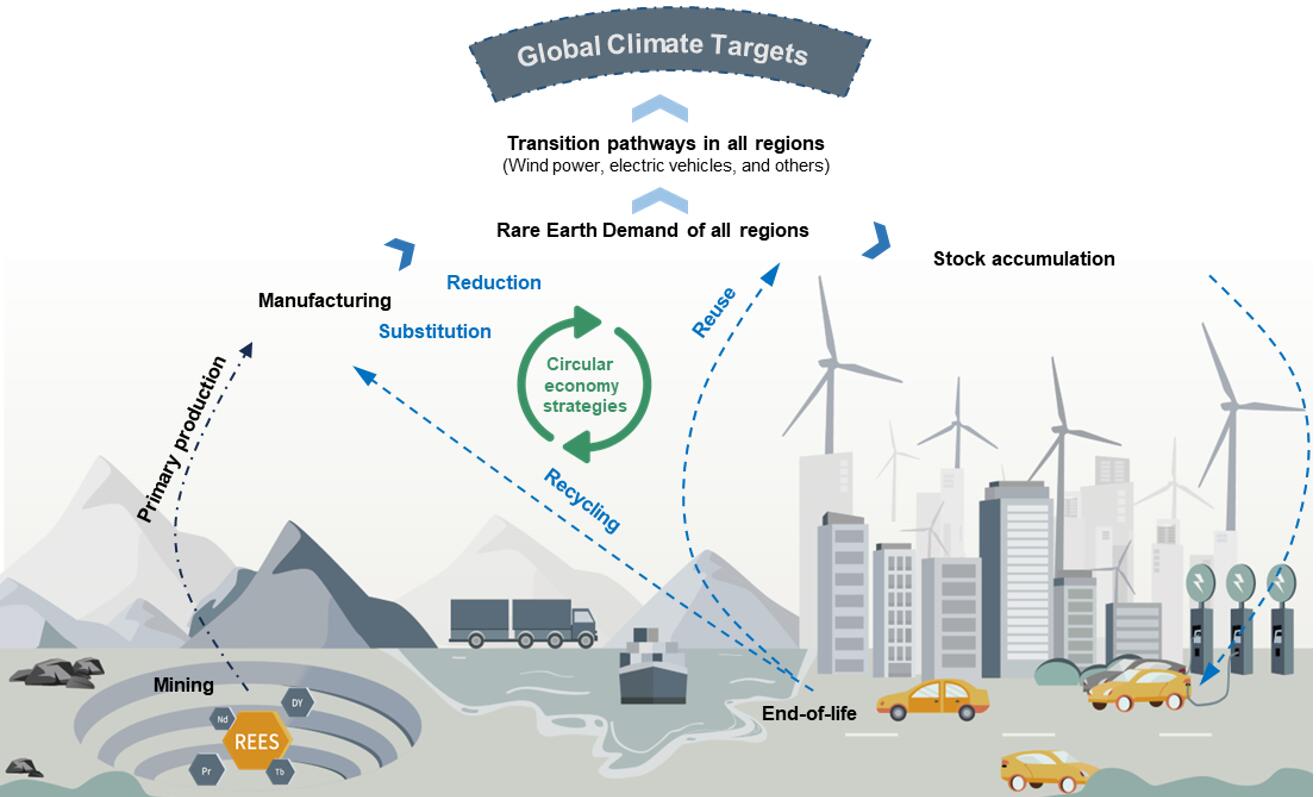
    Regional rare-earth element supply and demand balanced with circular economy strategies
    Peng Wang, Yu-Yao Yang, Oliver Heidrich, Li-Yang Chen, Li-Hua Chen*, Tomer Fishman & Wei-Qiang Chen*

    The growing dependence of society on rare-earth elements poses a challenge to achieving a just low-carbon transition globally. While circular economy strategies have gained attention, their specific impacts remain unmeasured. Here we present an integrated model that quantifies how circular economy strategies can reshape global supply chains of the critical rare-earth elements such as neodymium, praseodymium, dysprosium and terbium. The model considers both in-ground and in-use stocks across ten regions from 2021 to 2050. The projections include the full deployment of three widely accepted climate scenarios. We find a considerable mismatch between in-ground stocks, supply and demand at specific region and element levels, with the mismatch for heavy rare-earth elements as a key obstacle for achieving net-zero emissions targets. We suggest that, as in-ground stocks decline among mineral suppliers, the accumulation of in-use stocks in consuming regions can foster a more balanced and less polarized geopolitical landscape for rare-earth elements, and circular economy strategies can lead to an increase of 701 kt secondary supply and a decrease of 2,306 kt demand within the next three decades. Implementing these circular economy strategies will require international cooperation in the governance of rare-earth elements amid sustainable transition.
    Key words:

    Volume:

    Page:

    Journal:Nature Geoscience

    https://www.nature.com/articles/s41561-023-01350-9

    About Us

    • Brief Introduction
    • Address from the Director
    • Directors
    • Organization
    • IUE in Media

    Scientists

    • Academicians
    • Professors
    • Associate Professors

    Research

    • Research Divisions
    • Research Progress

    Education

    • Admission
    • Study at IUE
    • Scholarships

    INT'L Cooperation

    • INT'L Cooperation News
    • Partnership

    Papers

    Join Us

    • Job Opportunities
    • PIFI
    Copyright © Institute of Urban Environment,Chinese Academy of Sciences. All Rights Reserved.
    1799 Jimei Road, Xiamen 361021 China.+86-592-6190973.