


• Home
  • About Us
    • Brief Introduction
    • Address from the Director
    • Directors
    • Organization
    • IUE in Media
  • Scientists
    • Academicians
    • Professors
    • Associate Professors
  • Research
    • Research Divisions
    • Research Progress
  • Education
    • Admission
    • Study at IUE
    • Scholarships
  • INT'L Cooperation
    • INT'L Cooperation News
    • Partnership
  • Papers
  • Join Us
    • Job Opportunities
    • PIFI
      • What's PIFI
Contact Us   |   Sitemap   |   CAS   |   中文
  • Home
  • About Us
    • Brief Introduction
    • Address from the Director
    • Directors
    • Organization
    • IUE in Media
  • Scientists
    • Academicians
    • Professors
    • Associate Professors
  • Research
    • Research Divisions
    • Research Progress
  • Education
    • Admission
    • Study at IUE
    • Scholarships
  • INT'L Cooperation
    • INT'L Cooperation News
    • Partnership
  • Papers
  • Join Us
    • Job Opportunities
    • PIFI

Papers

  • HomePapers
  • Papers
    New Insights on the Formation of Nucleation Mode Particles in a Coastal City Based on a Machine Learning Approach
    Chen Yang, Hesong Dong, Yuping Chen, Lingling Xu, Gaojie Chen, Xiaolong Fan, Yonghong Wang, Yee Jun Tham, Ziyi Lin, Mengren Li, Youwei Hong, and Jinsheng Chen*

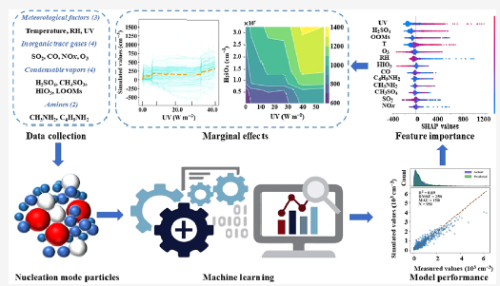
    Atmospheric particles have profound implications for the global climate and human health. Among them, ultrafine particles dominate in terms of the number concentration and exhibit enhanced toxic effects as a result of their large total surface area. Therefore, understanding the driving factors behind ultrafine particle behavior is crucial. Machine learning (ML) provides a promising approach for handling complex relationships. In this study, three ML models were constructed on the basis of field observations to simulate the particle number concentration of nucleation mode (PNCN). All three models exhibited robust PNCN reproduction (R2 > 0.80), with the random forest (RF) model excelling on the test data (R2 = 0.89). Multiple methods of feature importance analysis revealed that ultraviolet (UV), H2SO4, low-volatility oxygenated organic molecules (LOOMs), temperature, and O3 were the primary factors influencing PNCN. Bivariate partial dependency plots (PDPs) indicated that during nighttime and overcast conditions, the presence of H2SO4 and LOOMs may play a crucial role in influencing PNCN. Additionally, integrating additional detailed information related to emissions or meteorology would further enhance the model performance. This pilot study shows that ML can be a novel approach for simulating atmospheric pollutants and contributes to a better understanding of the formation and growth mechanisms of nucleation mode particles.
     

    Key words:machine learning;low-volatility oxygenated organic molecules (LOOMs);H2SO4;particle number concentration;nucleation mode

    Volume:

    Page:

    Journal:Environmental Science & Technology.

    https://doi.org/10.1021/acs.est.3c07042

    About Us

    • Brief Introduction
    • Address from the Director
    • Directors
    • Organization
    • IUE in Media

    Scientists

    • Academicians
    • Professors
    • Associate Professors

    Research

    • Research Divisions
    • Research Progress

    Education

    • Admission
    • Study at IUE
    • Scholarships

    INT'L Cooperation

    • INT'L Cooperation News
    • Partnership

    Papers

    Join Us

    • Job Opportunities
    • PIFI
    Copyright © Institute of Urban Environment,Chinese Academy of Sciences. All Rights Reserved.
    1799 Jimei Road, Xiamen 361021 China.+86-592-6190973.