


• Home
  • About Us
    • Brief Introduction
    • Address from the Director
    • Directors
    • Organization
    • IUE in Media
  • Scientists
    • Academicians
    • Professors
    • Associate Professors
  • Research
    • Research Divisions
    • Research Progress
  • Education
    • Admission
    • Study at IUE
    • Scholarships
  • INT'L Cooperation
    • INT'L Cooperation News
    • Partnership
  • Papers
  • Join Us
    • Job Opportunities
    • PIFI
      • What's PIFI
Contact Us   |   Sitemap   |   CAS   |   中文
  • Home
  • About Us
    • Brief Introduction
    • Address from the Director
    • Directors
    • Organization
    • IUE in Media
  • Scientists
    • Academicians
    • Professors
    • Associate Professors
  • Research
    • Research Divisions
    • Research Progress
  • Education
    • Admission
    • Study at IUE
    • Scholarships
  • INT'L Cooperation
    • INT'L Cooperation News
    • Partnership
  • Papers
  • Join Us
    • Job Opportunities
    • PIFI

Papers

  • HomePapers
  • Papers
    Relic DNA obscures DNA-based profiling of multiple microbial taxonomic groups in a river-reservoir ecosystem
    Yuanyuan Xue, Mamun Abdullah Al, Huihuang Chen, Peng Xiao, Hongteng Zhang, Erik Jeppesen, Jun Yang*

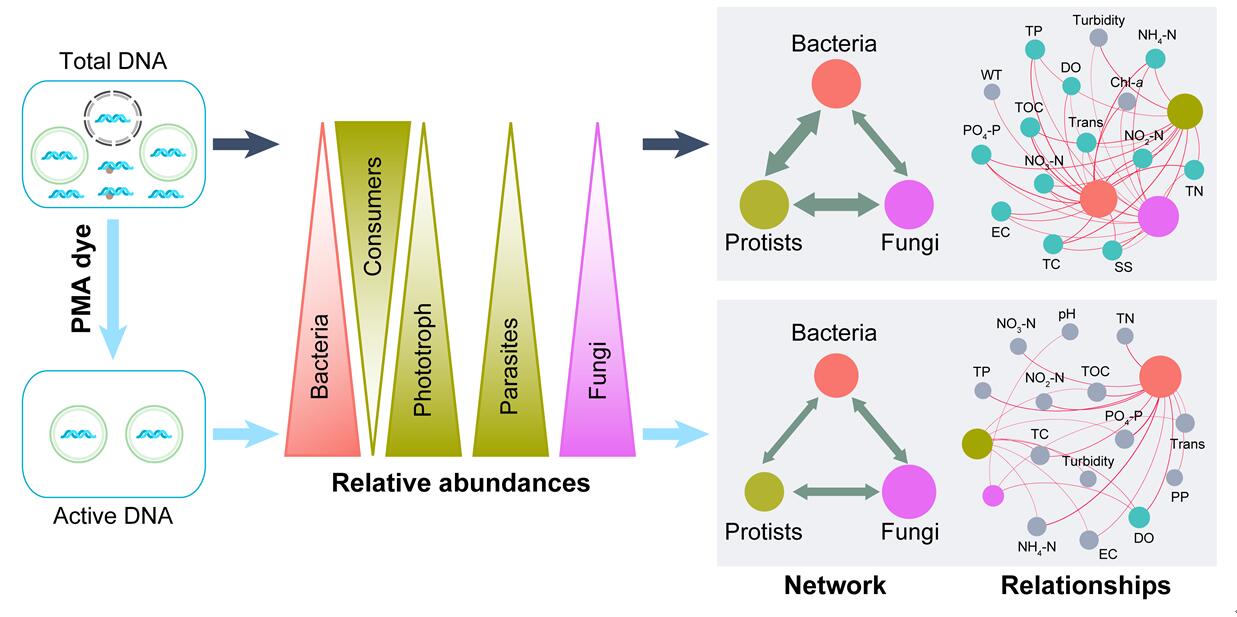
    Numerous studies have investigated the spatiotemporal variability in water microbial communities, yet the effects of relic DNA on microbial community profiles, especially microeukaryotes, remain far from fully understood. Here, total and active bacterial and microeukaryotic community compositions were characterized using propidium monoazide (PMA) treatment coupled with high-throughput sequencing in a river-reservoir ecosystem. Beta diversity analysis showed a significant difference in community composition between both the PMA untreated and treated bacteria and microeukaryotes; however, the differentiating effect was much stronger for microeukaryotes. Relic DNA only resulted in underestimation of the relative abundances of Bacteroidota and Nitrospirota, while other bacterial taxa exhibited no significant changes. As for microeukaryotes, the relative abundances of some phytoplankton (e.g. Chlorophyta, Dinoflagellata and Ochrophyta) and fungi were greater after relic DNA removal, whereas Cercozoa and Ciliophora showed the opposite trend. Moreover, relic DNA removal weakened the size and complexity of cross-trophic microbial networks and significantly changed the relationships between environmental factors and microeukaryotic community composition. However, there was no significant difference in the rates of temporal community turnover between the PMA untreated and treated samples for either bacteria or microeukaryotes. Overall, our results imply that the presence of relic DNA in waters can give misleading information of the active microbial community composition, co-occurrence networks and their relationships with environmental conditions. More studies of the abundance, decay rate and functioning of nonviable DNA in freshwater ecosystems are highly recommended in the future.
    Key words:

    Volume:

    Page:

    Journal:Molecular Ecology

    https://doi.org/10.1111/mec.17071

    About Us

    • Brief Introduction
    • Address from the Director
    • Directors
    • Organization
    • IUE in Media

    Scientists

    • Academicians
    • Professors
    • Associate Professors

    Research

    • Research Divisions
    • Research Progress

    Education

    • Admission
    • Study at IUE
    • Scholarships

    INT'L Cooperation

    • INT'L Cooperation News
    • Partnership

    Papers

    Join Us

    • Job Opportunities
    • PIFI
    Copyright © Institute of Urban Environment,Chinese Academy of Sciences. All Rights Reserved.
    1799 Jimei Road, Xiamen 361021 China.+86-592-6190973.