


• Home
  • About Us
    • Brief Introduction
    • Address from the Director
    • Directors
    • Organization
    • IUE in Media
  • Scientists
    • Academicians
    • Professors
    • Associate Professors
  • Research
    • Research Divisions
    • Research Progress
  • Education
    • Admission
    • Study at IUE
    • Scholarships
  • INT'L Cooperation
    • INT'L Cooperation News
    • Partnership
  • Papers
  • Join Us
    • Job Opportunities
    • PIFI
      • What's PIFI
Contact Us   |   Sitemap   |   CAS   |   中文
  • Home
  • About Us
    • Brief Introduction
    • Address from the Director
    • Directors
    • Organization
    • IUE in Media
  • Scientists
    • Academicians
    • Professors
    • Associate Professors
  • Research
    • Research Divisions
    • Research Progress
  • Education
    • Admission
    • Study at IUE
    • Scholarships
  • INT'L Cooperation
    • INT'L Cooperation News
    • Partnership
  • Papers
  • Join Us
    • Job Opportunities
    • PIFI

Papers

  • HomePapers
  • Papers
    Biochar-derived dissolved organic matter (BDOM) and its influence on soil microbial community composition, function, and activity: A review
    Muhammad Azeem,Tian-Ran Sun,Parimala Gnana Soundari Arockiam Jeyasundar,Rui-Xia Han,Hui Li,Hamada Abdelrahman,Sabry M. Shaheen,Yong-Guan Zhu &Gang Li*

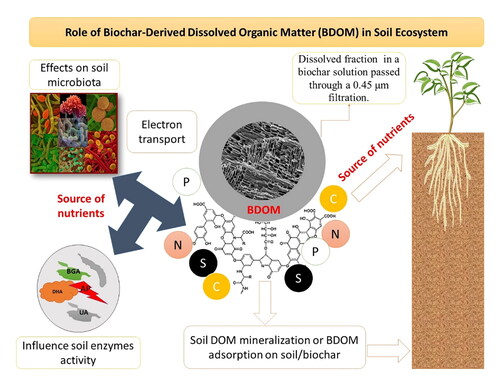
    Biochar-derived dissolved organic matter (BDOM) plays key roles in soil ecosystem by affecting soil physicochemical and biological properties and supplying nutrients to soil microbes. It can either enhance or suppress the growth of certain soil microorganisms, depending on its composition and content of labile organic compounds. This review aims to discuss and summarize the role of BDOM in modifying soil microbial functioning, microbial community structure, and enzymatic activity. We mainly focus on the role of BDOM as a function of its concentration, type of feedstock biomass, and pyrolysis temperature (PT). Results show that saw dust- and manure-based biochars produce higher BDOM concentrations than straw-, bone-, and sludge-based biochars. The types of feedstock biomass and its PT determine BDOM characteristics and its interaction with soil microbial communities. Plant-derived biochar with pyrolysis temperature ≤300°C often results in a more aliphatic BDOM than that with pyrolysis temperature ≥500°C, which yields a more aromatic BDOM. BDOM of plant biochar contains higher specific ultraviolet absorbance (SUVA) and humification index (HIX) than that of manure biochar. The SUVA and HIX of BDOM positively correlate (R2=0.68–0.96) with the content of total fatty acid methyl esters, but negatively correlate with the abundances of actinomycetes, arbuscular mycorrhizae, and fungal communities. However, the environmental fate of BDOM in biochar amended soil requires long-term experiment, both in laboratory and field scales, to provide a full understating of BDOM interaction with soil organic matter and microorganisms and help to tailor a safe utilization of biochar in agroecosystems.
     

    Key words:Biochar;pyrolysis temperature;feedstock type;dissolved organic matter; soil microbiome;soil enzyme activity

    Volume:53(21)

    Page:1912-1934

    Journal:CRITICAL REVIEWS IN ENVIRONMENTAL SCIENCE AND TECHNOLOGY

    https://doi.org/10.1080/10643389.2023.2190333

    About Us

    • Brief Introduction
    • Address from the Director
    • Directors
    • Organization
    • IUE in Media

    Scientists

    • Academicians
    • Professors
    • Associate Professors

    Research

    • Research Divisions
    • Research Progress

    Education

    • Admission
    • Study at IUE
    • Scholarships

    INT'L Cooperation

    • INT'L Cooperation News
    • Partnership

    Papers

    Join Us

    • Job Opportunities
    • PIFI
    Copyright © Institute of Urban Environment,Chinese Academy of Sciences. All Rights Reserved.
    1799 Jimei Road, Xiamen 361021 China.+86-592-6190973.