


• Home
  • About Us
    • Brief Introduction
    • Address from the Director
    • Directors
    • Organization
    • IUE in Media
  • Scientists
    • Academicians
    • Professors
    • Associate Professors
  • Research
    • Research Divisions
    • Research Progress
  • Education
    • Admission
    • Study at IUE
    • Scholarships
  • INT'L Cooperation
    • INT'L Cooperation News
    • Partnership
  • Papers
  • Join Us
    • Job Opportunities
    • PIFI
      • What's PIFI
Contact Us   |   Sitemap   |   CAS   |   中文
  • Home
  • About Us
    • Brief Introduction
    • Address from the Director
    • Directors
    • Organization
    • IUE in Media
  • Scientists
    • Academicians
    • Professors
    • Associate Professors
  • Research
    • Research Divisions
    • Research Progress
  • Education
    • Admission
    • Study at IUE
    • Scholarships
  • INT'L Cooperation
    • INT'L Cooperation News
    • Partnership
  • Papers
  • Join Us
    • Job Opportunities
    • PIFI

Papers

  • HomePapers
  • Papers
    A Systematic Workflow of Data Mining Confirms Widespread Occurrence of Antibiotic Contamination in Freshwater Reservoirs
    Zhao-Feng Guo, Wiebke J. Boeing, Yao-Yang Xu*, Edoardo Borgomeo, Dong Liu & Yong-Guan Zhu

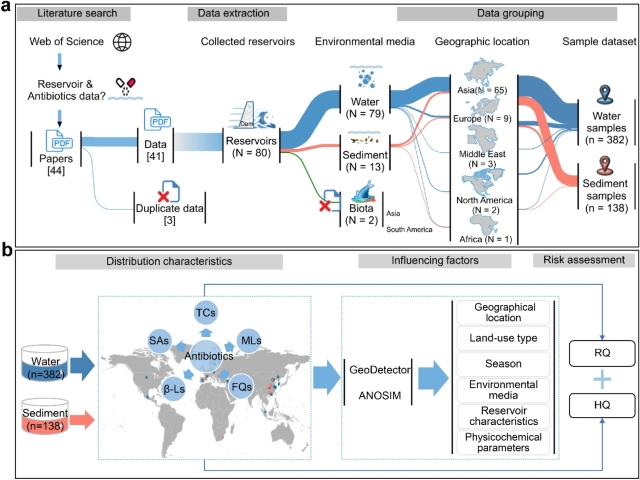
    Antibiotic residues in reservoirs threatens ecosystems and human health. Whereas numerous studies have been conducted on their occurrence and distribution, overall quantitative and comparative analysis of antibiotic contamination in reservoirs is challenging due to scattered data and scale differences. Here, we integrate antibiotic data from 520 samples in 80 reservoirs and provide an overview of the distribution, determinants, and potential risks of these emerging contaminants in reservoirs at a cross-continental scale. A total of 69 antibiotics were detected in reservoirs, with sulfonamides, fluoroquinolones, tetracyclines, macrolides, and β-lactams occurring more frequently. Concentration and type of antibiotics varied among continents and reservoirs between data generated from sediment and water. Geographic location, seasonal variation, artificial impervious area around the reservoir, reservoir characteristics, and water quality also influenced reservoir antibiotic distributions. These factors enhanced the explanatory power of antibiotic distribution through linear or non-linear interactions. Cumulative risk for 44 antibiotics in reservoirs is low, but it is essential to further assess the environmental behavior and integrated risk of antibiotics from an interdisciplinary perspective and at the human-food chain-ecosystem interface, particularly antibiotic resistance under “One Health” framework.
    Key words:Reservoirs;Antibiotics contamination;Distribution;Determinants;Risk assessment;Data mining

    Volume:

    Page:23

    Journal:EXPOSURE AND HEALTH

    https://link.springer.com/article/10.1007/s12403-022-00529-6

    About Us

    • Brief Introduction
    • Address from the Director
    • Directors
    • Organization
    • IUE in Media

    Scientists

    • Academicians
    • Professors
    • Associate Professors

    Research

    • Research Divisions
    • Research Progress

    Education

    • Admission
    • Study at IUE
    • Scholarships

    INT'L Cooperation

    • INT'L Cooperation News
    • Partnership

    Papers

    Join Us

    • Job Opportunities
    • PIFI
    Copyright © Institute of Urban Environment,Chinese Academy of Sciences. All Rights Reserved.
    1799 Jimei Road, Xiamen 361021 China.+86-592-6190973.