


• Home
  • About Us
    • Brief Introduction
    • Address from the Director
    • Directors
    • Organization
    • IUE in Media
  • Scientists
    • Academicians
    • Professors
    • Associate Professors
  • Research
    • Research Divisions
    • Research Progress
  • Education
    • Admission
    • Study at IUE
    • Scholarships
  • INT'L Cooperation
    • INT'L Cooperation News
    • Partnership
  • Papers
  • Join Us
    • Job Opportunities
    • PIFI
      • What's PIFI
Contact Us   |   Sitemap   |   CAS   |   中文
  • Home
  • About Us
    • Brief Introduction
    • Address from the Director
    • Directors
    • Organization
    • IUE in Media
  • Scientists
    • Academicians
    • Professors
    • Associate Professors
  • Research
    • Research Divisions
    • Research Progress
  • Education
    • Admission
    • Study at IUE
    • Scholarships
  • INT'L Cooperation
    • INT'L Cooperation News
    • Partnership
  • Papers
  • Join Us
    • Job Opportunities
    • PIFI

Papers

  • HomePapers
  • Papers
    Increasing Antimicrobial Resistance and Potential Human Bacterial Pathogens in an Invasive Land Snail Driven by Urbanization
    Yiyue Zhang , Jian-Qiang Su, Hu Liao , Martin F Breed , Haifeng Yao, Huayuan Shangguan, Hong-Zhe Li , Xin Sun* , Yong-Guan Zhu

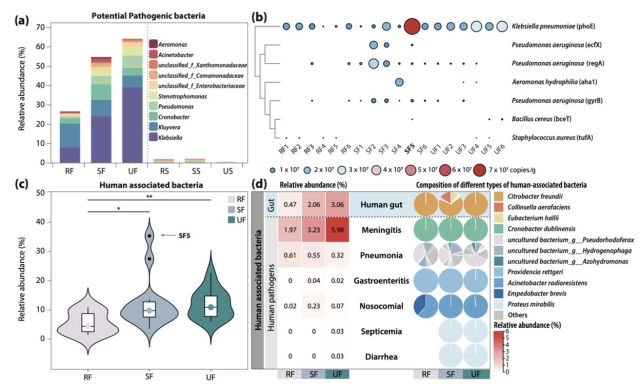
    Our understanding of the role urbanization has in augmenting invasive species that carry human bacterial pathogens and antimicrobial resistance (AMR) remains poorly understood. Here, we investigated the gut bacterial communities, antibiotic resistance genes (ARGs) and potential antibiotic-resistant pathogens in giant African snails (Achatina fulica) collected across an urbanization gradient in Xiamen, China (n = 108). There was a lack of correlation between the microbial profiles of giant African snails and the soils of their habitats, and the resistome and human-associated bacteria were significantly higher than those of native snails as well as soils. We observed high diversity (601 ARG subtypes) and abundance (1.5 copies per 16S rRNA gene) of giant African snail gut resistome. Moreover, giant African snails in more urban areas had greater diversity and abundance of high-risk ARGs and potential human bacterial pathogens (e.g., ESKAPE pathogens). We highlight that urbanization significantly impacted the gut microbiomes and resistomes of these invasive snails, indicating that they harbor greater biological contaminants such as ARGs and potential human bacterial pathogens than native snails and soils. This study advances our understanding of the effect of urbanization on human bacterial pathogens and AMR in a problematic invasive snail and should help combat risks associated with invasive species under the One Health framework.
    Key words:ESKAPE pathogens; antibiotic resistance genes; biological invasion; human bacterial pathogens; metagenome-assembled genomes; resistome.

    Volume:

    Page:

    Journal:Environmental Science & Technology

    https://doi.org/10.1021/acs.est.3c01233

    About Us

    • Brief Introduction
    • Address from the Director
    • Directors
    • Organization
    • IUE in Media

    Scientists

    • Academicians
    • Professors
    • Associate Professors

    Research

    • Research Divisions
    • Research Progress

    Education

    • Admission
    • Study at IUE
    • Scholarships

    INT'L Cooperation

    • INT'L Cooperation News
    • Partnership

    Papers

    Join Us

    • Job Opportunities
    • PIFI
    Copyright © Institute of Urban Environment,Chinese Academy of Sciences. All Rights Reserved.
    1799 Jimei Road, Xiamen 361021 China.+86-592-6190973.