


• Home
  • About Us
    • Brief Introduction
    • Address from the Director
    • Directors
    • Organization
    • IUE in Media
  • Scientists
    • Academicians
    • Professors
    • Associate Professors
  • Research
    • Research Divisions
    • Research Progress
  • Education
    • Admission
    • Study at IUE
    • Scholarships
  • INT'L Cooperation
    • INT'L Cooperation News
    • Partnership
  • Papers
  • Join Us
    • Job Opportunities
    • PIFI
      • What's PIFI
Contact Us   |   Sitemap   |   CAS   |   中文
  • Home
  • About Us
    • Brief Introduction
    • Address from the Director
    • Directors
    • Organization
    • IUE in Media
  • Scientists
    • Academicians
    • Professors
    • Associate Professors
  • Research
    • Research Divisions
    • Research Progress
  • Education
    • Admission
    • Study at IUE
    • Scholarships
  • INT'L Cooperation
    • INT'L Cooperation News
    • Partnership
  • Papers
  • Join Us
    • Job Opportunities
    • PIFI

Papers

  • HomePapers
  • Papers
    Suppressive Strong Metal-Support Interactions on Ruthenium/TiO2 Promote Light-Driven Photothermal CO2 Reduction with Methane
    Qiang Li, Huiling Wang, Meng Zhang, Guanghui Li, Jing Chen, Hongpeng Jia*

    Strong metal-support interactions (SMSI) have gained great attention in the heterogeneous catalysis field, but its negative role in regulating light-induced electron transfer is rarely explored. Herein, we describe how SMSI significantly restrains the activity of Ru/TiO2 in light-driven CO2 reduction by CH4 due to the photo-induced transfer of electrons from TiO2 to Ru. In contrast, on suppression of SMSI Ru/TiO2-H2 achieves a 46-fold CO2 conversion rate compared to Ru/TiO2. For Ru/TiO2-H2, a considerable number of photo-excited hot electrons from Ru nanoparticles (NPs) migrate to oxygen vacancies (OVs) and facilitate CO2 activation under illumination, simultaneously rendering Ruδ+ electron deficient and better able to accelerate CH4 decomposition. Consequently, photothermal catalysis over Ru/TiO2-H2 lowers the activation energy and overcomes the limitations of a purely thermal system. This work offers a novel strategy for designing efficient photothermal catalysts by regulating two-phase interactions.
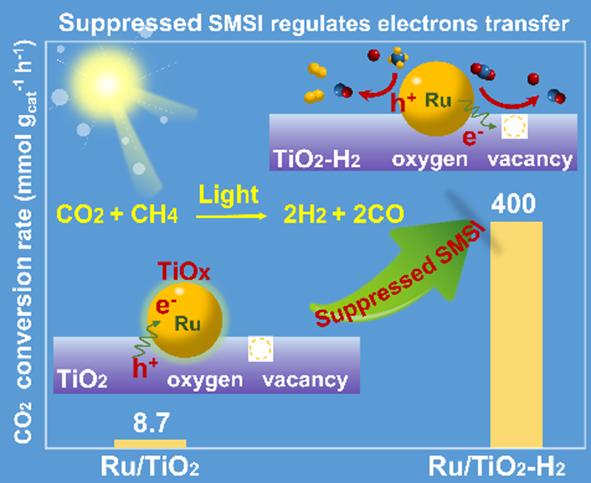
    The effect of suppressive SMSI on regulating electrons transfer and the catalytic performance

    Key words:CO2 Reduction; Electronic Transfer Modulations; Photothermal Catalysis; Suppressed Strong Metal-Support Interactions

    Volume:

    Page:

    Journal:Angewandte Chemie International Edition

    https://doi.org/10.1002/anie.202300129

    About Us

    • Brief Introduction
    • Address from the Director
    • Directors
    • Organization
    • IUE in Media

    Scientists

    • Academicians
    • Professors
    • Associate Professors

    Research

    • Research Divisions
    • Research Progress

    Education

    • Admission
    • Study at IUE
    • Scholarships

    INT'L Cooperation

    • INT'L Cooperation News
    • Partnership

    Papers

    Join Us

    • Job Opportunities
    • PIFI
    Copyright © Institute of Urban Environment,Chinese Academy of Sciences. All Rights Reserved.
    1799 Jimei Road, Xiamen 361021 China.+86-592-6190973.