


• Home
  • About Us
    • Brief Introduction
    • Address from the Director
    • Directors
    • Organization
    • IUE in Media
  • Scientists
    • Academicians
    • Professors
    • Associate Professors
  • Research
    • Research Divisions
    • Research Progress
  • Education
    • Admission
    • Study at IUE
    • Scholarships
  • INT'L Cooperation
    • INT'L Cooperation News
    • Partnership
  • Papers
  • Join Us
    • Job Opportunities
    • PIFI
      • What's PIFI
Contact Us   |   Sitemap   |   CAS   |   中文
  • Home
  • About Us
    • Brief Introduction
    • Address from the Director
    • Directors
    • Organization
    • IUE in Media
  • Scientists
    • Academicians
    • Professors
    • Associate Professors
  • Research
    • Research Divisions
    • Research Progress
  • Education
    • Admission
    • Study at IUE
    • Scholarships
  • INT'L Cooperation
    • INT'L Cooperation News
    • Partnership
  • Papers
  • Join Us
    • Job Opportunities
    • PIFI

Papers

  • HomePapers
  • Papers
    In-situ Construction of Manganese Oxide Photothermocatalyst to Deep Removal of Toluene by Highly Utilizing Sunlight Energy
    Meng Zhang, Guanghui Li, Qiang Li, Jing Chen, Ehiaghe Agbovhimen Elimiana, Hongpeng Jia*, and Hong He*

    The alternative use of electric energy by renewable energy to supply power for catalytic oxidation of pollutants is a sustainable technology, requiring a competent catalyst to realize efficient utilization of light and drive the catalytic reaction. Herein, in situ-synthesized manganese oxide heterostructure composites are developed through solvothermal reduction and subsequent calcination of amorphous manganese oxide (AMO). 95% of toluene conversion and 80% of CO2 mineralization were achieved over amorphous manganese oxide calcined at 250 °C (AMO-250) under light irradiation, and catalyst stability was maintained for at least 40 h. Highly utilization of light energy, uniformly dispersed nanoparticles, large specific surface area, improved metal reducibility, and oxygen desorption and migration ability at low temperature contribute to the good catalytic oxidation activity of AMO-250. Light activated more lattice oxygen to participate in the reaction via the Mars–van Krevelen (MvK) mechanism, and traditional e––h+ photocatalytic behavior exists over the AMO-250 heterostructure composite as an auxiliary degradation path. The reaction pathways of photothermocatalysis and thermocatalysis are close, except for the emergence of different copolymers, where light enhances the deep conversion of intermediates. A proof-of-concept study under natural sunlight has confirmed the feasibility of practical application in the photothermocatalytic degradation of pollutants.
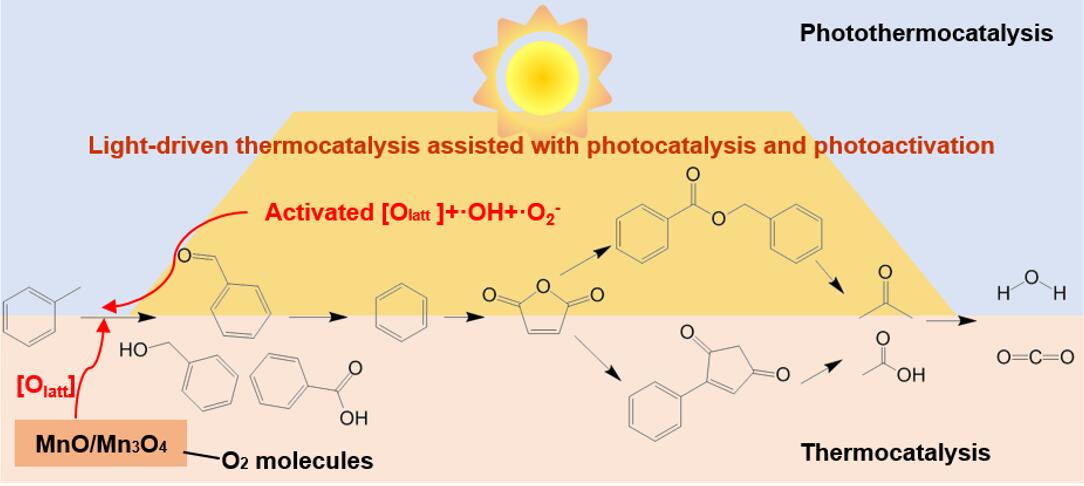
    Photothermocatalytic oxidation of toluene over manganese-based heteroustructure composite catalyst

    Key words:photothermocatalytic oxidation, VOCs, manganese oxides, sunlight energy, natural sunlight

    Volume:57(10)

    Page:4286-4297

    Journal:Environmental Science & Technology

    https://doi.org/10.1021/acs.est.2c09136

    About Us

    • Brief Introduction
    • Address from the Director
    • Directors
    • Organization
    • IUE in Media

    Scientists

    • Academicians
    • Professors
    • Associate Professors

    Research

    • Research Divisions
    • Research Progress

    Education

    • Admission
    • Study at IUE
    • Scholarships

    INT'L Cooperation

    • INT'L Cooperation News
    • Partnership

    Papers

    Join Us

    • Job Opportunities
    • PIFI
    Copyright © Institute of Urban Environment,Chinese Academy of Sciences. All Rights Reserved.
    1799 Jimei Road, Xiamen 361021 China.+86-592-6190973.