


• Home
  • About Us
    • Brief Introduction
    • Address from the Director
    • Directors
    • Organization
    • IUE in Media
  • Scientists
    • Academicians
    • Professors
    • Associate Professors
  • Research
    • Research Divisions
    • Research Progress
  • Education
    • Admission
    • Study at IUE
    • Scholarships
  • INT'L Cooperation
    • INT'L Cooperation News
    • Partnership
  • Papers
  • Join Us
    • Job Opportunities
    • PIFI
      • What's PIFI
Contact Us   |   Sitemap   |   CAS   |   中文
  • Home
  • About Us
    • Brief Introduction
    • Address from the Director
    • Directors
    • Organization
    • IUE in Media
  • Scientists
    • Academicians
    • Professors
    • Associate Professors
  • Research
    • Research Divisions
    • Research Progress
  • Education
    • Admission
    • Study at IUE
    • Scholarships
  • INT'L Cooperation
    • INT'L Cooperation News
    • Partnership
  • Papers
  • Join Us
    • Job Opportunities
    • PIFI

Papers

  • HomePapers
  • Papers
    Ecosystem Microbiome Science
    ZHU Yong-Guan* , ZHU Dong , Matthias C. Rillig, YANG Yunfeng , CHU Haiyan , CHEN Qing-Lin, Josep Penuelas*, CUI Hui-Ling , Michael Gillings*

    The microbiome contributes to multiple ecosystem functions and services through its interactions with a complex environment and other organisms. To date, however, most microbiome studies have been carried out on individual hosts or particular environmental compartments. This greatly limits a comprehensive understanding of the processes and functions performed by the microbiome and its dynamics at an ecosystem level. We propose that the theory and tools of ecosystem ecology be used to investigate the connectivity of microorganisms and their interactions with the biotic and abiotic environment within entire ecosystems and to examine their contributions to ecosystem services. Impacts of natural and anthropogenic stressors on ecosystems will likely cause cascading effects on the microbiome and lead to unpredictable outcomes, such as outbreaks of emerging infectious diseases or changes in mutualistic interactions. Despite enormous advances in microbial ecology, we are yet to study microbiomes of ecosystems as a whole. Doing so would establish a new framework for microbiome study: Ecosystem Microbiome Science. The advent and application of molecular and genomic technologies, together with data science and modeling, will accelerate progress in this field.
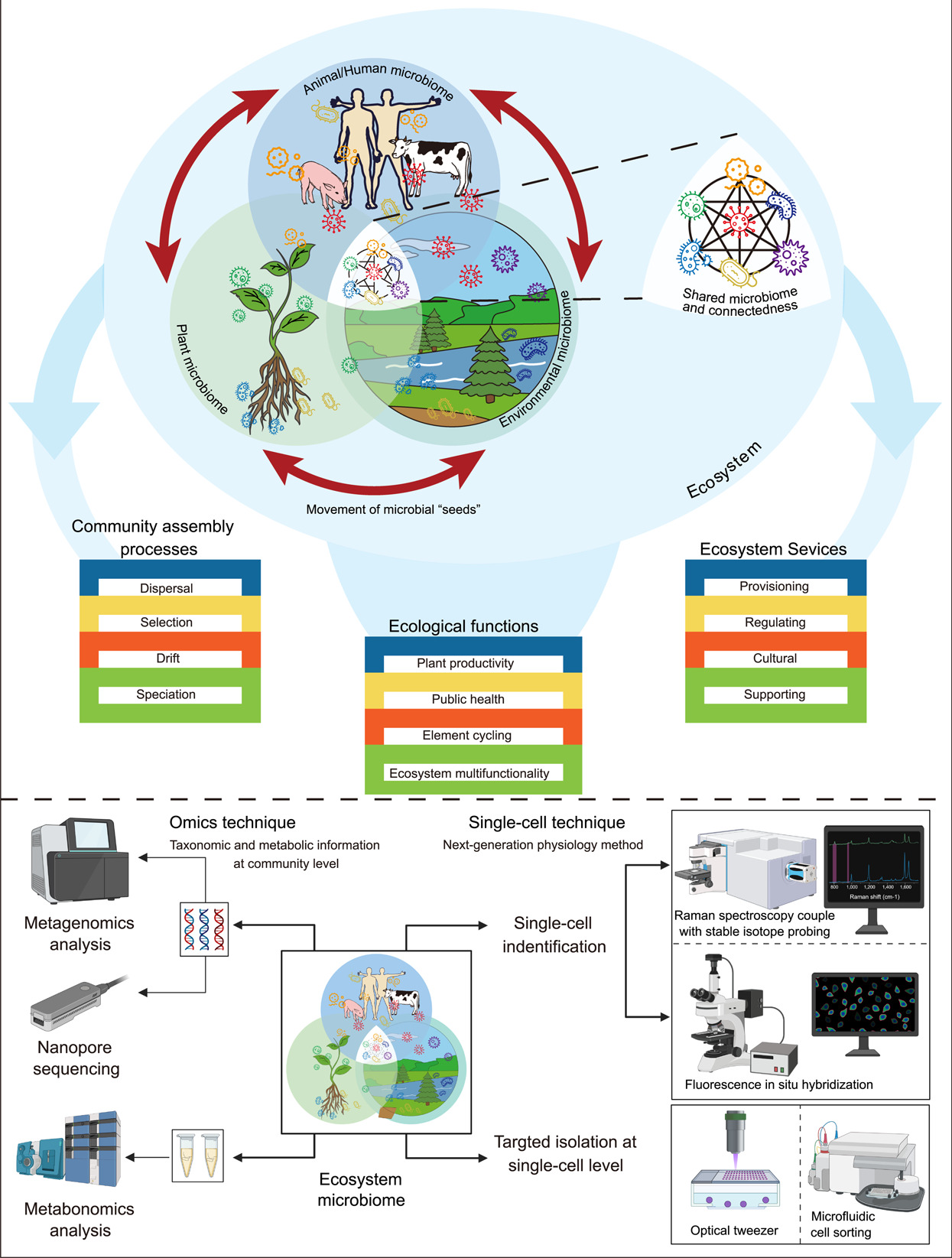
    The concept of ecosystem microbiomes and a technique map to briefly show how to study microbial genomes and functions in whole ecosystems. In general, omics methods could provide taxonomic and metabolic information at the community level. The recently developed functional Raman spectroscopy-based single-cell technology as a next-generation physiology method could provide information on microbiome function at the single-cell level.

    Key words:dynamics; ecosystem; global change; interactions; microbiome

    Volume:

    Page:

    Journal:MLIFE

    https://doi.org/10.1002/mlf2.12054

    About Us

    • Brief Introduction
    • Address from the Director
    • Directors
    • Organization
    • IUE in Media

    Scientists

    • Academicians
    • Professors
    • Associate Professors

    Research

    • Research Divisions
    • Research Progress

    Education

    • Admission
    • Study at IUE
    • Scholarships

    INT'L Cooperation

    • INT'L Cooperation News
    • Partnership

    Papers

    Join Us

    • Job Opportunities
    • PIFI
    Copyright © Institute of Urban Environment,Chinese Academy of Sciences. All Rights Reserved.
    1799 Jimei Road, Xiamen 361021 China.+86-592-6190973.