


• Home
  • About Us
    • Brief Introduction
    • Address from the Director
    • Directors
    • Organization
    • IUE in Media
  • Scientists
    • Academicians
    • Professors
    • Associate Professors
  • Research
    • Research Divisions
    • Research Progress
  • Education
    • Admission
    • Study at IUE
    • Scholarships
  • INT'L Cooperation
    • INT'L Cooperation News
    • Partnership
  • Papers
  • Join Us
    • Job Opportunities
    • PIFI
      • What's PIFI
Contact Us   |   Sitemap   |   CAS   |   中文
  • Home
  • About Us
    • Brief Introduction
    • Address from the Director
    • Directors
    • Organization
    • IUE in Media
  • Scientists
    • Academicians
    • Professors
    • Associate Professors
  • Research
    • Research Divisions
    • Research Progress
  • Education
    • Admission
    • Study at IUE
    • Scholarships
  • INT'L Cooperation
    • INT'L Cooperation News
    • Partnership
  • Papers
  • Join Us
    • Job Opportunities
    • PIFI

Papers

  • HomePapers
  • Papers
    Multiple Effects of Humic Components on Microbially Mediated Iron Redox Processes and Production of Hydroxyl Radicals
    Ruixia Han, Zhe Wang, Jitao Lv, Zhe Zhu, Guang-Hui Yu, Gang Li*, and Yong-Guan Zhu

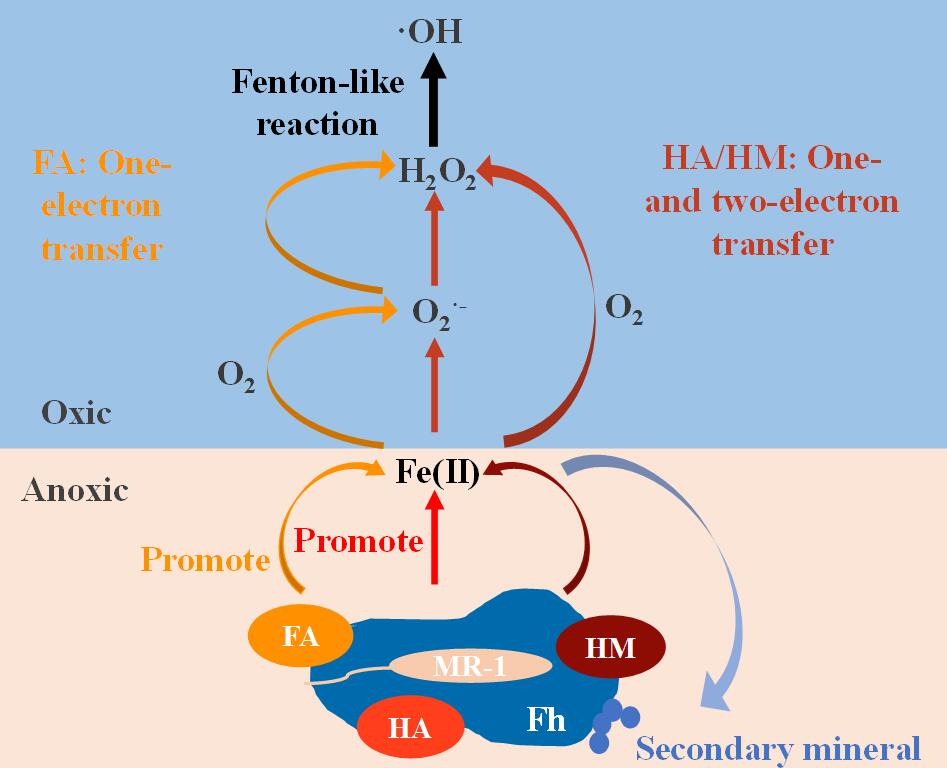
    Microbially mediated iron redox processes are of great significance in the biogeochemical cycles of elements, which are often coupled with soil organic matter (SOM) in the environment. Although the influences of SOM fractions on individual reduction or oxidation processes have been studied extensively, a comprehensive understanding is still lacking. Here, using ferrihydrite, Shewanella oneidensis MR-1, and operationally defined SOM components including fulvic acid (FA), humic acid (HA), and humin (HM) extracted from black soil and peat, we explored the SOM-mediated microbial iron reduction and hydroxyl radical (.OH) production processes. The results showed that the addition of SOM inhibited the transformation of ferrihydrite to highly crystalline iron oxides. Although FA and HA increased Fe(II) production over four times on average due to complexation and their high electron exchange capacities, HA inhibited 30–43% of the .OH yield, while FA had no significant influence on it. Superoxide (O2.–) was the predominant intermediate in .OH production in the FA-containing system, while one- and two-electron transfer processes were concurrent in HA- and HM-containing systems. These findings provide deep insights into the multiple mechanisms of SOM in regulating microbially mediated iron redox processes and .OH production.
    Key words:soil organic matter;hydroxyl radical;iron;reactive oxygen species;redox cycle;dissimilatory iron-reducing bacteria

    Volume:

    Page:

    Journal:ENVIRONMENTAL SCIENCE & TECHNOLOGY

    https://doi.org/10.1021/acs.est.2c03799

    About Us

    • Brief Introduction
    • Address from the Director
    • Directors
    • Organization
    • IUE in Media

    Scientists

    • Academicians
    • Professors
    • Associate Professors

    Research

    • Research Divisions
    • Research Progress

    Education

    • Admission
    • Study at IUE
    • Scholarships

    INT'L Cooperation

    • INT'L Cooperation News
    • Partnership

    Papers

    Join Us

    • Job Opportunities
    • PIFI
    Copyright © Institute of Urban Environment,Chinese Academy of Sciences. All Rights Reserved.
    1799 Jimei Road, Xiamen 361021 China.+86-592-6190973.