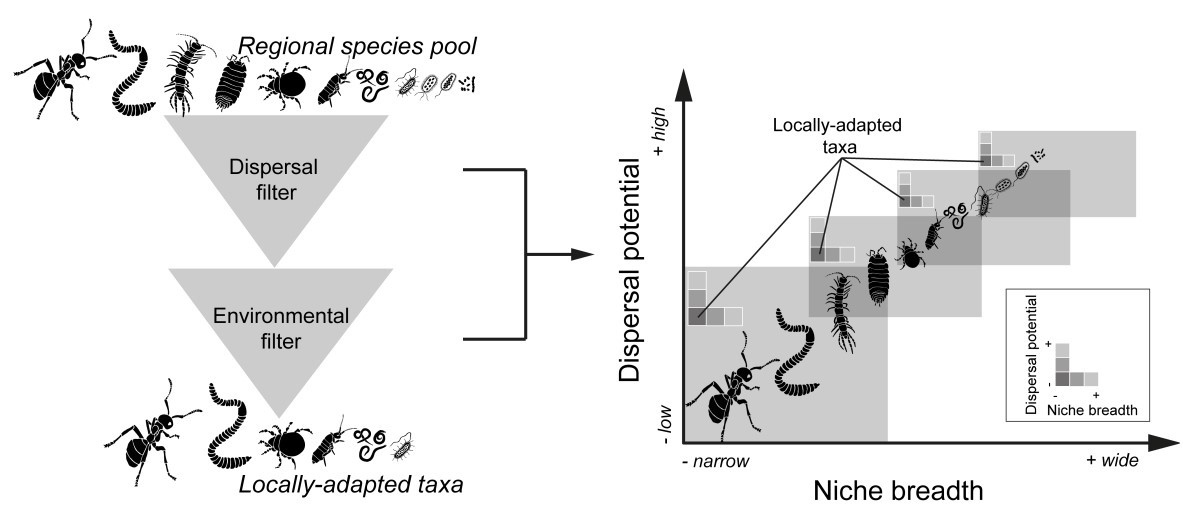
The size-plasticity hypothesis posits that larger size organisms are less plastic in their metabolic rates and, therefore, are more strongly environmental-filtered than smaller organisms. Many studies have supported this hypothesis by evaluating the relative roles of environmental filtration and dispersal for different taxonomic groups of soil organisms. Most observations are made at large spatial scales, which are assumed to have a wide array of varying habitats. However, since urbanization causes habitat fragmentation at smaller regional scales, testing the size-plasticity hypothesis at this scale would help better understand the spatial assortment of urban soil organisms which, in turn, would help to develop improved management and conservation strategies for urban soil health. Here, we used DNA metabarcoding on five groups of soil biota (bacteria, fungi, protists, nematodes, and invertebrates) to assess the relative importance of dispersal and environmental filters to examine the size-plasticity hypothesis at this spatial scale in an urban environment. We observed strong distance-decay of community similarities associated with higher levels of stochastic changes in bacteria, nematode, and protist communities but not fungal or invertebrate communities. Bacterial communities occupied the widest niche followed by protists and nematodes, potentially because of their higher dispersal abilities compared to the larger soil organisms. Null deviation of communities varied with taxonomic groups where bacteria and nematodes were mainly driven by homogenizing dispersal, protists and fungi by drift, and soil invertebrates by environmental selection. We further identified a small percentage of locally-adapted taxa (2.1%) that could be focal taxa for conservation and restoration efforts by, for example, restoring their habitats and enhancing their regional connectivity. These results support the size-plasticity hypothesis at the relatively unexplored regional scale in an urbanization context, and provide new information for improving urban soil health and sustainable city models.