


• Home
  • About Us
    • Brief Introduction
    • Address from the Director
    • Directors
    • Organization
    • IUE in Media
  • Scientists
    • Academicians
    • Professors
    • Associate Professors
  • Research
    • Research Divisions
    • Research Progress
  • Education
    • Admission
    • Study at IUE
    • Scholarships
  • INT'L Cooperation
    • INT'L Cooperation News
    • Partnership
  • Papers
  • Join Us
    • Job Opportunities
    • PIFI
      • What's PIFI
Contact Us   |   Sitemap   |   CAS   |   中文
  • Home
  • About Us
    • Brief Introduction
    • Address from the Director
    • Directors
    • Organization
    • IUE in Media
  • Scientists
    • Academicians
    • Professors
    • Associate Professors
  • Research
    • Research Divisions
    • Research Progress
  • Education
    • Admission
    • Study at IUE
    • Scholarships
  • INT'L Cooperation
    • INT'L Cooperation News
    • Partnership
  • Papers
  • Join Us
    • Job Opportunities
    • PIFI

Papers

  • HomePapers
  • Papers
    Response of soil viral communities to land use changes
    Hu Liao;Hu Li;Chen-Song Duan;Xin-Yuan Zhou;Qiu-Ping Luo;Xin-Li An; Yong-Guan Zhu & Jian-Qiang Su*

    Soil viruses remain understudied when compared to virus found in aquatic ecosystems. Here, we investigate the ecological patterns of soil viral communities across various land use types encompassing forest, agricultural, and urban soil in Xiamen, China. We recovered 59,626 viral operational taxonomic units (vOTUs) via size-fractioned viromic approach with additional mitomycin C treatment to induce virus release from bacterial fraction. Our results show that viral communities are significantly different amongst the land use types considered. A microdiversity analysis indicates that selection act on soil vOTUs, resulting in disparities between land use associated viral communities. Soil pH is one of the major determinants of viral community structure, associated with changes of in-silico predicted host compositions of soil vOTUs. Habitat disturbance and variation of soil moisture potentially contribute to the dynamics of putative lysogenic vOTUs. These findings provide mechanistic understandings of the ecology and evolution of soil viral communities in changing environments.
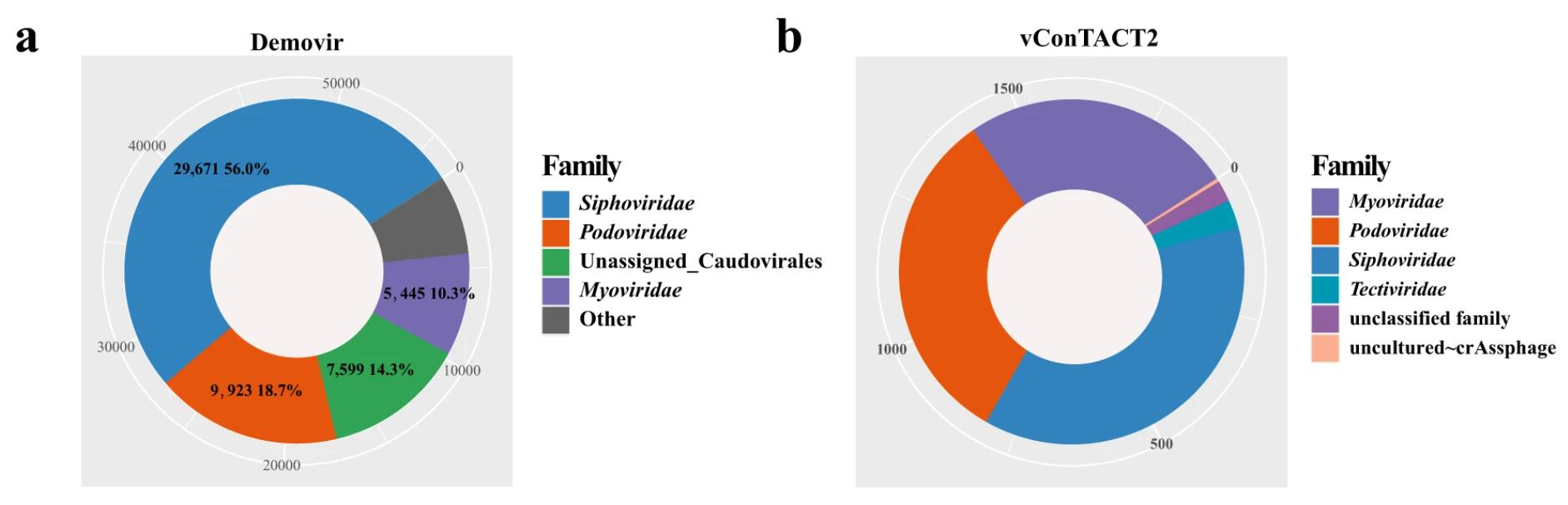
    Pie charts showing the affiliation of 56,870 vOTUs at family level assigned by script Demovir (a). and the affiliation of 1864 vOTUs at family level assigned by package vConTACT2 (b). Source data are provided in the Source Data file.

    Key words:

    Volume:13

    Page:6027

    Journal:NATURE COMMUNICATIONS

    https://www.nature.com/articles/s41467-022-33771-2

    About Us

    • Brief Introduction
    • Address from the Director
    • Directors
    • Organization
    • IUE in Media

    Scientists

    • Academicians
    • Professors
    • Associate Professors

    Research

    • Research Divisions
    • Research Progress

    Education

    • Admission
    • Study at IUE
    • Scholarships

    INT'L Cooperation

    • INT'L Cooperation News
    • Partnership

    Papers

    Join Us

    • Job Opportunities
    • PIFI
    Copyright © Institute of Urban Environment,Chinese Academy of Sciences. All Rights Reserved.
    1799 Jimei Road, Xiamen 361021 China.+86-592-6190973.