


• Home
  • About Us
    • Brief Introduction
    • Address from the Director
    • Directors
    • Organization
    • IUE in Media
  • Scientists
    • Academicians
    • Professors
    • Associate Professors
  • Research
    • Research Divisions
    • Research Progress
  • Education
    • Admission
    • Study at IUE
    • Scholarships
  • INT'L Cooperation
    • INT'L Cooperation News
    • Partnership
  • Papers
  • Join Us
    • Job Opportunities
    • PIFI
      • What's PIFI
Contact Us   |   Sitemap   |   CAS   |   中文
  • Home
  • About Us
    • Brief Introduction
    • Address from the Director
    • Directors
    • Organization
    • IUE in Media
  • Scientists
    • Academicians
    • Professors
    • Associate Professors
  • Research
    • Research Divisions
    • Research Progress
  • Education
    • Admission
    • Study at IUE
    • Scholarships
  • INT'L Cooperation
    • INT'L Cooperation News
    • Partnership
  • Papers
  • Join Us
    • Job Opportunities
    • PIFI

Papers

  • HomePapers
  • Papers
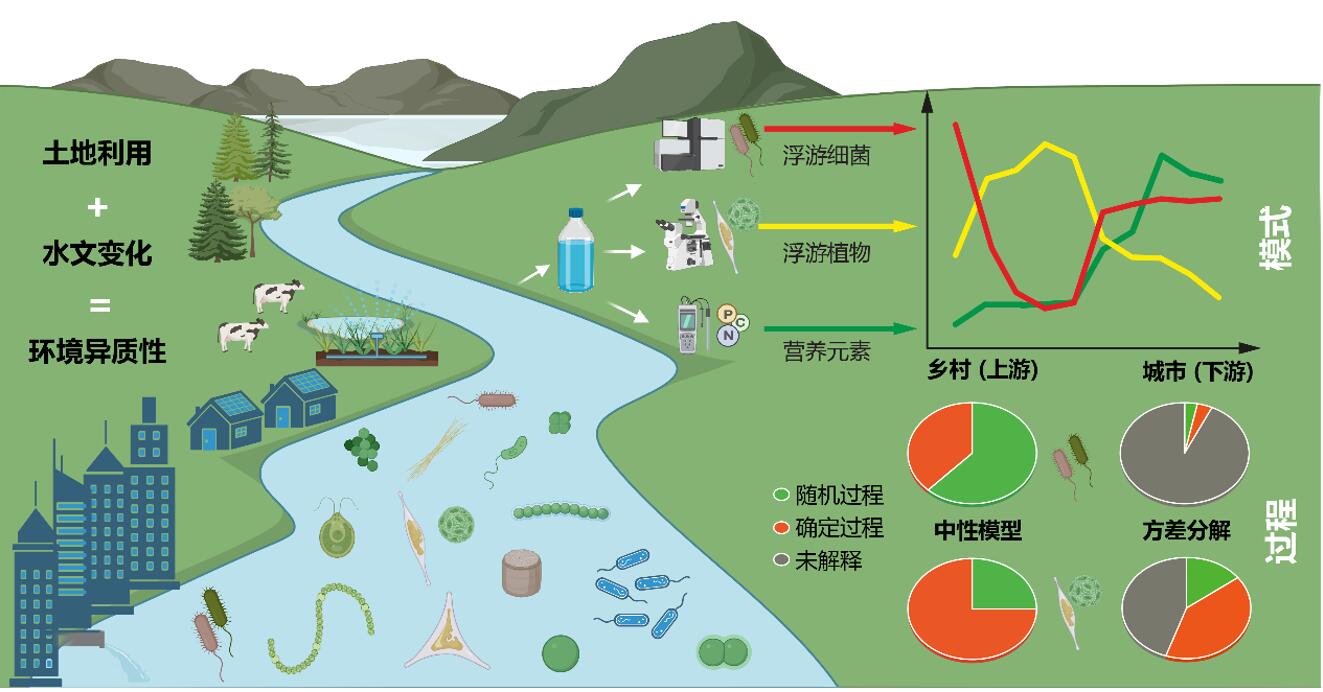
    Riverine bacterioplankton and phytoplankton assembly along an environmental gradient induced by urbanization
    Alain Isabwe, R. YANG Jun, WANG Yongming,David M. Wilkinson,Emily B. Graham, CHEN Huihuang,YANG Jun*

    Longitudinal environmental heterogeneity and directionality of the water movement are key features that may exert contrasting forces on riverine plankton assembly. Directionality strengthens dispersal-driven assembly, but this can be masked by urbanization-induced environmental heterogeneity along the river continuum. In the light of this contrast, we aimed at delineating the relative importance of assembly processes generating distribution patterns of bacterioplankton and phytoplankton communities in a river draining an urbanizing watershed in Southeast China. We applied variation partitioning analysis, neutral community model, and quantitative process estimate on molecular and morphological plankton data obtained over the years 2012-2016. Despite a relatively short distance between sampling sites (<?20?km), plankton community similarity decreased with increasing distance from the upstream pristine site toward the downstream urban area, and formed clusters that roughly corresponded to five habitat patches, predefined based on hydrology and longitudinal landscape change. These distribution patterns were predominantly driven by deterministic and stochastic processes for phytoplankton and bacterioplankton, respectively, indicating a balance between dispersal due to fluvial connectivity and local selective pressures. Considering the global loss of river connectivity due to downstream fragmentation and flow regulation, our findings imply that plankton-based ecological approaches could be useful to hedge against an uncertain future of rivers draining urbanizing watersheds in an ecologically sustainable way.
    Key words:

    Volume:

    Page:

    Journal:LIMNOLOGY AND OCEANOGRAPHY

    https://doi.org/10.1002/lno.12179

    About Us

    • Brief Introduction
    • Address from the Director
    • Directors
    • Organization
    • IUE in Media

    Scientists

    • Academicians
    • Professors
    • Associate Professors

    Research

    • Research Divisions
    • Research Progress

    Education

    • Admission
    • Study at IUE
    • Scholarships

    INT'L Cooperation

    • INT'L Cooperation News
    • Partnership

    Papers

    Join Us

    • Job Opportunities
    • PIFI
    Copyright © Institute of Urban Environment,Chinese Academy of Sciences. All Rights Reserved.
    1799 Jimei Road, Xiamen 361021 China.+86-592-6190973.