


• Home
  • About Us
    • Brief Introduction
    • Address from the Director
    • Directors
    • Organization
    • IUE in Media
  • Scientists
    • Academicians
    • Professors
    • Associate Professors
  • Research
    • Research Divisions
    • Research Progress
  • Education
    • Admission
    • Study at IUE
    • Scholarships
  • INT'L Cooperation
    • INT'L Cooperation News
    • Partnership
  • Papers
  • Join Us
    • Job Opportunities
    • PIFI
      • What's PIFI
Contact Us   |   Sitemap   |   CAS   |   中文
  • Home
  • About Us
    • Brief Introduction
    • Address from the Director
    • Directors
    • Organization
    • IUE in Media
  • Scientists
    • Academicians
    • Professors
    • Associate Professors
  • Research
    • Research Divisions
    • Research Progress
  • Education
    • Admission
    • Study at IUE
    • Scholarships
  • INT'L Cooperation
    • INT'L Cooperation News
    • Partnership
  • Papers
  • Join Us
    • Job Opportunities
    • PIFI

Papers

  • HomePapers
  • Papers
    Estuarine plastisphere as an overlooked source of N2O production
    SU Xiaoxuan; YANG Leyang; YANG Kai; TANG Yijia; WEN Teng; WANG Yingmu; Matthias C. Rillig; Lena Rohe; PAN Junliang; LI Hu & ZHU Yong-guan *

    “Plastisphere”, microbial communities colonizing plastic debris, has sparked global concern for marine ecosystems. Microbiome inhabiting this novel human-made niche has been increasingly characterized; however, whether the plastisphere holds crucial roles in biogeochemical cycling remains largely unknown. Here we evaluate the potential of plastisphere in biotic and abiotic denitrification and nitrous oxide (N2O) production in estuaries. Biofilm formation provides anoxic conditions favoring denitrifiers. Comparing with surrounding bulk water, plastisphere exhibits a higher denitrifying activity and N2O production, suggesting an overlooked N2O source. Regardless of plastisphere and bulk water, bacterial and fungal denitrifications are the main regulators for N2O production instead of chemodenitrification. However, the contributions of bacteria and fungi in the plastisphere are different from those in bulk water, indicating a distinct N2O production pattern in the plastisphere. These findings pinpoint plastisphere as a N2O source, and provide insights into roles of the new biotope in biogeochemical cycling in the Anthropocene.
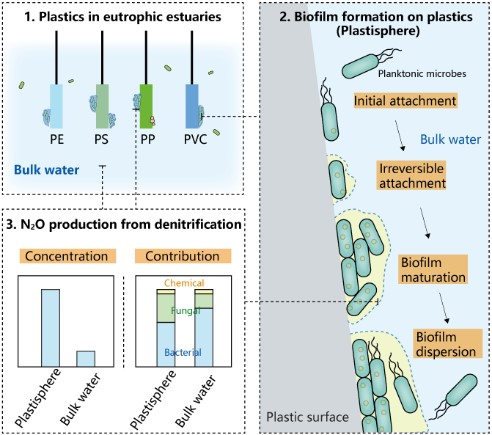
    Fig. 2: Concentrations of extracellular polymeric substances (EPS) in the plastisphere and bulk water.

    Key words:

    Volume:

    Page:3884

    Journal:NATURE COMMUNICATIONS

    https://www.nature.com/articles/s41467-022-31584-x

    About Us

    • Brief Introduction
    • Address from the Director
    • Directors
    • Organization
    • IUE in Media

    Scientists

    • Academicians
    • Professors
    • Associate Professors

    Research

    • Research Divisions
    • Research Progress

    Education

    • Admission
    • Study at IUE
    • Scholarships

    INT'L Cooperation

    • INT'L Cooperation News
    • Partnership

    Papers

    Join Us

    • Job Opportunities
    • PIFI
    Copyright © Institute of Urban Environment,Chinese Academy of Sciences. All Rights Reserved.
    1799 Jimei Road, Xiamen 361021 China.+86-592-6190973.