


• Home
  • About Us
    • Brief Introduction
    • Address from the Director
    • Directors
    • Organization
    • IUE in Media
  • Scientists
    • Academicians
    • Professors
    • Associate Professors
  • Research
    • Research Divisions
    • Research Progress
  • Education
    • Admission
    • Study at IUE
    • Scholarships
  • INT'L Cooperation
    • INT'L Cooperation News
    • Partnership
  • Papers
  • Join Us
    • Job Opportunities
    • PIFI
      • What's PIFI
Contact Us   |   Sitemap   |   CAS   |   中文
  • Home
  • About Us
    • Brief Introduction
    • Address from the Director
    • Directors
    • Organization
    • IUE in Media
  • Scientists
    • Academicians
    • Professors
    • Associate Professors
  • Research
    • Research Divisions
    • Research Progress
  • Education
    • Admission
    • Study at IUE
    • Scholarships
  • INT'L Cooperation
    • INT'L Cooperation News
    • Partnership
  • Papers
  • Join Us
    • Job Opportunities
    • PIFI

Papers

  • HomePapers
  • Papers
    Promotional effect of Fe and Ce co-doping on a V2O5-WO3/TiO2 catalyst for SCR of NOx with high K and Pb resistance
    YI Xianfang, WANG Jinxiu*, LIU Yuqiu, CHEN Yanting and CHEN Jinsheng *

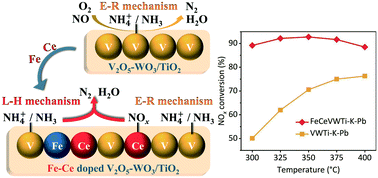
    There is an increasing demand to develop efficient SCR deNOx catalysts with high resistance to alkali and heavy metals. In this study, a V2O5–WO3/TiO2 (denoted VWTi) catalyst modified with FeOx and CeOx in 0.05Fe/V and 1.5Ce/V molar ratio (denoted FeCeVWTi) showed enhanced SCR activity and resistance to K–Pb co-poisoning in the temperature range of 300–400 °C. The FeCeVWTi catalyst also presented outstanding tolerance to H2O and SO2. After K–Pb poisoning, the FeCeVWTi catalyst showed 92.7% NOx conversion at 350 °C, much higher than that of the VWTi catalyst (70.6%). The Fe and Ce co-doping significantly improved the redox ability, V5+ ratio and surface chemisorbed oxygen ratio of the VWTi catalyst by the interaction between Fe, Ce and V. The cooperation between Fe and Ce slightly decreased the surface acidity but significantly enhanced the NOx adsorption on the FeCeVWTi catalyst. Additionally, in situ DRIFTS revealed that the SCR reaction on VWTi followed an E–R mechanism, while Fe and Ce co-doping changed the reaction route and made the SCR reaction on FeCeVWTi follow both an E–R mechanism and an L–H mechanism. The enhanced redox ability and adsorption of NOx played decisive roles in improving the alkali–heavy metal resistance of the FeCeVWTi catalyst.
    Key words:NH3-SCR; V2O5–WO3/TiO2; co-doping; alkali-heavy metal resistance

    Volume:

    Page:

    Journal:CATALYSIS SCIENCE & TECHNOLOGY

    https://doi.org/10.1039/D2CY00818A

    About Us

    • Brief Introduction
    • Address from the Director
    • Directors
    • Organization
    • IUE in Media

    Scientists

    • Academicians
    • Professors
    • Associate Professors

    Research

    • Research Divisions
    • Research Progress

    Education

    • Admission
    • Study at IUE
    • Scholarships

    INT'L Cooperation

    • INT'L Cooperation News
    • Partnership

    Papers

    Join Us

    • Job Opportunities
    • PIFI
    Copyright © Institute of Urban Environment,Chinese Academy of Sciences. All Rights Reserved.
    1799 Jimei Road, Xiamen 361021 China.+86-592-6190973.